Category: Douma

  • The Role of Snipers in the Arab Spring and Maidan Protests/ By William Van Wagenen

    The Role of Snipers in the Arab Spring and Maidan Protests/ By William Van Wagenen

    Original Link Here: The Role of Snipers in the Arab Spring and Maidan Protests | The Libertarian Institute

    As anti-government protests known as the Arab Spring swept through the Middle East in early 2011, observers felt they were witnessing spontaneous, grassroots calls for freedom against decades of tyranny and dictatorship.

    While the demands of the protestors were largely sincere, the protests that erupted in Tunisia, Egypt, Yemen, Libya, and crucially, Syria, were nevertheless the product of an unconventional warfare campaign organized by the Barack Obama administration, including the National Security Council (NSC), State Department, CIA, and allied intelligence agencies.

    Rooted in Obama’s Presidential Study Directive 11 (PSD-11), the unconventional warfare campaign sought to spark “democratic transitions” in U.S. allied and enemy states alike. The objective was to replace authoritarian, Arab nationalist rulers with Muslim Brotherhood dominated governments even more friendly to American and Israeli interests.

    As I have detailed in my book, Creative Chaos: Inside the CIA’s covert war to topple the Syrian government, Obama’s PSD-11 is an outgrowth of the broader American and Israeli effort to topple the government of Bashar al-Assad that began after 9/11.

    The unconventional warfare campaign to spark the Arab Spring involved training local activists to use social media and internet privacy technologies such as Facebook and Tor to organize protests highlighting existing grievances.

    Snipers were then unleashed to carry out false flag killings of protestors that could be blamed on government security forces.

    The killing of protestors created the “martyrs” needed to fuel the fire of the protests and galvanize Arab populations to call for the overthrow of their governments.

    Crucially, the false flag killings gave President Obama the necessary pretext to declare that Arab leaders had “lost legitimacy” by “killing their own people” and to demand their ouster.

    As Russian military analyst Yuferev Sergey observed, the sniper phenomenon first appeared in Tunisia and then “smoothly migrated” to Egypt, Yemen, Libya, and finally to Syria.

    “At first, I didn’t know why people were protesting. Syria was a rich country. Life was very good,” a Christian from Syria who witnessed the early events of the so-called Arab Spring told this author. “But then the government started shooting protestors. It gave people a reason to protest even more.”

    The phenomenon appeared again in 2014 in Ukraine when snipers killed more than one hundred protesters, known as the “Heavenly Hundred,” in Kiev’s Maidan square. The killings led to a U.S.-backed coup that ousted the country’s pro-Russian president.

    This paper details the role of snipers in efforts to topple governments in Tunisia, Egypt, Libya, Yemen, Syria, and Ukraine.

    Presidential Study Directive 11

    In August 2010, U.S. President Barack Obama tasked a team of advisors led by National Security Council officials, including Samantha Power, Ben Rhodes, Michael McFaul, and Dennis Ross, to issue a report known as Presidential Study Directive 11.

    The report laid the blueprint for regime change in four Arab countries, including Egypt and three others left unnamed.

    According to reporting from The New York Times, Obama “pressed his advisors to study popular uprisings in Latin America, Eastern Europe, and Southeast Asia to determine which ones worked and which did not.”

    The report, the result of weekly meetings involving experts from the State Department and CIA, then “identified likely flashpoints, most notably Egypt, and solicited proposals for how the administration could push for political change in countries with autocratic rulers who are also valuable allies of the United States.”

    The Obama administration was particularly concerned about Egypt due to the expected succession crisis to the rule of the country’s aging and unpopular president, Hosni Mubarak. U.S. officials wanted a way to control who would take Mubarak’s place, rather than leave the outcome to chance or allow Mubarak to place his son in power after him.

    The policy advocated assisting the rise to power of Islamist groups, specifically the Muslim Brotherhood.

    As David Ignatius of The Washington Post reported in March 2011, after the Arab Spring was well under way, the Obama administration’s “low-key policy” involved “preparing for the prospect that Islamist governments will take hold in North Africa and the Middle East.”

    Tacitly endorsing the Brotherhood, a senior Obama administration official argued, “If our policy can’t distinguish between al-Qaeda and the Muslim Brotherhood, we won’t be able to adapt to this change.”

    Unconventional Warfare

    While states at times engage in direct conflict against one another, they more often wage war covertly through proxies.

    To avoid a direct confrontation and the possibility of a nuclear exchange during the Cold War, the United States, Soviet Union, China, France, and the United Kingdom “empowered rebel groups to act as proxies conducting irregular warfare on behalf of the patron state,” wrote Mike Fowler, Associate Professor of Military and Strategic Studies at the U.S. Air Force Academy.

    “This empowerment often involved training, equipping, and funding non-state actors to overthrow or undermine governments that supported (whether real or perceived) the opposing power,” he added.

    CIA support for Muslim extremists, known as the mujahideen, in Afghanistan to topple the pro-Soviet government in Kabul and to later fight occupying Soviet troops, is well documented.

    Turning Members into Martyrs

    After the fall of the Soviet Union, American efforts to overthrow post-Soviet states that remained within the Russian sphere of influence involved not only covert military support for “rebel” groups, but also the use of “non-violent” methods to spark anti-government protest movements known as “Color Revolutions.”

    The use of non-violence to undermine pro-Russian governments was first theorized by American academic Gene Sharp and implemented by activists from the Center for Applied Non-Violent Action and Strategies (CANVAS) in Serbia.

    Inherent to the non-violent strategy is the use of “political jiu-jitsu,” in which activists skillfully make government violence and repression “backfire,” writes Srdja Popovic, the executive director of CANVAS, in Foreign Policy.

    Popovic emphasizes that to be successful, a movement must “be ready to capitalize on oppression.”

    “Following a repressive act, it’s vital that activists keep the public aware of what has happened and take sustained measures to ensure that they don’t forget. One clever way to achieve this is to turn members of the movement who have faced particular scrutiny by a regime into martyrs,” he explained.

    While opposition activists (and the intelligence agencies supporting them) can wait for an oppressive regime to create martyrs to rally around, they can also “create” them through “provocations.”

    Employing snipers to carry out false flag killings during protests against an oppressive regime is an effective way to create such martyrs.

    Russian analyst Yuferev Sergey stated that the use of snipers is not an effective riot control method for dispersing crowds at protests. If a sniper opens fire at a crowd, demonstrators will not hear or immediately notice the shots. Once they do, they will not know where the shots are coming from, or which way to run to escape them.

    But the use of snipers at protests is an effective way to manufacture anger against an existing government or leader.

    “[T]he bodies with gunshot wounds to the head or heart are sure to be found by journalists, and all this will go on TV and on the Internet,” Sergey writes. In the confusion of the events, no one will “rush to conduct ballistic examinations, to look for places from which the snipers worked. The answer is ready in advance, and all the blame immediately falls on the head of the ruling regime. This is exactly what the organizers of such provocations are trying to achieve.”

    As a result, the presence of snipers has become the “hallmark of unrest” arising in many countries where the United States is seeking to topple an existing government, Sergey adds.

    Snipers are used to create the “martyrs” needed by U.S.-trained and funded “non-violent” activists to rally around when calling for a government to be overthrown.

    Snipers in Tunisia

    The small north African nation of Tunisia was the first country to see its president toppled in the so-called Arab Spring.

    The first protests in Tunisia erupted in the city of Sidi Bouzid in December 2010, four months after the Obama administration issued PSD-11.

    A few weeks before, on November 28, Wikileaks released more than 250,000 leaked U.S. State Department cables, known as “Cablegate.”

    Some of the cables regarded Tunisia, including one from the U.S. ambassador to the country discussing the corruption of President Zine El Abidine Ben Ali, his wife, and a broader circle of government officials.

    The release of cables highlighting Ben Ali’s corruption was not part of a random, arbitrary dump of diplomatic documents later seized upon by Tunisians. It was part of a carefully prepared campaign by Wikileaks, which partnered with Tunisian exiles from the dissident website, Nawaat, to promote the cables.

    Al-Jazeera reported that Wikileaks provided the cables in advance to Nawaat, whose activists read the documents, added context, translated them to French, and published them on a special website, Tunileaks, to allow Tunisian readers to understand them.

    Thanks to this prior coordination, when Wikileaks was ready to release the cables, Nawaat was ready as well.

    “As agreed, the first TuniLeaks went live less than an hour after WikiLeaks had published the diplomatic cables on its own site,” Al-Jazeera wrote.

    According to Al-Jazeera, “Nawaat helped fertilize the cyber terrain so that when the uprising finally came, dissident networks were in place to battle the censorship regime. Nawaat amplified the protesters’ voices, sending them echoing across the internet and beyond.”

    Al-Jazeera Arabic promoted the contents of the leaked cables as well by discussing them in a series of talk shows, helping to ensure Tunisians knew “their government was being run by a corrupt and nepotistic extended family.”

    Tom Malinowski, a senior fellow at the McCain Institute, wrote in Foreign Policy that the cables released by Wikileaks had an important effect.

    “The candid appraisal of Ben Ali by U.S. diplomats…contradicted the prevailing view among Tunisians that Washington would back Ben Ali to the bloody end, giving them added impetus to take to the streets,” Malinowski wrote.

    “They further delegitimized the Tunisian leader and boosted the morale of his opponents at a pivotal moment in the drama that unfolded over the last few week,” he added.

    Because the Wikileaks and Nawaat campaign to highlight corruption in Tunisia took place in the context of the PSD-11, this raises the question of whether Wikileaks participated, whether knowingly or unknowingly, in the Obama administration’s unconventional warfare campaign to topple Bin Ali.

    On November 30, 2010, two days after Wikileaks released the massive trove of diplomatic cables, Zbigniew Brezinski, former national security adviser in the Jimmy Carter administration, speculated that Wikileaks was being manipulated by foreign intelligence agencies, which likely “seed” the organization’s releases with information to achieve specific objectives.

    In July 2010, founder and editor Julian Assange indicated that, for security reasons, Wikileaks prefers not to know the source of leaks to the organization. “We never know the source of the leak,” he told journalists during an event at London’s Frontline Club. “Our whole system is designed such that we don’t have to keep that secret.”

    In the past Wikileaks has relied on and promoted privacy software known as Tor, which allows users to browse websites, communicate, and transfer documents anonymously. Journalist Yasha Levine has documented how Tor, although touted as a privacy tool to counter U.S. government surveillance by Assange and National Security Agency (NSA) whistleblower Edward Snowden, was itself developed by the U.S. military.

    Tor proved crucial in helping U.S.-trained activists topple Arab governments during the Arab Spring.

    On December 17, 2010, roughly three weeks after the release of the Wikileaks cables, a young Tunisian man, Mohammad Bouazizi, lit himself on fire to protest the confiscation of his vegetable cart by a policewoman. He was taken to the hospital, where he died of his burns two weeks later, on January 4.

    Anti-government protests erupted following Bouazizi’s act of self-immolation, which was widely viewed as the primary catalyst for the so-called “Tunisian Revolution” that followed.

    However, the protests did not gain the momentum needed to force President Ben Ali from power until after snipers killed more than a dozen protestors in the town of Kasserine in western Tunisia between January 8 and 11.

    Human Rights Watch (HRW) was able to find hospital and municipal records for seventeen victims killed during protests in Kasserine.

    HRW noted the death of Mohammed Amine Mbarki, a 17-year-old son of a mechanic, as typical of the violence there. Mbarki joined an anti-government demonstration on January 8 at the main roundabout in the Zehour district, the poor neighborhood where he lived. While riot police fired tear gas at protestors from the front of a police station, Mbarki was shot by a bullet in the back of the head.

    “We were shocked,” said Mbarki’s friend, Hamza Mansouri, who was with him. Mansouri told HRW that police snipers never before seen in Kasserine did the killing.

    “Zehour residents quickly sanctified the roundabout with the name Martyrs Square. Young people readily exhibit videos on their mobile phone of chaos and bloody police violence. One shows a frenzied scene in a hospital emergency room, where a victim is shown with his brain blown out,” Daniel Williams of HRW wrote.

    Snipers again opened fire at a funeral procession passing through Martyrs Square the next day, January 9. Witnesses told HRW that five or six people died at the roundabout that day, including at least one during the funeral.

    Snipers opened fire again on January 10, before “disappearing” from the city that night. “One of the wonders of the uprising is that the more the police shot protesters, the more determined they became,” Williams of HRW concluded.

    Al-Jazeera reported that according to witnesses in Kasserine, several people were shot from behind by “unidentified agents wearing different, slicker uniforms” than the regular police or army.

    “From the beginning, [the army was] against shooting at people,” said Adel Baccari, a local magistrate.

    The Qatari outlet added that the rifles and ammunition were not of the type used by Tunisian security forces.

    Al-Jazeera noted that the killing of protestors by live sniper fire made such an impact that President Ben Ali referenced it in his speech on January 13. “Enough firing of real bullets,” Bin Ali said. “I refuse to see new victims fall.”

    The speech turned out to be his last.

    Tunisian doctor and activist Zied Mhirsi observed that the sniper killings were decisive in shifting public opinion against Ben Ali and pressuring him to resign and flee the country. Mhirsi says that the day after Ben Ali’s speech, January 14, saw a massive protest in the Tunisian capital that was organized through Facebook and which “everyone joined,” including the country’s middle class.

    “And that day was crucial in showing that the public opinion has totally shifted and there was nobody supporting [Ben Ali] anymore. And then also that he lost control because he said no more real bullets on January 13th. And on January 14th there were still bullets in the air and snipers,” Mhirsi explained.

    As a result, January 14 “was also the day he left,” ending his twenty-three years in power.

    Mhirsi explained further to CBS News’ 60 Minutes program, “The turning point, the real one here was the real bullets…And then here we have the ruler, the government asking its police to shoot its own people using snipers, shooting people with real bullets in their heads.”

    In addition to helping activists organize protests, Facebook played a key role in spreading awareness of the sniper killings among Tunisians.

    “Facebook was the only video-sharing platform that was available to Tunisians. And seeing videos of people shot with real bullets in their heads on Facebook was shocking to many Tunisians,” Mhirsi added.

    Before the “revolution,” young activists from Tunisia had joined others from Egypt, Syria, Iran and other Middle East states in attending conferences to learn how to use new technologies such as Facebook, Twitter, and Tor, for these purposes in the years preceding the Arab Spring.

    The conferences were sponsored by the U.S. State Department and American tech companies, including Facebook and Google.

    The same day Ben Ali was ousted, the White House issued a statement in which Barack Obama condemned the violence against protesters and welcomed Ben Ali’s exit. “I applaud the courage and dignity of the Tunisian people,” Obama claimed, while calling for “free and fair elections in the near future that reflect the true will and aspirations of the Tunisian people.”

    As anticipated by Obama’s PSD-11, a new government came to power in Tunisa led by Islamists.

    Ben Ali’s rule was replaced by an interim government which removed the ban on Tunisia’s Muslim Brotherhood-linked Al-Nahda party, leading to what Foreign Policy described as the party’s “meteoric rise.”

    After Al-Nahda won 41% of the vote in Tunisia’s first parliamentary elections in October 2011, Noah Feldberg of Bloomberg wrote, “It’s official: The Islamists have won the Arab Spring. And the result was as inevitable as it is promising.”

    After Ben Ali was toppled, Tunisians called for an investigation to prosecute the officials of the old regime presumed to be responsible for ordering snipers to kill protestors. However, Deutsche Welle (DW) reported in December 2011 that an investigative committee failed to determine the identities of the shooters.

    As a result, the mother of one of the victims denounced what she considered a “cover-up” by the transitional government headed by Beji Caid Essebsi for the “killers of the martyrs.”

    DW adds that security men in the Ministry of Interior were also angry after being blamed for the sniper killings by members of the Tunisian military. They organized multiple protests in Tunis demanding “the disclosure of the truth about the snipers,” who they said had also killed some security personnel. The men called for the release of their colleagues who had been arrested but not proven guilty of killing demonstrators during the protests.

    Snipers in Egypt

    After appearing in Tunisia, the sniper phenomenon emerged again two weeks later in Egypt amid anti-government protests seeking to oust President Hosni Mubarak.

    The protests in Egypt were spearheaded by activists from the April 6 Youth Movement, which was a member of the U.S. State Department’s Alliance for Youth Movements (AYM).

    The AYM was funded by the from the U.S. government-established National Endowment for Democracy (NED) and organized by Jared Cohen, a State Department official working under Secretary of State Hillary Clinton. In September 2010, Cohen left government service to become the first director of Google Ideas, later known as Jigsaw.

    According to PBS Frontline, April 6 members had been coordinating directly with the State Department since at least 2008.

    According to a diplomatic cable released by Wikileaks, April 6 member Ahmed Saleh visited the U.S. to take part in a State Department-organized “Alliance of Youth Movements Summit” in New York. While at the summit, he discussed techniques with fellow activists to evade government surveillance and harassment.

    After the summit, Saleh held meetings with members of Congress and their staffers on Capital Hill in Washington DC. The meetings involved discussions around his ideas for regime change in Egypt before the presidential elections scheduled for 2011.

    During the same period, April 6 activist Mohammed Adel traveled to Serbia to take a course on Gene Sharp’s strategies for nonviolent revolutions from activists from OTPOR, Frontline added.

    In 2010, activists from the April 6 Youth Movement chose to focus their anti-government organizing campaign around the death of Khalid Said, a young Egyptian man who was brutally beaten to death by police near his home in Alexandria in June of that year.

    April 6 activist and Google executive Wael Ghonim created the “We are all Khalid Said” Facebook page, which he used to help organize the first major anti-government protest, the “Day of Revolt” in Cairo’s Tahrir Square on January 25, 2011.

    During the Friday “Day of Rage” protest three days later, on January 28, street battles erupted between demonstrators and riot police at Tahrir Square, with police using violent methods, including beating protesters as well as using tear gas, water cannons, rubber bullets, and lethal shotgun ammunition.

    But snipers were also present at the January 28 protest. Amnesty International reports, “According to an eyewitness, a boy and his mother, who found themselves in the midst of this chaos, lifted their arms in the air to demonstrate their peaceful intention. Nonetheless, the boy was shot in the neck and fell back on his mother.”

    Amnesty reported further, “According to protesters, by 7pm snipers dressed in black or grey standing on top of buildings, including the Prime Minister’s Cabinet office, were among those firing at peaceful demonstrators. According to eyewitnesses, five or six people were shot on Qasr El Einy Street and many more were injured.”

    Kamel Anwar, a fifty-six year old doctor with two children, was shot from behind on Qasr El Einy Street. He said snipers opened fire from the Taawun Petrol Station. He saw a teenage boy falling to the ground and remain motionless before he himself was shot.

    Snipers appeared again the following day, January 29, as street battles between protestors and security forces escalated near the Ministry of Interior.

    “Snipers in the residential buildings on the street also fired at them, shooting a journalist with a camera in the chest, according to an eyewitness…12 are believed to have been killed,” Amnesty reported.

    Evidence later presented in Cairo’s Criminal Court confirmed that snipers were deployed at the height of the eighteen-day revolution.

    Al-Ahram newspaper reported, “Evidence included video footage showing men standing atop the ministry building in Cairo’s Lazoughli district on 29 January firing on protesters using live ammunition.”

    “Footage also showed an unarmed protester bleeding to death from a head wound. According to medical reports also presented as evidence, the protester died after sustaining two bullet wounds to the head,” Al-Ahram added.

    Just three days later, on February 1, President Barack Obama seized on the killings to call for Mubarak to step down. Obama publicly stated that the transition to a new government “must begin now.”

    Earlier in the day, Obama had sent a message to Mubarak through Frank Wisner, a former U.S. ambassador to Egypt, telling him to “step down immediately,” Politico reported. Mubarak agreed to give up power ten days later, on February 11.

    The deaths of dozens of protestors killed by snipers on January 29 had given Obama the justification to demand a foreign leader and U.S. ally be removed.

    While the perception persisted that the Obama administration had sought to keep their old ally in power as long as possible, Politico later reported that a group of White House aides, including Ben Rhodes and Denis McDonough, “gathered for an impromptu party” after Mubarak stepped down. “It was a euphoric night for us, no doubt,” said Michael McFaul, Obama’s top Russia aide and a participant in the PSD-11 strategy meetings.

    A year later, in January 2012, the Muslim Brotherhood’s Freedom and Justice Party (FJP) won the largest number of seats in Egypt’s first democratic elections. In June 2012, Muslim Brotherhood candidate Mohammed Morsi was elected president of Egypt.

    In March 2013, Morsi’s government commissioned a report claiming that Mubarak’s security forces were responsible for killing eight hundred protesters during the revolution.

    “According to the leaked report, police were responsible for most of the deaths—many at the hands of police snipers shooting from the roofs surrounding Tahrir Square,” The Guardian reported.

    In 2014, after Morsi had been deposed in a coup by Egyptian general Abdul Fattah Al-Sisi, Judge Mahmoud Al-Rashidy acquitted Mubarak’s former Interior Minister Habib al-Adly and six of his aides on charges of inciting and conspiring in the killing of protesters during the January 25 revolution.

    Mada Masr reported that Judge Rashidy said he knew the verdict would “shock many” and therefore released the 280-page judgment to make the evidence of his conclusions public. “The testimonies admitted to the use of live ammunition only around police stations or other strategic buildings [between January 28 and 31], which the judge argues is self-defense and also outside the scope of the case, which specifies the killing of protesters in public squares,” Mada Masr wrote.

    Rashidy argued that the Muslim Brotherhood was behind the violence. “It became evidently certain for the court that the group that targeted those security spots occupied by officers and employees went there with a conceived plan by an organized group that hides behind religion to tamper with the security and stability of the country,” the judge stated.

    Rashidy’s investigation explains how protestors were confirmed killed by government forces in some places, but not others. This suggests that the Egyptian police may have been responsible for killing protesters with live ammunition to protect ministry buildings, while snipers from unknown parties were killing protestors who died elsewhere, such as at Tahrir Square and on Qasr El Einy Street.

    Snipers in Libya

    Just one week after Mubarak fell, the sniper phenomenon again appeared, this time in Libya, when protestors took to the streets for another “Day of Rage.”

    On February 17, the Human Rights Solidarity campaign group told The Telegraph that snipers on rooftops in the city of Al-Baida had opened fire, killing thirteen protesters and wounding dozens more.

    Human Rights Watch (HRW) reported that according to protestors, sixteen attending the demonstrations were killed by gunshot in Al-Baida, while another seventeen were shot and killed in Benghazi, mostly near Abdel Nasser Street.

    As in Tunisia and Egypt, it was immediately assumed by western journalists and human rights activists that government security forces were responsible for the killings. “It is remarkable that Gaddafi is still copying the very same tactics that failed Hosni Mubarak so completely just across the border,” said Sarah Leah Whitson, Middle East and North Africa director at HRW, in response to the sniper fire.

    On February 18, Salon reported that in Benghazi, snipers killed at least fifteen mourners leaving a funeral for demonstrators killed the day before. “Snipers fired on thousands of people gathered in Benghazi, a focal point of the unrest, to mourn 35 protesters who were shot on Friday,” a hospital official said.

    Two weeks later, President Obama again seized on the killing of protestors and repeated the same demand he had made to Mubarak. “Colonel Qaddafi needs to step down from power,” the president said in a press conference at the White House on March 3. “You’ve seen with great clarity that he has lost legitimacy with his people.”

    The United Nations passed a resolution for a no-fly zone over Libya two weeks later. Member states voting for the resolution claimed that Qaddafi was “on the verge of even greater violence against civilians,” and “stressed that the objective was solely to protect civilians from further harm.”

    NATO then used the UN resolution authorizing a no-fly zone over Benghazi to launch a bombing campaign in support of Al-Qaeda-linked militants on the ground who were seeking to topple Qaddafi.

    Members of the February 17 Martyrs Brigade, which was formed by Muslim Brotherhood members, captured the capital Tripoli on August 23. The brigade was led by Abdul Hakim Belhadj, former commander of the Al-Qaeda-linked Libyan Islamic Fighting Group (LIFG).

    Unlike Bin Ali and Mubarak, Qaddafi had refused to step down. When he attempted to escape the city of Sirte before it was overrun on October 20, French warplanes bombed his convoy, killing up to ninety-five, including many who burned alive. Qaddafi survived but NATO-backed “rebels” quickly found him hiding in a pipe. He was either murdered on the spot or died while being transported in an ambulance.

    The door was now open for the Muslim Brotherhood and other Islamist groups to seek power in a future government, as envisioned by PSD-11.

    After Qaddafi’s fall, the country was temporarily governed by the National Transitional Council (NTC), which had been established on February 27, 2011 to act the “political face of the revolution.”

    Elections were planned for June of the following year to establish a General National Congress, which would write a constitution and establish a permanent government. In November, the Muslim Brotherhood in Libya held a public conference in Benghazi to restructure its organization, elect a new leader, and form a political party, the Justice and Construction Party (JCP).

    The LIFG formed the Libyan Islamic Movement for Change (LIMC), whose members split into two political parties.

    U.S. State Department documents obtained under the Freedom of Information Act (FOIA) revealed details of the Obama administration’s support for the Muslim Brotherhood in Libya.

    The documents showed that in April 2012, U.S. officials arranged for the Brotherhood’s public relations director, Mohammad Gaair, to visit Washington and speak at a conference hosted by the Carnegie Endowment for International Peace. The conference was entitled, “Islamists in Power.”

    An undated State Department cable noted that the ambassadors of the United States, United Kingdom, France, and Italy visited Mohammad Sawan, Chairman of the Brotherhood’s JCP party at his office in Tripoli.

    The State Department cable noted, ‘‘On their part, the Ambassadors praised the active role of the [JCP] Party in the political scene and confirmed their standing with the Libyan people and Government despite its weaknesses and they are keen to stabilize the region.”

    Ahead of the parliamentary elections in July 2012, The New York Times reported that leading Islamists in Libya had predicted that their parties would win as much as 60% of the seats in the congress. However, the “Islamist wave” that swept through Egypt and Tunisia was broken, the Times noted, when a coalition led by Mustafa Abd al-Jalil, the chairman of the NTC, won the most votes.

    Jalil’s success in defeating the Brotherhood owed in part to his own promise to make Islamic law a main source of legislation for the new constitution and through the backing of his tribe, the Warfalla, one of the largest in the country.

    Snipers in Yemen

    After Libya, the sniper phenomenon soon appeared in Yemen as well, where Arab Spring demonstrations erupted to challenge the rule of President Ali Abdullah Saleh, who had ruled the country for over three decades.

    On Friday, March 18, 2011, tens of thousands of protestors gathered in the Yemeni capital of Sana at a large traffic circled dubbed “Taghyir Square” or “Change Square.” The Associated Press (AP) reported, “As snipers hidden on rooftops fired methodically on Yemeni protesters Friday, police sealed off a key escape route with a wall of burning tires, turning the largest of a month of anti-government demonstrations into a killing field in which at least 46 people perished.”

    “Many of the victims, who included children, were shot in the head and neck, their bodies left sprawled on the ground or carried off by other protesters desperately pressing scarves to wounds to try to stop the bleeding,” the AP added.

    The AP then quoted Mohammad al-Sabri, an opposition spokesman, who immediately attributed the killings directly to President Saleh. “It is a massacre. This is part of a criminal plan to kill off the protesters, and the president and his relatives are responsible for the bloodshed in Yemen today,” Sabri said.

    President Obama followed by saying, “Those responsible for today’s violence must be held accountable.”

    However, like Ben Ali and Mubarak, President Saleh denied at a press conference that government forces were involved, claiming that the gunmen may have been from among the demonstrators themselves.

    The New York Times noted that the sniper massacre would harm the Yemeni president, who had just begun Saudi-brokered negotiations to share power with Yemen’s opposition coalition, which was” dominated” by the Muslim Brotherhood-linked Islah Party.

    “It’s not in Saleh’s interest at all to have people get shot,” the Times quoted Charles Schmitz, a Yemen expert at Towson University, as saying. “That fact deepened the mystery over the shootings,” the paper concluded.

    The advantage gained by the opposition from the massacre was confirmed by a protestor, Abdul-Ghani Soliman. “I actually expect more than this, because freedom requires martyrs,” said Mr. Soliman. “This will continue, and it will grow.”

    In the wake of the massacre, American and Yemeni officials stated that the Obama administration “quietly has shifted positions,” concluding that Saleh “must be eased out of office,” despite his role as a U.S. partner in the so-called Global War on Terror.

    “The Obama administration has determined that President Ali Abdullah Saleh, who had his supporters fire on peaceful demonstrators, is unlikely to bring about required reforms,” the Columbus Dispatch wrote, even though “Saleh has been considered a critical ally in fighting the Yemeni branch of al-Qaida.”

    The Dispatch wrote further that negotiations for Saleh to hand over power to a provisional government “began after government-linked gunmen killed more than 50 protesters at a rally on March 18, prompting a wave of defections of high-level government officials the following week.”

    Notably, the Obama administration was now pushing Saleh to share power with the Muslim Brotherhood-linked Islah Party, which had a relationship with Al-Qaeda.

    The Brookings Institution observed that as a result of the transition to a new, post-Saleh government, “Islah enjoyed new opportunities for institutional power,” and “initially seemed ascendant” until it experienced difficulties due to opposition from the Shia Zayid party, Ansar Allah (also known as the Houthis).

    The New York Times later noted that Islah was led by Abdul Majid al-Zindani, a onetime mentor to Osama bin Laden who was named a “specially designated global terrorist” by the U.S. Treasury Department in 2004. During protests at Change Square in Sana in March, Zindani gave a speech in which he declared, “An Islamic state is coming!” the Times noted.

    Brookings highlighted the relationship as well, writing that Islah’s “murky relationship” with extremist organizations like Al-Qaida in the Arabian Peninsula (AQAP) and the Islamic State (ISIS) also “proved an obstacle to maintain power.”

    Snipers in Syria

    Arab Spring protests in Syria began in March 2011 after Deraa residents were angered by the detention and alleged torture of several young teenage boys who had written slogans against President Bashar al-Assad on the wall of a school.

    Syrian activists and the Arab media promoted exaggerated accounts of the teenage boys’ mistreatment to help spark protests.

    “The ‘Daraa children,’ as they were dubbed in the media, weren’t children, and many had nothing to do with the writing on the walls, but tales of their harsh treatment in custody (real and embellished) sparked protests for their release, demonstrations that ignited the Syrian revolution in mid-March and christened Daraa as its birthplace,” Time journalist Rania Abouzeid, who reported from within Syria for several years during the war, noted.

    On March 18, the same day snipers killed forty-six in Yemen, protestors gathered at the Al-Omari Mosque in the southern Syrian town of Deraa, for the first large anti-government demonstration in Syria. Four protestors were killed in murky circumstances that evening.

    In his book, The Past Decade in Syria: The Dialectic of Stagnation and Reform, Muhammad Jamal Barout reports that according to Abd al-Hamid Tafiq, the Al-Jazeera Damascus bureau chief, “a group of masked militants riding motorcycles opened fire on the demonstrators, killing four people between the hours of six and eight in the evening, including Ahmad al-Jawabra, who was considered the first martyr.”

    And who were the masked militants riding motorcycles? Barout takes for granted that they were from the government side. But it is unclear why the government would resort to using masked men on motorbikes in Deraa to suppress protests.

    One possibility is that the masked men on motorcycles were “saboteurs” or “infiltrators” from a third party seeking to create martyrs needed to stoke anger, and further protest, against the government.

    Five days later, on March 23, Reuters reported the presence of snipers amid the killing of ten more protesters in Deraa, including at a mosque and at the edge of the city during a protest march. “Snipers wearing black masks were seen on rooftops,” Reuters wrote, assuming they were from the government side.

    “You didn’t know where the bullets were coming from. No one could carry away any of the fallen, one Deraa resident said.

    “Bodies fell in the streets. We do not know how many died,” another witness told the news agency.

    Snipers later appeared in the town of Douma in the eastern Ghouta area of the Damascus countryside. The killing of protesters in Douma, coupled with the strong Salafist beliefs of many of its residents, made the town a center of the protest movement in the country.

    In his book, Syria: A Way of Suffering to Freedom, Al-Jazeera analyst Azmi Bishara observes that Douma residents organized a small anti-government protest of about one thousand people on Friday, March 25 to show solidarity with demonstrators in Deraa.

    AFP reports that six civilians were shot and killed a week later, on April 1, when about three thousand protestors gathered at the Great Mosque in Douma for another protest. Of these events, Bishara writes that, “snipers on the buildings overlooking the square fired live bullets at the protesters, resulting in six martyrs.”

    Bishara observed further that, “This was the first time that live bullets were used to suppress protesters in the Damascus countryside” and that it “immediately turned into a catalyst” that pushed the residents “to rise up against the regime” and participate further in demonstrations.

    funeral (and de facto protest) for the martyrs was held two days later, on April 3. This time, huge crowds turned out, which Bishara attributes to the work of the snipers, assuming them to come from the government side.

    “The scene of the funeral of the martyrs of Douma on April 3, 2011, in which about 60,000 citizens participated, illustrates the adverse effect of the precise solution that the regime followed in confronting the uprising,” Bishara wrote.

    In contrast, Syrian state media insisted that an unknown armed group opened fire on the protestors in Douma, killing both civilians and security personnel. However, the killings had a strong effect on how Syrians perceived the chaotic events, turning many against the government.

    Yusuf, a Christian from the neighboring town of Irbeen in eastern Ghouta, told this author, “The snipers helped light the fire of the Syrian revolution. After many protestors were killed, the demonstrations got bigger, and more people were against the government.”

    Protests spread to many more cities and towns the following week, as did the killings.

    On April 8, dubbed the “Friday of Steadfastness,” large demonstrations took place in Deraa and several surrounding villages.

    In Deraa, twenty-seven people were killed, Al-Jazeera reported, citing medical sources and witnesses. One witness claimed the security forces opened fire with rubber-coated bullets and live rounds to disperse stone-throwing protesters.

    In contrast, state-run SANA news agency reported that nineteen members of the security forces were killed and seventy-five people wounded by “armed groups” in Daraa using live ammunition.

    Syrian sociologist Mohammad Jamal Barout stated that demonstrators blamed government affiliated gangs (shabiha) for the killings, while the government blamed “infiltrators.”

    Many on the government side began to accept the opposition narrative of government responsibility.

    The Deraa representative in the People’s Assembly, Syria’s parliament, held the security services responsible for the killings, while the editor-in-chief of the official Tishreen newspaper was dismissed from her position after questioning the government denial that the snipers came from among its security forces, Barout explained.

    During the April 8 demonstration in Deraa, some protestors gathered in front of the Palace of Justice. Most were from the Al-Musalma, Al-Radi, and Aba Zaid families. They were the same families of the protestors killed on March 18 by the masked “motorcycle riders,” Barout noted.

    By this time, not only peaceful protestors were being killed, but also armed opposition militants and army soldiers engaged in gunbattles with one another. However, to obscure the nature of the violence and blame it on the government, opposition activists began claiming that dead opposition militants were actually civilian protestors, and that government soldiers were not being killed by the opposition militants, but by fellow soldiers for refusing to fire on protestors and trying to defect.

    In one notable case, snipers killed nine soldiers traveling in a bus on the coastal highway near Banias on April 9, the day after the Deraa protests. Opposition activists attempted to blame the army for killing its own soldiers, allegedly for refusing to fire on protestors. But one soldier who survived the attack said he was not shot at by fellow soldiers. He stated that he did not have orders to fire on peaceful protestors, but only at anyone shooting at him first.

    By this time, some prominent opposition activists began to acknowledge “infiltrators” may have behind the killing of some protestors, journalist Alix Van Buren of Italy’s la Repubblica newspaper reported on April 12.

    When Van Buren asked eighty-year-old lawyer Haythem al-Maleh, the “father of civil rights” in Syria, about the possibility of “infiltrators,” Maleh spoke of “those who want to poison the relationship between the people and the regime: those who shoot at demonstrators and soldiers, to spread terror.”

    On Monday, April 18, opposition activists took the decision to march to the square of the new clock tower in the center of Homs, Syria’s third largest city, and to establish a sit-in there resembling that established in Egypt’s Tahrir Square previously. The sit-in would set the stage for another alleged massacre that was used to suggest that the Syrian government was using appalling levels of violence to suppress peaceful dissent.

    Human Rights Watch (HRW) released testimony from an alleged defected intelligence officer who claimed that dozens and dozens of people were killed and wounded at the sit-in in over thirty minutes of shooting by Air Force security, the army, and Alawite gangs.

    Shortly after the massacre, “earth diggers and fire trucks arrived. The diggers lifted the bodies and put them in a truck. I don’t know where they took them. The wounded ended up at the military hospital in Homs,” the alleged defector told HRW.

    Al-Jazeera similarly reported claims by activists of a “real massacre,” and that “shooting was being carried out directly on the demonstrators.”

    Time journalist Rania Abouzeid reported that the alleged clock tower massacre “was a turning point in the struggle for Homs, although years later some of the men present that night would admit that claims of a massacre were exaggerated, even fabricated, by rebel activists to garner sympathy.” But news of the fabricated massacre made an impact on Syrians who believed it to be true.

    Ahmed, a man from Homs who owned a shop near the clock tower during the period of the early protests, told this author that when the protests began in 2011, Assad was “beloved.”

    However, after seeing that so many protestors had been killed, he became an opponent of the government and joined a Free Syrian Army (FSA) group in Homs. After fighting against the government for two years, he fled to opposition-controlled territory in Idlib to resume his life as a shop owner.

    The chaos and killings continued in the weeks after the alleged massacre in Homs. Syrian security forces allegedly killed 103 people across the country during “Great Friday” demonstrations four days later, on April 22. Syrian activists speaking to Al-Jazeera called it the “bloodiest day” of the revolution so far.

    In response to the killings, President Obama issued a strong statement, saying the “outrageous use of violence to quell protests must come to an end now.” On May 19, Obama demanded further that Assad either lead the transition to democracy “or get out of the way.”

    Snipers soon also appeared in Hama, Syria’s fourth largest city and the site of traditional Muslim Brotherhood opposition to the Assad government, dating back to the events of 1982. On June 4, opposition activists claimed snipers opened fire on protesters gathered in Hama’s old quarter and the nearby Assi Square, killing at least fifty-three.

    “The firing began from rooftops on the demonstrators. I saw scores of people falling in Assi square and the streets and alleyways branching out. Blood was everywhere,” one witness told Reuters. “It looked to me as if hundreds of people have been injured but I was in a panic and wanted to find cover. Funerals for the martyrs have already started,” he added.

    Finally, on August 18, 2011, President Obama publicly called for Assad to “step aside” while imposing sanctions on the Syrian government, The Washington Post reported.

    In a nod to the Muslim Brotherhood, the Post noted that in Syria, the “Sunni majority, however, has an Islamist strain long repressed by the Assads that could demand a larger role in the next government.”

    In December 2011, Secretary of State Hillary Clinton declared that the United States viewed the Syrian National Council (SNC) as a “leading and legitimate representative of Syrians seeking a peaceful transition,” after meeting with leaders of the group residing outside Syria.

    Reuters later noted that although the public face of the SNC was the secular, Paris-based professor Bourhan Ghalioun, the organization was in fact controlled by the Muslim Brotherhood. “[T]here is little dispute about who calls the shots,” the news agency stated.

    As in Tunisia, Egypt, Libya, and Yemen, the bodies of the dead protestors in Syria were paraded on TV and the internet, but no one rushed to conduct a ballistic analysis of who was shooting them.

    Instead, the answer was “ready in advance,” and all the blame immediately fell “on the head of the ruling regime,” as the Russian analyst Yuferev Sergey predicted.

    However, as journalist Kit Klarenberg observed, “If peaceful protesters were killed in the initial stages of the Syrian ‘revolution,’ the question of who was responsible remains unanswered today.”

    Evidence that the Syrian government did not order the killing of protestors in this early period is found in the minutes of the meetings of the Syrian government’s Central Crisis Management Cell, which was organized by Assad to manage the response to the protests.

    The Crisis Cell minutes were revealed in the “Assad files,” a massive cache of documents smuggled out of Syria. The documents were preserved by a European funded NGO, the Commission for International Justice and Accountability (CIJA), for the purpose of gathering evidence of the involvement of top government officials in war crimes.

    Contrary to what was claimed, the documents do not show that senior Syrian security officials issued orders to shoot protestors. Instead, they contain numerous orders instructing the security forces to avoid shooting civilians, and to only use live fire in cases of self-defense, as the soldier in Banias claimed.

    Klarenberg writes that in the days leading up to the mid-March protests, Crisis Cell officials issued explicit instructions to security forces that citizens “should not be provoked.”

    Another order from the Crisis Cell states, “In order to avoid the consequences of continued incitement…and foil the attempts of inciters to exploit any pretext, civil police and security agents are requested not to provoke citizens.”

    Klarenberg notes further that on April 18, the Crisis Cell ordered the military to only “counter with weapons those who carry weapons against the state, while ensuring that civilians are not harmed.”

    In his discussion of the Crisis Cell documents, analyst Adam Larson notes that an order from April 23 states security forces should be “Focusing on arresting inciters, especially those shooting at demonstrators (snipers or infiltrators).”

    Because these are internal communications that were never expected to be made public, the Syrian leadership would not have hesitated to discuss orders for snipers to shoot peaceful protestors to suppress the demonstrations, if that had been their strategy.

    But they recommended the opposite, perhaps as result of seeing what had already happened in Tunisia, Egypt, Libya, and Yemen.

    To supplement the protests, the CIA launched an Al-Qaeda-led insurgency to topple Assad’s government, as detailed in this author’s book, Creative Chaos. War engulfed Syria over the next fourteen years, killing hundreds of thousands and displacing millions.

    Known as Operation Timber Sycamore, the CIA effort was finally successful in December 2024 when former Al-Qaeda and Islamic State in Iraq commander Abu Mohammad al-Jolani was installed as president of Syria by the governments of the United States, Israel, the United Kingdom, Russia, and Turkey.

    Advisors assigned to Jolani by British intelligence quicky helped him rebrand as Ahmad al-Sharaa, who was warmly greeted by U.S. President Donald Trump in Saudi Arabia in May 2025. The former Al-Qaeda leader then sat down for an intimate talk with a former CIA director, David Petraeus, in New York, not far from the site of destroyed World Trade Center towers, on the sidelines of the UN General Assembly in September 2025.

    Snipers in Ukraine

    The sniper phenomenon appeared again years later, this time in Ukraine, during U.S.-backed protests in Kiev to topple the pro-Moscow government of President Viktor Yanukovych in February 2014.

    Months before, in November 2013, Ukrainian politician Oleg Tsarev accused the U.S. embassy in Kiev of preparing a coup.

    While speaking on the floor of the parliament, Tsarov said the U.S. embassy had launched a project called “TechCamp,” which prepares activists for information warfare and to discredit state institutions using modern media. Multiple conferences were organized to train “potential revolutionaries for organizing protests and the toppling of the government,” Tsarov explained.

    During the conferences, “American instructors show examples of successful use of social networks to organize protests in Egypt, Tunisia and Libya,” he added.

    State Department emails released by Wikileaks report that Alec Ross, the State Department’s Senior Advisor for Innovation, played a key role in organizing the Ukraine Tech Camps.

    Along with Hillary Clinton’s State Department advisor, Jared Cohen, Ross had helped train activists from the Middle East to use Facebook and other technologies to organize protests in advance of the Arab Spring.

    As part of a delegation of Tech executives, Ross and Cohen visited Syria in 2010 to discreetly explore ways to use new technologies to “create disruptions in society that we could potentially harness for our purposes.”

    Shortly after the Syria trip, Fortune magazine noted that Cohen “advocates for the use of technology for social upheaval in the Middle East and elsewhere.”

    In December 2013, a month after Ukrainian parliament member Tsarev accused Washington of preparing a coup, activists established a protest camp at Maidan Square in the center of the Ukrainian capital.

    On December 13, as anti-government protests were underway, the late U.S. Senator John McCain told CNN during a live interview from Kiev that a U.S. delegation in Ukraine is seeking to “bring about” a “transition” in the country. He expressed how “pleased” he was that Undersecretary of State Victoria Nuland was present in Kiev with him, attempting to achieve the same goal.

    Protests continued in the following weeks, with demonstrators maintaining an encampment surrounded by barricades at Maidan Square amid the freezing winter weather.

    However, on February 18deadly clashes between police and anti-government protesters in Maidan left at least twenty-five people dead and hundreds injured, the Associated Press reported.

    The following day, February 19, Obama said he was watching the violence in Ukraine “very carefully.”

    “We expect the Ukrainian government to show restraint and to not resort to violence when dealing with peaceful protesters,” Obama said.

    At the same time, Senators McCain and Chris Murphy (D-CT) announced they were preparing legislation that would impose sanctions against Ukrainians who have committed, ordered or supported acts of violence against peaceful protesters. “There must be consequences for the escalation of violence in Ukraine,” they said in a statement. “Unfortunately, that time has now come.”

    Unmentioned by Obama, McCain, and Murphy was the fact that thirteen of the victims killed the day before were not protestors, but members of the police.

    As Libertarian Institute Director Scott Horton details in Provoked, his exhaustive study of the Russia-Ukraine conflict, false flag snipers from the opposition opened fire on protestors at Maidan just one day after Obama and McCain’s warnings.

    The Frankfurter Allgemeine Zeitung (FAZ) later described the events of that day as “a cold-blooded bloodbath.”

    “On February 20, a Thursday, the confrontation reaches its climax. Shots lash over the barricades. People collapse…The masked men fire for minutes at anyone who comes into their sights,” reported the FAZ.

    Over the course of several days at Maidan, snipers assumed to be from President Yanukovych’s Berkut police units killed 103 protestors. The victims were quickly branded as the “Heavenly Hundred” at a mass funeral the following day.

    The “martyrs” needed to topple the pro-Russian Ukrainian government had now been created.

    Social media tools promoted at the U.S.-funded TechCamp, in particular Google-owned YouTube, played a key role in publicizing the deaths and establishing the narrative that the Yanukovych government was responsible. “That same day, video images sealing Yanukovych’s fate circulate on YouTube: masked gunmen in police uniforms fire into the crowd,” the FAZ wrote.

    Amid the ensuing outrage over the killings, the Ukrainian president fled Kiev to the city of Kharkiv near the Russian border. “Yanukovych was overthrown the very night of the following day, on February 21. The images of the carnage were his downfall,” the German newspaper noted.

    Amid attempts by European Union leaders to broker a deal with the opposition that would have kept Yanukovych in power until elections in December, Reuters reported that one of the protestors gave an emotional speech that same night demanding the president be removed in response to the killings.

    Speaking at Maidan Square with open coffins behind him, Volodymyr Parasuik stated, “Our kinsmen have been shot, and our leaders shake hands with this killer. This is shame. Tomorrow, by 10 o’clock, he has to be gone.”

    As Scott Horton observed, Parasuik publicly mourned the dead at Maidan and accused Yanukovych of their killing, even though he was the same man who commanded snipers to shoot police, and likely fellow protestors, on the morning of February 20 from the Music Conservatory.

    The day after Parasuik’s speech, February 22, Ukraine’s parliament passed a resolution stating Yanukovych “is removing himself [from power] because he is not fulfilling his obligations,” and voted to hold early presidential elections.

    Just one day later, February 23, Ukraine’s acting interior minister said Yanukovych was wanted for “mass murder,” Reuters added, while calling Parasuik the “toast of Kiev.”

    Political scientists Samuel Charap of the Rand Corporation and Timothy Colton of Harvard University note that the U.S. ambassador to Russia at the time, Michael McFaul, later told an audience at the German Marshall Fund in Washington DC that he received numerous “high-five emails” from colleagues in the days after the coup.

    As noted above, McFaul participated in the PSD-11 planning meetings as an NSC staffer and celebrated with colleagues when Egypt’s President Mubarak was overthrown.

    On May 25, pro-U.S. candidate Petro Poroshenko was elected President of Ukraine. President Obama called Poroshenko the same day to congratulate him on his victory and to “commend the Ukrainian people for making their voices heard.”

    Charap and Colton also pointed to the “jubilation in Western capitals” following the coup, as Ukraine’s new government was determined to reverse Yanukovych’s “relatively Russia-friendly foreign policy” and move closer to the EU.

    After the successful coup, questions soon arose questioning the identity of the snipers at Maidan.

    Scott Horton notes further that in early March, Estonian Foreign Minister Urmas Paet told the EU High Representative for Foreign Affairs and Security, Catherine Ashton, that he was receiving “disturbing” reports from a doctor who treated victims at a first aid station at Maidan.

    The doctor said that of the first thirteen gunshot victims brought in, all were shot to the “heart, to neck, to lung.” Crucially, the doctor stated that the bullets that killed protestors were of the same type as those that killed police.

    “The evidence appeared to show that the people who were killed by snipers [were] from both sides, among policemen and people in the street. That they were the same snipers killing people from both sides,” Paet stated in a leaked phone call with Ashton.

    “So that there is now stronger and stronger understanding that behind the snipers, it was not Yanukovych, but it was somebody from the new coalition,” the Estonian minister concluded.

    Just as in Tunisia and Egypt, the new government that came to power courtesy of the snipers showed little interesting in investigating the killings. “And it’s really disturbing that now the new coalition, that they don’t want to investigate what exactly happened,” Paet added.

    Commenting on these killings one year later, UN Special Rapporteur on extrajudicial, summary, or arbitrary executions, Christof Heyns, similarly stated that he was “concerned by the apparent shortcomings of the investigation into these events.”

    Years later, Ivan Katchanovski, a Ukrainian professor of Political Science at the University of Ottawa in Canada, conducted a detailed forensic investigation of the killings using video and photographic evidence filmed by journalists and protestors and broadcast on TV and on social media.

    He concluded that the protestors were not killed by police units loyal to Yanukovych, but by snipers from a far-right opposition group’s occupying positions in the Music Conservatory and upper floors of the Hotel Ukraina above Maidan Square.

    “This was the best documented case of mass killing in history, broadcast live on TV and the internet, in presence of thousands of eyewitnesses. It was filmed by hundreds of journalists from major media in the West, Ukraine, Russia, and many other countries as well as by numerous social media users,” Katchanovski wrote. “Yet, to this day, no one has been brought to justice for this major and consequential crime.”

    While the Ukrainian and Western governments and mainstream media promoted a narrative placing blame on the Yanukovych government, Katchanovski’s work “found that this was an organized mass killing of both protesters and the police, with the goal of delegitimizing the Yanukovych government and its forces and seizing power in Ukraine.”

    The 2014 sniper operation led in part to the current war raging between Ukraine and Russia.

    In April 2014, just one month after the Maidan protests, Ukraine’s interim President Olexander Turchynov, launched an “anti-terror” operation to crush ethnic Russian separatists in Donbass in eastern Ukraine who rejected the coup against Yanukovych.

    A civil war ensued, leaving 14,000 Ukrainians, civilians and combatants, from both sides dead. The civil war then contributed to Russia launching its invasion in 2022. Hundreds of thousands of Ukrainian and Russian soldiers have since died.

    Though the evidence of who killed the Heavenly Hundred at Maidan is clear, the Ukrainian government continues to hide the truth and commemorate them each year as martyrs for the so-called “Revolution of Dignity.”

    The Western press also refuses to acknowledge the real culprits, instead blaming Russia.

    To commemorate the Maidan events in 2024, Luke Harding of The Guardian wrote that the 103 protesters were killed by “pro-Putin government forces.”

    During a trip to Ukraine following the Russian invasion in in 2022, this author had a conversation with a Ukrainian woman, Luba, which illustrated how an unconventional warfare campaign involving false flag killings can influence the political views of the population of a target country. Despite being born in Crimea to ethnic Russian parents and speaking Russian as a first language, Luba was militantly pro-Ukraine and believed that Russian President Vladimir Putin’s 2022 invasion was part of an effort to commit genocide against Ukrainians. Luba said she attended the protests in Maidan in 2014 and that the killing of the protestors by snipers strongly influenced her beliefs about Russia.

    Like many Ukrainians, she believed the narrative that police loyal to Yanukovych had killed the protestors. She said she believed the snipers may have even been Russian special forces, sent by Moscow to help Yanukovych suppress the protests to stay in power.

    Conclusion

    In August 2010, the Obama administration issued Presidential Study Directive 11, calling for “democratic transitions” in Middle East states, including in U.S. allies, that would lead to Islamists from the Muslim Brotherhood taking power. In the following months, protests erupted in Tunisia, Egypt, Libya, Yemen, and Syria, demanding that long-time autocratic rulers be toppled.

    The protests were organized and led by activists trained in the use of social media and other technologies, including Tor, Facebook, and YouTube, by the U.S. State Department in cooperation with U.S. technology firms.

    In each instance, the phenomenon of the snipers appeared, targeting protestors with precise shots to the head and neck.

    The killings were quickly attributed to government security forces, providing the “martyrs” needed to fuel the protestor’s anger further. The protests snowballed as more and more people turned against the Arab rulers they had previously supported.

    In each case, the sniper phenomenon gave President Obama the pretext to call for these rulers to leave power, saying the killing of protestors had caused them to lose legitimacy. As a result, opposition movements led by the Muslim Brotherhood either took power, or nearly took power, in each country as well.

    Three years later, the same pattern emerged in Ukraine.

    In each case, the false flag killings and accompanying activist-backed social media campaigns deeply impacted the views of many people in the target countries. In the cases of Syria and Ukraine, the unconventional warfare campaigns launched by elements within the U.S. government led to major conflicts that have killed hundreds of thousands of people.

    Civilians and soldiers in Syria and Ukraine have suffered from crimes carried out by all sides in those conflicts, crimes which would not have occurred had covert measures to effect “democratic transitions” not been implemented by planners in Washington.

  • Eva Bartlett on War Propaganda Against Syria

    Eva Bartlett on War Propaganda Against Syria

    On the accusations of the Syrian army using chemical weapons in Douma, 2018.
    Related:
    Syrian civilians from ground zero expose Douma chemical hoax
    Torture, starvation, executions: Eastern Ghouta civilians talk of life under terrorist rule

    READ MORE:

    https://thegrayzone.com/2020/09/23/syria-leaks-uk-contractors-opposition-media/

  • Canadian Foreign Policy Is Utterly Barbaric

    Canadian Foreign Policy Is Utterly Barbaric

    Original Link Here: Canadian Foreign Policy Is Utterly Barbaric – Global ResearchGlobal Research – Centre for Research on Globalization

    Global Research, January 15, 2025

    Author’s update as of January 15, 2025:

    Washington and its allies, including Canada, have now successfully “regime-changed” Syria. The result? A UN-proscribed terrorist organization (HTS) has forcibly overtaken the elected Syrian government, a member of the United Nations. 

    Syria is currently being carved up and destroyed by illegal occupying powers which include the U.S., Turkey, Israel and al Qaeda. The aforementioned occupying powers use and have used al Qaeda and ISIS as proxies to dismantle and destroy the elected, secular, pluralist Syrian nation-state, to turn the UN member state into “open territory” and to instate an “Islamic State” type of sectarian governance.

    In response to President Trump’s talk of annexing Canada, former Canadian prime minister Jean Chretien recently affirmed that

    We also had the guts to say no to your country when it tried to drag us into a completely unjustified and destabilizing war in Iraq.”

    Presumably, if we had better leadership in Canada, our government and its agencies would also have had “the guts” to firmly say No to Washington and its allies when they solicited our help to destroy Syria, which has also been a completely destructive and destabilizing war. So too our government should have had “the guts” to condemn rather than to support the current genocide against Palestinians, as well as Washington’s permanent warfare state which amounts to a war against humanity writ large.

    The Canada of Hope and Peace needs to be nourished and preserved whereas the current Canadian trajectories of international lawlessness and barbarism need to be rejected. By rejecting Washington-led wars of destruction, Canada would be showing the “spine and toughness” that Chretien describes, it would be showing to the world that we are an independent nation-state of morally and judicially sound policies that align with rather than negate international law.

    We might then become a beacon of hope and “the best country in the world.”

    ***

    Canadian Foreign Policy Is Utterly Barbaric

    By Mark Taliano, March 1, 2023

    Canada’s foreign policy is basically an appendage of U.S foreign policy, and it is utterly barbaric. Consider the example of Syria.

    Syria, like Turkey, has recently suffered catastrophic earthquakes.  Whereas humanitarian aid has justifiably poured into Turkey, it barely reaches the vast majority of Syrians.

    Why is this?  The answer is simple. Criminal unilateral coercive measures levied against Syria and Syrians allow aid to terrorist-occupied areas on the one hand, and deny aid to all areas governed by the democratically-elected, overwhelmingly popular, secular, pluralist government of Syria led by President Bashar al-Assad. (1)

    The aid to al Qaeda terrorist-occupied areas such as Idlib is hoarded and controlled (2) by terrorist-warlords as it trickles down to the people. (3) In fact the legitimate Syrian government recently attempted to ship aid into Idlib, but al Julani, former al Qaeda boss, now rebranded HTS boss, refused a convoy of aid coming from Damascus, saying that “he wouldn’t legitimize the internationally recognized Syrian government and he wouldn’t accept the aid.” (4)

    READ MORE: Western-Supported Al Qaeda Invasion Topples Elected Syrian Government

    Meanwhile, the truth of Canada’s foreign-policy barbarism is concealed by a vast war-propaganda complex which creates false perceptions of Canada’s humanitarianism as it doubles-down on barbarism. The deception is so great that people trying to help Syria are actually helping al Qaeda.

    Consider, for example,  the case of the Canadian-funded White Helmets.  Known and documented, the White Helmets are not the legitimate Syrian Civil Defense. (The real Syria Civil Defense was established in 1953, and is recognized by the International Organization for Civil Defense in Geneva.) They are instead, as pointed out by John Pilger, a “propaganda construct”. They operate solely in terrorist-occupied areas and hence they would be more accurately described as Al Qaeda rescuers.

    Vanessa Beeley recently pointed out that the White Helmet brand has been

    “extensively damaged by Syrian civilian accusations including theft, murder, torture, detention, being embedded with armed groups dominated by Al-Qaeda, organ trafficking, child abduction for presenting their chemical weapon staged events, and of course they were proven to be staged after the Douma 2018 chemical attack when the OPCW dissident inspectors, who were on the ground, pointed out that the events at the Medical Center in Douma were staged as I had already confirmed visiting the Medical Center days after the alleged attack.” (5)

    The plight of Syria and the Syrian people, victimized by Western unilateral coercive measures, by Western-supported terrorists, including ISIS and al Qaeda, and now by hypocritical and toxic earthquake response measures, is yet one more sordid example of the need to honour and enforce international law and the charter of the United Nations. Any so-called “Rules Based Order” as offered by Washington, would surely be more of the same: degenerate barbarism.

    *

    Click the share button below to email/forward this article. Follow us on Instagram and X and subscribe to our Telegram Channel. Feel free to repost Global Research articles with proper attribution.

    Mark Taliano is a Research Associate of the Centre for Research on Globalization (CRG) and the author of Voices from Syria, Global Research Publishers, 2017. He writes on his website where this article was originally published.

    Notes

    (1) e-mail/newsletter from Syria Support Movement: What we’ve learned about how to send donations to Syrian earthquake victims (mailchi.mp)

    (2) News Desk, “Qatar, US encourage legitimizing former Al-Qaeda leader in Syria: Report.” The Cradle,  23 February, 2023 (Qatar, US encourage legitimizing former Al-Qaeda leader in Syria: Report (thecradle.co)) Accessed 28 February, 2023.

    (3) Saffa Syria, “Al Qaeda Propagandists abuse Earthquake-struck Aleppo Children.” Syria News, 25 February 2023. (Al Qaeda Propagandists abuse Earthquake-struck Aleppo Children (syrianews.cc) ) Accessed 28 February, 2023.

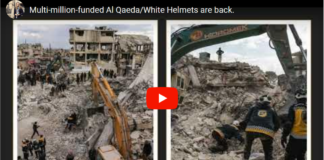
    (4) Vanessa Beeley, “Multi-million-fund al-Qaeda/White Helmets are back.” (Multi-million-funded Al Qaeda/White Helmets are back. – YouTube) 25 February, 2023. See also:( Multi-million-funded Al Qaeda/White Helmets are back./ By Vanessa Beeley – Mark Taliano)   Accessed 28 February, 2023.

    (5) Ibid

    Featured image is from the author


    Order Mark Taliano’s Book “Voices from Syria” directly from Global Research.

    **Voices from Syria**

    Author: Mark Taliano

    ISBN Number: 978-0-9737147-9-1

    Year: 2017

    Product Type: PDF File

    List Price: $6.50

    Special Offer: $5.00 

    Click to order.


    Global Research is a reader-funded media. We do not accept any funding from corporations or governments. Help us stay afloat. Click the image below to make a one-time or recurring donation.


    Comment on Global Research Articles on our Facebook page

    Become a Member of Global Research

  • A Note to Westerners on International Women’s Day: This Is What Your Government Supports In Syria/ By Basma Qaddour

    A Note to Westerners on International Women’s Day: This Is What Your Government Supports In Syria/ By Basma Qaddour

    What life was/ is like for women in terrorist-held areas in Syria??

    In Syria, all Western-supported terrorist groups [ Jabhet Al-Nusra, Hay’at Tahrir Al-Sham, ISIS, Al-Qaeda, armed moderate opposition….you can name it]  have exploited women and forced them into illegal activities, including begging, prostitution, sexual slavery, and theft.

    These groups and their dirty and brutal acts are supported and financed by the US and its allies.

    In August 2023, the Beirut-based Al-Mayadeen TV Channel quoted the US Al-Monitor website as saying that terrorists affiliated to “Hay’at Tahrir Al-Sham” [previousky known as Jabhet Al-Nusra and Al-Qaeda in Syria] and the “Turkestan Islamic Party” force women in Idlib governorate in north-west Syria to be engaged in sexual slavery and they traffic them between Syria and Turkey. (1)

    The TV channel indicated that these crimes happen in total darkness, making it difficult to get details of the crime or the victims, as there is no official data on the exact number of sex trafficking victims in Syria that could be way beyond the records.

    It narrated the story of several women taken as victims of sex and organ trafficking networks.

    Wafaa, 19, recalled being at the hands of a Kuwaiti man nicknamed Abu Abdallah, telling Al-Monitor:  “My nightmare began on February 3, when a man in his 60s known as Abu Abdallah came to my house, where I was living with my uncle after my father was killed in battles in Idlib in 2015. He was accompanied by a Muslim cleric that went by Abu Hamza, and they both asked my uncle to buy me for $5,000, to which he agreed.”

    “Abu Abdallah immediately took me to the house of a woman named Mona, in Deir Hassan village, in the north of Idlib, where she was running a prostitution ring. There I saw a large number of women, who like me, were bought by Abu Abdallah.”

    Wafaa said that he repeatedly raped her and sold her to his friends. “I told my uncle about what I was going through in this house,” she said, adding: “but he did nothing to save me. So I accepted my fate and surrendered to physical abuse until I was taken to Turkey.”

    In Gaziantep, there were several Syrian women and girls  staying there and men from different Arab nationalities were walking among them, examining their bodies before buying one of them, according to Wafaa.

    Many families were forced to sell daughters to strangers in exchange for sustenance, just like the case of Najla (a pseudonym), 17, whose mother sold her to a 37-year-old Saudi man for $3,000 for a temporary marriage in exchange for money.

    These crimes were also committed by all terrorists groups, which are called” armed opposition” by the western media outlets, in all areas that had or have been under their occupation in Syria since 2012.

    In this context, the second edition of Mark Taliano’s “Voices from Syria ” book asserted that the terrorists control occupied territories with unspeakable barbarism. A witness to the massacre at Adra in 2013 described the scene in these words (2):

    “The rebels began to attack the government centres, and attacked the police station – where all the policemen were killed after only a brief clash because of the large numbers of attackers. They (the attackers) then headed to the checkpoint located on the edge of the city before moving to the clinic, where they slaughtered one from the medical staff and put his head in the popular market. They then dragged his body in front of townspeople who gathered to see what was happening. Bakery workers who resisted their machinery being taken away were roasted in their own oven. Jabhat al-Nusra and Islamic Front fighters went from house to house with a list of names and none of those taken away then has been seen since.” 

    “When the Syrian Arab Army (SAA) would try to enter Adra, the jihadists would throw women and children from the 20,000 people it captured off the top floors in front of the army.”

    Even in Douma suburb in the Eastern Ghouta of Damascus, terrorist groups put women in cages and used them as human shield to prevent the Syrian Army from atracking the suburb in November 2015.

    Taliano continues, “Women in particular have no rights in terrorist-occupied areas of Syria but Western “progressives” and even “feminists” have allowed themselves to be socially-engineered by Mainstream Everything to support state policies of oppression and devastation.

    Lilly Martin, an American living permanently in Syria, wrote: ” On March 21, 2014 terrorists beheaded my Christian neighbors, and raped the old ladies who they kidnapped and took to Turkey, and killed others, and destroyed the whole village of Kessab, Syria. This is not a rumor, this is a fact. (3)

    Vanessa Beeley reported on 12 December 2016 (4) that we spent much of yesterday in Hanano speaking with very recently liberated civilians. “One lady I interviewed and filmed told me that her 8 year old daughter had died in Nusra Front prison 3 days before the liberation by SAA. Her eldest daughter had been chosen to be raped by the terrorists, saved by the liberation. Her husband had been shot by the terrorists. She told me of a woman who had been begging the terrorists for food. They shot her in the mouth. She said terrorists had been murdering anyone who tried to leave Hanano via the humanitarian corridors and then blaming it on the Syrian government. She described all manner of torture and atrocities committed by these NATO “moderates”.

    “It is known and documented, and has been for years, that the West and its allies support these un-Islamic terrorists to destroy and control other countries and their peoples. It is known and documented that the terrorists who behead, rape, and pillage their way through the Middle East and elsewhere are our proxies. We pay the bills, and we orchestrate the carnage,” the book asserted. (5)

    Actually, the west-supported terrorists’ brutal implementation and misinterpretation of Shari’a law in the areas under its control was spreading.

    In March 2021, Three women and one man were stoned to death in Idlib on the orders of HTS terrorists.

    According to sources close to HTS, who spoke to The New Arab’s Arabic language service Al-Araby Al-Jadeed, the individuals executed  were charged with “adultery” and “attempted murder”.

    They were brutally executed in the city centre and the sentence was carried out by the security apparatuses, sources said, indicating that the terrorist of HTS used to carry out public executions against civilians.

    Moreover, women in terrorist-held areas  are prevented from attending schools, studying at universities, going outside homes without Niqab ( Long garment worn by women to cover their entire body and face) …etc.

    All these terrorists’ acts against women have nothing to do with Islam because terrorists hold extremist ideology based on violence and murder.

    Besides the usurpation of women’s rights, the freedom of movement of both women and men  to safe government-held areas through humanitarian corridors that have been opened by the Syria state with the aim of evacuating civilians from terrorist-held areas was blocked.

    According to the testimony of Terrorist Mohammad Faraj Hallaq (6) that was mentioned in the “Voices From Syria” book, “the terrorists hoard food, distribute food only to those who work with the terrorists and obey their orders, force others to fight the Syrian Arab Army (SAA) under the threat of death, imprison protestors, and plant explosions in ‘humanitarian corridors’ to prevent people from escaping terrorist-occupied areas.

    Taliano continues, “The captivity and forced servitude of residents in terrorist-occupied areas is further illustrated by a Facebook post Lilly Martin shared with friends:

    ‘Breaking news from East Aleppo: Oct 21,2016: a family were able to get out to safety! Yes, I watched the interview with them on local TV. The wife said they got tired of waiting so many days to evacuate to safety. They knew that snipers were shooting at people trying to leave, but decided they would take their chances, because her husband was ill and needed medicine and food. They noticed a group of likewise civilians waiting to make a dash for it. They all started running. During their sprint out, 10 civilians with her were shot dead, including a pregnant woman! Her husband said he had been 85 kilos weight, but was now 65 kilos. He was haggard and ill looking, and using one walking cane. The children also stated that they lived in fear of the terrorists. They would not allow children to attend school, they would shoot kids if they stood in the streets and stared at them. Bread had been 25 Syrian Pounds (SYP) a packet, and was now SYP1,000 . Unbelievable hardships and suffering. I believe these stories because they were coming right out of the mouths of the people, just minutes after running to safety. If it was a reporter recounting stories, I could doubt it, but you can’t doubt their stories. I always said to myself that once the people get out of East Aleppo, you will hear horror stories, and these stories will directly reflect on these American backed and supported terrorists.’ “

    Here, the question that we want to raise on the occasion of the International Women’s Day is: “ What have the International Organizations that support women all over the world done on the ground to protect women in terrorist- held area?? “ …Nothing

    In December 2011, the American investigative journalist Miri Wood (7)wrote the following:


    “ femicide and other heinous atrocities against Syrian women continue to be ignored by the West, including so-called feminist groups. Watching the wretched diplomats drone on about protecting the murderers of Syrian women while braying about the need for ‘rights of women in the SAR’ makes it woefully past time for the gloves to come off. There is something particularly rancid when a man who has ignored mass slaughter, kidnapping, and rape of women dares to utter a single word about women’s rights.

    Between April 2011 — mere weeks after NATO’s Spring was exploded onto Syria — and June 2013, thirty-seven thousand (37,000) rapes were committed against Syrian women, and one thousand (1,000) Syrian women were kidnapped.

    In August 2011 — during the early days of the foreign invasion of Syria, when all the ‘moderate’ terrorists were members of the so-called ‘Syrian Free Army’  — Syrian television journalist, Yara Al Saleh was among the 1,000 women kidnapped (along with her crew, some of whom were murdered.” (1)

    These kidnapped and raped women are victims of the terrorist war that has targeted every civilian and every stone in the country since 2011.

    To sum up, it is  heartbreaking  to read stories about the suffering of such women, who live in terrorist- held areas and whose rights are genetic and date back thousands of years, to the great warrior queen, Zenobia.

    The women in terrorist- held areas want to move to government-secured areas where they have full rights to vote, to become parliamentarians, ministers, and ambassadors, to be safe, and to wear what they want.

    Basma Qaddour


    Notes:

    Mark Taliano and Basma Qaddour, Voices from Syria, Second Revised Edition. Global Research.

    Voices from Syria – Second Revised Edition – Mark Taliano

    Voices from Syria: Mark Taliano: 9780987938916: Amazon.com: Books

    (1)       https://www.almayadeen.net/news/politics/-%D8%A7%D9%84%D9%85%D9%88%D9%86%D9%8A%D8%AA%D9%88%D8%B1—%D9%86%D8%B3%D8%A7%D8%A1-%D9%8A%D8%B1%D9%88%D9%8A%D9%86-%D8%AA%D8%AC%D8%A7%D8%B1%D8%A8-%D9%85%D8%B1%D9%88%D8%B9%D8%A9-%D9%81%D9%8A-%D8%B4%D8%A8%D9%83%D8%A7%D8%AA-%D8%A7%D9%84%D8%A5%D8%AA%D8%AC%D8%A7%D8%B1-%D8%A8%D8%A7%D9%84%D8%A8%D8%B4%D8%B1

    (2)  “Voices From Syria” book, second edition, Chapter I   “ In Their Own Voices”, Page.17.

    (3)  “Voices From Syria” book, second edition, Chapter I   “ In Their Own Voices”, Page.12.

    (4)  “Voices From Syria” book, second edition, Chapter III   “ Feigned Humanitarianism as Cover for Crimes of the Highest Order”, Page.40.

    (5)  https://www.newarab.com/news/syrian-islamist-militant-group-stones-three-women-death

    (6)  “Voices From Syria” book, second edition, Chapter VI   “ Syrians Support Their Homeland”, Page.67

    (7)  https://marktaliano.net/femicide-atrocities-against-syrian-women-by-wests-terrorists-by-miri-wood/

  • Video: Crimes Against Syria

    Video: Crimes Against Syria

    Global Research, September 17, 2023

    All Global Research articles can be read in 51 languages by activating the Translate Website button below the author’s name.

    To receive Global Research’s Daily Newsletter (selected articles), click here.

    Click the share button above to email/forward this article to your friends and colleagues. Follow us on Instagram and Twitter and subscribe to our Telegram Channel. Feel free to repost and share widely Global Research articles.

    *** 

    Washington-led Empire’s criminal war on Syria is a war against civilization itself.

    Empire, with its legacy media accomplices, hides behind veils of fabricated lies to commit crimes against children, women, men, Muslims, Christians, minorities, secularism, democracy, and the entire fabric of the sovereign nation of Syria itself.

    Empire balkanizes, steals, loots, plunders, and supports terrorism of all kinds, even as it imposes colllective punishment in the form of unilateral coercive measures against those in government-secured areas.

    “Crimes Against Syria” unmasks the war propaganda apparatus. It presents the evidence-based truth that the West and its agencies seek to obscure.

    READ MORE: Video: “Crimes Against Syria” Produced by Mark Taliano

    Big lies of “humanitarian warfare” and the “Global War on Terror” are exposed for all to see.

    Watch the trailer below.

    Watch the full documentary below.

    *

    Note to readers: Please click the share button above. Follow us on Instagram and Twitter and subscribe to our Telegram Channel. Feel free to repost and share widely Global Research articles.

    Mark Taliano is a Research Associate of the Centre for Research on Globalization (CRG) and the author of Voices from Syria, Global Research Publishers, 2017. He writes on his website where this article was originally published.

    Featured image is from Syria News


    Order Mark Taliano’s Book “Voices from Syria” directly from Global Research.

    **Voices from Syria**

    Author: Mark Taliano

    ISBN Number: 978-0-9737147-9-1

    Year: 2017

    Product Type: PDF File

    List Price: $6.50

    Special Offer: $5.00 

    Click to order.


    Comment on Global Research Articles on our Facebook page

    Become a Member of Global Research


  • Canadian Foreign Policy is Utterly Barbaric

    Canadian Foreign Policy is Utterly Barbaric

    Canada’s foreign policy is basically an appendage of U.S foreign policy, and it is utterly barbaric. Consider the example of Syria.

    Syria, like Turkey, has recently suffered catastrophic earthquakes.  Whereas humanitarian aid has justifiably poured into Turkey, it barely reaches the vast majority of Syrians.

    Why is this?  The answer is simple. Criminal unilateral coercive measures levied against Syria and Syrians allow aid to terrorist-occupied areas on the one hand, and deny aid to all areas governed by the democratically -elected, overwhelmingly popular, secular, pluralist government of Syria led by President Bashar al-Assad. (1)

    The aid to al Qaeda terrorist- occupied areas such as Idlib is hoarded and controlled (2)by terrorist-warlords as it trickles down to the people. (3) In fact the legitimate Syrian government recently attempted to ship aid into Idlib, but al Julani, former al Qaeda boss, now rebranded HTS boss, refused a convoy of aid coming from Damascus, saying that “he wouldn’t legitimize the internationally recognized Syrian government and he wouldn’t accept the aid.” (4)

    Meanwhile, the truth of Canada’s foreign-policy barbarism is concealed by a vast war-propaganda complex which creates false perceptions of Canada’s humanitarianism as it doubles-down on barbarism. The deception is so great that people trying to help Syria are actually helping al Qaeda.

    Consider, for example,  the case of the Canadian-funded White Helmets.  Known and documented, the White Helmets are not the legitimate Syrian Civil Defense. (The real Syria Civil Defense was established in 1953, and is recognized by the International Organization for Civil Defense in Geneva.) They are instead, as pointed out by John Pilger, a “propaganda construct”. They operate solely in terrorist-occupied areas and hence they would be more accurately described as Al Qaeda rescuers.

    Vanessa Beeley recently pointed out that the White Helmet brand has been

    “extensively damaged by Syrian civilian accusations including theft, murder, torture, detention, being embedded with armed groups dominated by Al-Qaeda, organ trafficking, child abduction for presenting their chemical weapon staged events, and of course they were proven to be staged after the Douma 2018 chemical attack when the OPCW dissident inspectors, who were on the ground, pointed out that the events at the Medical Center in Douma were staged as I had already confirmed visiting the Medical Center days after the alleged attack.” (5)

    The plight of Syria and the Syrian people, victimized by Western unilateral coercive measures, by Western-supported terrorists, including ISIS and al Qaeda, and now by hypocritical and toxic earthquake response measures, is yet one more sordid example of the need to honour and enforce international law and the charter of the United Nations. Any so-called “Rules Based Order” as offered by Washington, would surely be more of the same: degenerate barbarism.

    (1) e-mail/newsletter from Syria Support Movement: What we’ve learned about how to send donations to Syrian earthquake victims (mailchi.mp)

    (2) News Desk, “Qatar, US encourage legitimizing former Al-Qaeda leader in Syria: Report.” The Cradle,  23 February, 2023 (Qatar, US encourage legitimizing former Al-Qaeda leader in Syria: Report (thecradle.co)) Accessed 28 February, 2023.

    (3) Saffa Syria, “Al Qaeda Propagandists abuse Earthquake-struck Aleppo Children.” Syria News, 25 February 2023. (Al Qaeda Propagandists abuse Earthquake-struck Aleppo Children (syrianews.cc) ) Accessed 28 February, 2023.

    (4) Vanessa Beeley, “Multi-million-fund al-Qaeda/White Helmets are back.” (Multi-million-funded Al Qaeda/White Helmets are back. – YouTube) 25 February, 2023. See also:( Multi-million-funded Al Qaeda/White Helmets are back./ By Vanessa Beeley – Mark Taliano)   Accessed 28 February, 2023.

    (5) Ibid

    READ MORE: 

    Environmental Modification Techniques (ENMOD) and the Turkey-Syria Earthquake: An Expert Investigation is Required – Global ResearchGlobal Research – Centre for Research on Globalization

    Dr. Bassma Kodmani dead in Paris, and Syria left in ruins – Mideast Discourse


  • Multi-million-funded Al Qaeda/White Helmets are back./ By Vanessa Beeley

    Multi-million-funded Al Qaeda/White Helmets are back./ By Vanessa Beeley


    Transcript:

    I was actually talking to Cory Morningstar, who put me on track to investigate the White Helmets. So I think she wrote about them originally in 2014- one year after they were established by British Military Intelligence operative, James Le Mesurier, employed by Analysis Research and knowledge ( ARK) group that’s headed up by very probably an MI6 operative Alistair Harris, who’s operating in a number of countries around the world on behalf of the British government.

    And we were both talking about the fact that we’re suddenly post-earthquake seeing wall-to-wall propaganda resurrecting the White Helmet brand, that of course had been extensively damaged by Syrian civilian accusations including theft, murder, torture, detention, being embedded with armed groups dominated by Al-Qaeda, organ trafficking, child abduction for presenting their chemical weapon staged events, and of course they were proven to be staged after the Douma 2018 chemical attack when the OPCW dissident inspectors, who were on the ground, pointed out that the events at the Medical Center in Douma were staged as I had already confirmed visiting the Medical Center days after the alleged attack.

    So the brand itself had been we thought irreparably damaged. They tried to revive it in Ukraine. The White Helmets go to Ukraine…That didn’t really work. In fact, it really worked against them because people then started to affiliate them with the Nazi elements in Ukraine, particularly with the mercenaries going from the northeast of Syria into Ukraine to fight alongside the Azov and Aidar battalions, and also of course more recently the influx of ISIS from Syria into Ukraine to fight alongside the Ukrainian forces such as they are now.  But suddenly after the earthquakes, or the two earthquakes, major earthquakes that hit Syria on the 6th of February, we’ve seen it’s like Groundhog Day. We’ve gone back to the 2013 promotional material wall-to-wall across all media outlets, who are the White Helmets, the same kind of copy-paste Syria Campaign narratives that were produced back then, who are they volunteers- three thousand volunteers saving 115 lives in Syria etc….But what I want to focus on today is the fact that here in Syria we see that the West collectively and their allies in Israel and the Gulf States,  namely Qatar and Saudi Arabia, are capitalizing on the humanitarian tragedy on the earthquake to effectively revive the military war against the Syrian government.

    I mentioned attacks carried out by ISIS…The Western media is portraying attacks by Assad personally… Of course that’s what they’ve always done against terrorist positions in the Northwest….And reality those so-called attacks have been defensive campaigns to prevent the advance of the armed groups dominated by Al-Qaeda, known to be a U.S admitted to be a U.S. asset inside Syria.. And so the White Helmet Resurrection in my view is part of this drive to re-arm, re-equip and refinance the armed groups in the Northwest to lead a military campaign alongside ISIS in the Northeast, Central Syria and the southeast, and bolstered by the latest Israeli aggression on the 19th of February around 1:00 am when they attacked various sites in Syria, including a number of sites in Damascus, killing five Syrian civilians, injuring dozens, more damaging the Damascus Citadel’s archaeological institutes destroying historical documents by UNESCO heritage site in Sweida- to the south of Damascus- 300 kilometers away from the U.S military base in al Tanf.

    So, what I’m trying to say today to people that are not aware of who the White Helmets are and who may be getting pulled into funding the various donation sites that are associated with the White Helmets… I want to try and point out how this uptake in funding has come as a result of the earthquake.. So in other words the earthquake is being exploited by the West, while of course they’re maintaining to a large degree the majority of the sanctions against the bulk of the Syrian population- 80% living under the Syrian government protection.

    So first of all, let’s have a look. I’ll run through quite quickly, and I’ve only really taken a small percentage of the funding campaigns that are out there linked to the White Helmets. So first of all we see secretary Anthony Blinken: “Today, I’m announcing plans for additional 100 million dollars to provide life-saving aid in Turkey and Syria”. And I have to say also when they mentioned Syria, they’re talking about Northwest Syria. They’re talking about the pocket of Syria that is controlled by Al-Qaeda or Hay’at Tahrir al-Sham and Abu Muhammad al-Julani ( The head of HTS) who by the way refused the Convoy of 14 trucks of humanitarian aid that came from Damascus through southern Idlib, and after a week of negotiation between Syrian Arab Crescent the UAE and the armed groups dominated by al-Julani, Al-Julani put out a statement saying that he wouldn’t legitimize the internationally recognized Syrian government and he wouldn’t accept the aid.

    Activists on the ground told me he was asking for ten thousand dollars per truck for it to enter Idlib to bring aid to the Syrian people under their occupation. So Blinken basically goes on this is all part of this kind of rebranding or cleaning up of the White Helmet brand. So here he states that he’s honored to meet representatives of the Syria Civil Defense, of course we know there are not the Syria Civil Defense. The real Syria Civil Defense was established in 1953 in Syria and it’s the only recognized, Syria Civil Defense by the International Organization for Civil Defense in Geneva. Added to the U.S. So Blinken’s talks about 100 million which will be distributed part of it through USAID, we have Germany offering 30 million euros for NGOs. We assume among those will be the White Helmets in the Northwest again controlled by Al-Qaeda. Samantha Power, who heads up USAID under the Biden Administration is talking look at the second part of her tweet 85 million in funding, and of course she had a conversation with Raed Al Salah (The head of the White Helmets).

    And so we know that much of this funding will in effect go to the White Helmets. The White Helmets putting out their thank you tweet to Samantha Power, the USAID Bureau for humanitarian assistance, lead photographed alongside a White Helmets management. And I have to say all of this money to our knowledge is coming into bank accounts in Istanbul, that are managed by the three directors of the White Helmets: Raed Saleh, Farouq Habib and Munir Mustafa,  and of course we would like to have some transparency on how this money is going to be distributed into the Northwest which as I keep saying is under the control of al-Qaeda, again from Samantha Powers. So she very kindly adds on an additional 5 million to assist with rescue equipment fuel for life-saving operations and crucial support for ambulance networks. We’ll come on to that later.

    Interesting here, I just want to point out look at the uniform and the branding of the White Helmets. We’re going very much towards kind of EU-UK fire Brigade insignia, and notice of course that everything is in English despite the fact that they work in an Arabic speaking environment. Ambassador Linda Thomas Greenfield, the United States Representative for the US, is talking about the decision to open two additional border crossings. So again, this is related in my view to the uptick in military support for the armed groups, and the Revival of the military campaign to topple the Syrian government while Syria itself is at its most vulnerable. Qatar which of course originally put in around 3 billion into supporting regime change in Syria from 2011 onwards, and whose media was responsible for much of the propaganda that demonized the Syrian government.

    Now interesting that they do actually state that they’re going to support the operations of the White Helmet, but they’re a little bit coy about mentioning the amount. They say that basically they are fundraising 10 million dollars and they set aside one million. But we can assume that an awful lot more will be coming in from Qatar and Saudi Arabia. The Canadian government will provide an initial 10 million in aid to Turkey and Syria. And Denmark alongside the UK krona 20 million to the Syria civil defense. So again going directly to the White Helmets. And I think that’s around 2 million. I think sterling and a little bit more than that in dollars. The UK government not to be outdone commit to additional funding to the White Helmets to support search and rescue in Syria.

    The White Helmets thanked the British delegation, which was headed up by the right honorable Andrew Mitchell who’s the Minister of State for development and Africa. Of course he was honored to meet the white Helmets Heroes involved in search and rescue operations in Northwest Syria. They’ve released an additional 4.3 million pounds. The UK foreign office funds the White Helmets year on year 2.2 million minimum, and I believe that 4.3 million has just been increased to 5 million.  I’ll do a summary of all the funding so far at the end,, but then let’s get on to what I call the kind of billionaire complex, influencer cartels “Choose Love” which was previously help refugees has had a target of 4.164 million to raise for the White Helmet. I recommend everybody goes to the UK column article: “White Helmets, Halal Systems and the Grotesque Militarization of Humanitarianism in Syria” where you will find a lot of information about Choose Love or help refugees as it was previously.

    This rebranding of these NGOs, or the members of the NGO complex is very common when their reputation is tarnished. The rebranding happens just as of course it did with al-Qaeda in Syria multiple times, then we have a AVAAZ, instrumental in funding the war campaign against the Syrian government from 2011 onwards. I mentioned Danny Abdul day, and before if people remember back in, I think it was 2012 of ours had the smuggle hope for Syria Campaign, which raised over 2 million to equip the so-called citizen journalists, who produced much of the early propaganda before the White Helmets took over. So the latest of our campaigns.

    I also want to draw your attention to the language that’s being used by the major and by these funding campaigns. It’s doomsday in Turkey and Syria. I’ve seen this across multiple media outlets again pushing the very familiar tagline on the White Helmets, one brave group of Syrian volunteers who’s already responding literally digging people out of trouble with bare hands. Pay attention to that sentence “The white helmets are the best hope for people in parts of Syria”. Will they admit they omit the fact that “it’s the part of Syria that contains the majority of al-Qaeda and affiliated armed terrorist groups including the Uyghurs from China, Chechens, Saudi Arabians, Afghanistanis, Turkistanis, etc….”And then they are crying out for rescue supplies: fuel and an emergency shelter,  and our movement could provide it in hours. That’s interesting. Avaaz could provide materials for the White Helmets in the Northwest now.

    You’ll also be seeing- and that’s where I  really want to draw people’s attention to this. You’re going to be seeing a lot of images like this: White Helmets holding children aloft, a lot of cheering and shouting and a lot of cameras, a lot of mobile phones and very clean children and children that don’t look remotely traumatized by six -now ten- days under the rubble. You’re going to see a lot of that.. Don’t please be fooled by it.

    The real theory of civil defense, the Syrian Arab Crescent and the various emergency relief teams inside proper Syria are too busy actually doing their work to pose for photo opportunities. But note here the White Helmets thank of ours then you have what’s this one the Voices Project USA, which is effectively Syria Campaign. Syria campaign established by Ayman Asfari, a UK based Syrian oil baron investigated by the serious fraud organization that looked into his funding of the conservative party under Theresa May. And this is the American version of the Syria Campaign. But the Syria campaign have their own funding campaign going again showing very emotive pictures of the White Helmets: “GoFundMe” that shut down multiple fundraisers for people inside Syria under the government protection, but however managed to raise a hundred thousand to support the White Helmets riots ahead of the White Helmets was actually allowed to start a funding campaign with Gulf. On me it wasn’t shut down. The mayor of London said it can’t. In Trafalgar Square, City Hall is assisting the Syrian community and creating Syria house a space where they can pay their respects, and we even have the royal family involved in Trafalgar Square. The king looks very sorry. Syrian Community tent where members of the Syrian Community can come together to support those who need it most and guess who’s on the left of King Charles ( in the photo) that’s Ayman Asfari, who I just mentioned, who has pretentions to the throne of Syria. The king himself has committed to making a donation to the DEC appeal that has raised over 60 million for Northwest Syria.

    Now this is where it gets kind of interesting. So here we’ve got an interview on Le devoir. So in this interview I’ll translate from French. We’ve heard the cries of people under the rubble but they said we don’t have equipment to save them that’s the White Helmets, and here you have one of the primary members of the White Helmets talking about the White Helmets’ needs: fuel,  search and rescue equipment, heavy vehicles, spare parts for vehicles, tires for vehicles.

    Now remember how many millions are being pledged to this organization of less than 3 000 volunteers. Now in amongst the media campaign I found these photographs of the lack of heavy machinery, while the White Helmets are allegedly digging people out from under the rubble and then let’s have a look back at this. This is the White Helmets YouTube channel in Idlib. 15.2k subscribers. It’s been running since 2013, and if you can play the video Mike, I just want to show from one year ago amount of Machinery that the White Helmets had available to them. And at one point that I want to make during this video is the White Helmets operate with an annual budget from their various sponsors in the west and in the Gulf States and Israel, 35 million  per year.

    The real serious civil defense, 10 000 volunteers across 80 percent of the population of Syria, have an annual budget of 50 000. While the White Helmets have all of this equipment. And while the White Helmets had in fact stolen equipment from the rails of Syria civil defense -when they occupied areas where the real Syria civil defense operated. In Aleppo- for example, I spoke to one of the captains of the Syria civil defense the real one and he told me that for 44 collapsed buildings they only had seven machines to actually help them dig people out from under the rubble.

    So this gives you an indication and a comparison between the two organizations: One funded by the West in order to destabilize their country and criminalize the Syrian government. The other, the genuine Syria civil defense that is working for the Syrian people. So I want to look at this very quickly. This is the Syria Regional program for USAID final report 2020 and note in the small print at the bottom that “USAID and now the British government siphoned their funding not directly to the White Helmets but through Chemonics  International.

    And let’s have a look. So this was since 2013 to 2020. I’ve circled in Red. So 46% of the funding, 25.2 million went to the supply of heavy equipment for the White Helmets. So their claims that they don’t have heavy equipment available are false, and so therefore one has to ask: Where are the millions going??? and let’s just do a quick recap of what I’ve talked about. So, Blinken talked about 100 million [part of it via USAID], and we also have to remember USAID’s connections to the CIA. Germany 30 million Euros. So, 31.7 million dollars USAID, 85 million plus an extra 5 million for the White Helmets, Denmark in collaboration with the UK 1.9 million, the UK FCDO about 6 million. Choose Love $4.8 million. DEC that I mentioned that the King Charles is going to be donating to 72 million dollars,  Qatar at least 10 million. So the total is 316 million so far.

    And as I said I’ve only scratched the surface. I’ve not looked into the EU, the UN pledges, etc…, and the White Helmets 20 million minimum. So their annual budget is 35 million. They’re getting that anyway one assumes, and here we have 20 million on top for 3 000 volunteers that already have all the equipment they need to dig people out. So why is this money needed. And just a quick reminder from John Pilger award-winning journalist/ film maker as he said: “I think in 2016 or 2017, the White Helmets are complete propaganda construct”, and he also mentioned they’re working alongside Nusra Front, which is Al-Qaeda in Syria.

    NOTE: Avaaz is U.S.-based nonprofit organization launched in January 2007 that promotes global activism on issues such as climate change, human rights, animal rights, corruption, poverty, and conflict. In 2012, The Guardian referred to Avaaz as “the globe’s largest and most powerful online activist network


    Transcript with Time-Stamps:

    I was actually talking to Corey Morningstar
    0:03
    um who put me on track to investigate
    0:06
    the White Helmets so I think she wrote
    0:07
    about them originally in 2014 one year
    0:11
    after they were established by British
    0:13
    Military Intelligence operative James
    0:15
    Le Mesurier
    0:17
    um employed by Analysis Research and
    0:20
    knowledge Arc group that’s headed up by
    0:23
    very probably an MI6 operative Alistair
    0:26
    Harris who’s operating in a number of
    0:30
    countries around the world on behalf of
    0:32
    the British government
    0:33
    and we were both talking about the fact
    0:36
    that we’re we’re suddenly
    0:38
    post-earthquake seeing wall to wall
    0:41
    propaganda
    0:42
    resurrecting the White Helmet brand that
    0:45
    of course had been extensively damaged
    0:48
    by Syrian civilian accusations including
    0:53
    um theft, murder, torture, detention, being
    0:56
    embedded with armed groups dominated by
    0:59
    Al-Qaeda, organ trafficking, child
    1:01
    abduction for
    1:03
    um presenting their chemical weapon
    1:07
    um staged events and of course they were
    1:09
    proven to be staged after the Douma 2018
    1:12
    chemical attack when the OPCW dissident
    1:16
    inspectors who were on the ground
    1:17
    pointed out that that the events at the
    1:22
    Medical Center in Douma were staged as I
    1:25
    had already confirmed visiting the
    1:28
    Medical Center days after the alleged
    1:30
    attack so the brand itself had been we
    1:33
    thought irreparably damaged they tried
    1:36
    to revive it in Ukraine the White
    1:38
    elmets go to Ukraine that didn’t really
    1:41
    work in fact it really worked against
    1:44
    them because people then started to
    1:47
    affiliate them with the Nazi elements in
    1:50
    Ukraine particularly with the
    1:51
    mercenaries going from the northeast of
    1:53
    Syria
    1:54
    into Ukraine to fight alongside the Azov
    1:58
    and Aidar battalions and also of course
    2:01
    more recently on the influx of Isis from
    2:04
    Syria into Ukraine to to fight alongside
    2:08
    the Ukrainian forces such as they are
    2:10
    now but suddenly after the earthquakes
    2:14
    or the two earthquakes major earthquakes
    2:16
    that hit Syria on the 6th of February
    2:20
    we’ve seen uh I mean it’s like Groundhog
    2:23
    Day we’ve gone back to the 2013
    2:25
    promotional material wall to wall across
    2:29
    all media Outlets who are the White
    2:31
    Helmets the same kind of copy paste
    2:34
    Syria Campaign narratives that were
    2:37
    produced back then who are they
    2:39
    volunteers three thousand volunteers
    2:41
    saving 115
    2:43
    000 lives in Syria etc etc but what I
    2:46
    want to focus on today is the fact that
    2:49
    that
    2:50
    um here in Syria we see that the West
    2:53
    collectively and their allies in Israel
    2:57
    and the Gulf States namely Qatar and
    2:59
    Saudi Arabia are capitalizing on the
    3:02
    humanitarian tragedy on the earthquake
    3:04
    to effectively revive the military war
    3:08
    against the Syrian government I
    3:09
    mentioned attacks carried out by ISIS
    3:13
    um the Western media is portraying
    3:15
    attacks by Assad personally of course
    3:18
    that’s what they’ve always done against
    3:20
    terrorist positions in the Northwest and
    3:23
    reality those so-called attacks have
    3:26
    been defensive
    3:28
    um campaigns to prevent the advance of
    3:31
    the Armed groups dominated by Al-Qaeda
    3:33
    known to be a U.S admitted to be a U.S
    3:36
    asset inside Syria and so the White
    3:40
    Helmet Resurrection in my view is part
    3:43
    of this drive to re-arm re-equip
    3:47
    refinance the armed groups in the
    3:49
    Northwest to lead a military campaign
    3:52
    alongside ISIS in the Northeast Central
    3:56
    Syria and the southeast
    4:00
    um and bolstered by the latest Israeli
    4:03
    aggression on the 19th of February
    4:04
    around 1am when they attacked
    4:07
    um various sites in Syria including a
    4:10
    number of sites in Damascus killing five
    4:12
    Syrian civilians
    4:14
    um injuring dozens more damaging the
    4:17
    Damascus Citadel
    4:19
    archaeological institutes destroying
    4:21
    historical documents by UNESCO heritage
    4:24
    site in Sweida to the south of uh
    4:27
    Damascus 300 kilometers away from the
    4:30
    U.S military base in al Tanf so
    4:34
    um what I’m trying to to say today to
    4:37
    people that are not aware of who the
    4:39
    White Helmets are and who may be getting
    4:42
    pulled into funding the various
    4:45
    um donation sites that are um associated
    4:49
    with the White Helmets I want to try and
    4:51
    point out how this uptake in funding has
    4:55
    come as a result of the earthquake
    4:58
    um so in other words the earthquake is
    4:59
    being exploited by the West while of
    5:03
    course they’re maintaining to a large
    5:04
    degree the majority of the sanctions
    5:07
    um against the bulk of the Syrian
    5:09
    population the 80 living under the
    5:12
    Syrian government protection
    5:15
    um
    5:16
    so first of all let’s have a look uh
    5:18
    I’ll run through quite quickly and I’ve
    5:20
    only really taken
    5:23
    um a small percentage of the funding
    5:25
    campaigns that are out there linked to
    5:27
    the White Helmets so first of all we see
    5:30
    secretary Anthony Blinken today I’m
    5:32
    announcing plans for additional 100
    5:34
    million dollars to provide life-saving
    5:36
    Aid in Turkey and Syria and I have to
    5:39
    say also when they mentioned Syria
    5:41
    they’re talking about Northwest Syria
    5:42
    they’re talking about the pocket of
    5:44
    Syria that is controlled by Al-Qaeda or
    5:48 Hay’at Tahrir al-Sham  and Abu Muhammad al-Julani
    5:51
    the head of HTS who by the way
    5:56
    refused the Convoy of 14 trucks of
    5:59
    humanitarian Aid that came from Damascus
    6:02
    through southern Idlib and after a week
    6:05
    of negotiation between Syrian Arab
    6:08
    Crescent the UAE and the armed groups
    6:10
    dominated by al-Julani put out a
    6:13
    statement saying that he wouldn’t
    6:15
    legitimize the internationally
    6:18
    recognized Syrian government and he
    6:19
    wouldn’t accept the aid activists on the
    6:22
    ground told me he was asking for ten
    6:25
    thousand dollars per truck for it to
    6:27
    enter Idlib to bring Aid to the Syrian
    6:29
    people under their occupation
    6:31
    so Blinken basically goes on this is all
    6:35
    part of this kind of
    6:37
    um rebranding or cleaning up of the
    6:41
    White Helmet brand so here he he states
    6:43
    that he’s honored to meet
    6:44
    representatives of the Syria Civil
    6:46
    Defense of course we know there are not
    6:48
    the Syria Civil Defense the real Syria
    6:51
    Civil Defense was established in 1953 in
    6:54
    Syria and it’s the only recognized Syria
    6:56
    Civil Defense by the International
    6:58
    Organization for Civil Defense in Geneva
    7:02
    um added to
    7:05
    um the U.S so Blinken talks about 100
    7:07
    million which will be distributed part
    7:09
    of it through USAID we have Germany
    7:13
    um offering 30 million euros for NGOs we
    7:18
    assume among those
    7:20
    um will be the White Helmets in the
    7:22
    Northwest again controlled by Al-Qaeda
    7:24
    Samantha Power who heads up
    7:27
    um USAID under the Biden Administration
    7:30
    is talking look at the second part of
    7:34
    her tweet 85 million in funding and of
    7:37
    course she had a conversation with right
    7:39
    Salah the head of the White Helmets and
    7:42
    so we know that much of this funding
    7:44
    will in effect go to the White Helmets
    7:48
    the white helmets putting out there
    7:49
    thank you tweet to Samantha Power The
    7:52
    USAID Bureau for humanitarian assistance
    7:54
    lead photographed alongside a white
    7:58
    helmet
    7:59
    management and I have to say all of this
    8:02
    money to our knowledge is coming into
    8:04
    bank accounts in Istanbul that are
    8:07
    managed by the three directors of the
    8:09
    White Helmets
    8:14
    Mustafa and of course we would like to
    8:17
    have some transparency on how this money
    8:20
    is going to be distributed into the
    8:22
    Northwest which as I keep saying is
    8:24
    under the control of al-Qaeda again from
    8:27
    Samantha Powers so she very kindly adds
    8:30
    on an additional 5 million to assist
    8:33
    with rescue equipment fuel for
    8:35
    life-saving operations and crucial
    8:37
    support for ambulance networks we’ll
    8:39
    come on to that later
    8:42
    um interesting here I just want to point
    8:43
    out look at the uniform and The Branding
    8:46
    of the White Helmets we’re going very
    8:48
    much towards
    8:50
    um kind of EU UK fire Brigade insignia
    8:54
    and notice of course that everything is
    8:57
    in English despite the fact that they
    8:59
    work in an Arabic speaking environment
    9:03
    um Ambassador Linda Thomas Greenfield
    9:05
    the United States Representative for the
    9:08
    US is talking about the decision to open
    9:11
    two additional border crossings so again
    9:13
    this is related in my view to the uptick
    9:16
    in um military support for the armed
    9:19
    groups uh and the Revival of the
    9:21
    military campaign to topple the Syrian
    9:25
    government while Syria itself is at its
    9:27
    most vulnerable Qatar which of course
    9:31
    originally put in around 3 billion into
    9:33
    supporting regime change in Syria from
    9:36
    2011 onwards and whose media was
    9:39
    responsible
    9:40
    um for much of the propaganda that
    9:43
    demonized the Syrian government now
    9:46
    interesting that they do actually state
    9:49
    that they’re going to support the
    9:50
    operations of the White Helmet but
    9:53
    they’re a little bit Coy about
    9:55
    mentioning
    9:56
    um the amount
    9:58
    um they say that basically they are
    10:02
    fundraising 10 million dollars and they
    10:05
    set aside one million but we can assume
    10:08
    um that an awful lot more will be coming
    10:09
    in from Qatar and Saudi Arabia the
    10:12
    Canadian government will provide an
    10:14
    initial 10 million in Aid to Turkey and
    10:16
    Syria
    10:18
    um and Denmark alongside the UK uh uh
    10:24
    krona 20 million to the Syria civil
    10:26
    defense so again going directly to the
    10:29
    White Helmets
    10:31
    um and I think that’s around
    10:35
    um 2 million I think uh Sterling and a
    10:39
    little bit more than that in dollars
    10:42
    um the UK government not to be outdone
    10:45
    commit to additional uh funding to the
    10:47
    White Helmets to support search and
    10:50
    rescue in Syria uh the White Helmets
    10:52
    thanked the British delegation which was
    10:55
    headed up by the right honorable Andrew
    10:57
    Mitchell who’s the Minister of State for
    10:59
    development and Africa of course he was
    11:03
    honored to meet the white helmet Heroes
    11:04
    involved in search and rescue operations
    11:06
    in Northwest Syria
    11:08
    um they’ve released an additional
    11:11
    additional 4.3 million pounds
    11:15
    um the UK foreign office funds the white
    11:18
    helmets year on year 2.2 million minimum
    11:22
    and I believe that 4.3 million has just
    11:25
    been increased um to 5 million I’ll do a
    11:29
    summary of all the funding so far at the
    11:32
    end but then let’s get on to what I call
    11:35
    the kind of Billionaire Complex
    11:37
    um
    11:38
    influencer cartel Choose Love which was
    11:41
    previously help refugees has had a
    11:45
    target of
    11:47
    4.164 million to raise
    11:50
    um for the white helmet I recommend
    11:52
    everybody goes to the UK column article
    11:54
    White Helmets and Halal systems the
    11:57
    grotesque militarization of
    11:59
    humanitarianism in Syria where you will
    12:01
    find a lot of information about Choose
    12:04
    Love or help refugees as it was
    12:07
    previously this rebranding of these ngos
    12:10
    or the members of the NGO complex is
    12:13
    very common when their reputation is
    12:15
    tarnished the the rebranding happens
    12:18
    just as of course it did with al-Qaeda
    12:21
    in Syria multiple times then we have a
    12:25
    AVAAZ
    12:26
    um
    12:27
    instrumental in funding uh the the war
    12:32
    campaign against the Syrian government
    12:34
    from 2011 onwards I mentioned Danny
    12:36
    Abdul day and before
    12:38
    um if people remember back in I think it
    12:41
    was 2012 of ours had the smuggle hope
    12:44
    for Syria Campaign which raised over 2
    12:47
    million to equip the so-called citizen
    12:50
    journalists who produced much of the
    12:53
    early propaganda before the white
    12:54
    helmets took over so the latest of ours
    12:57
    campaign I also want to draw your
    12:59
    attention to the language that’s being
    13:01
    used by the major and by these funding
    13:03
    campaigns it’s doomsday in Turkey and
    13:06
    Syria I’ve seen this across multiple
    13:08
    media utlets
    13:10
    again pushing the very familiar tagline
    13:14
    on the White Helmets one brave group of
    13:16
    Syrian volunteers who’s already
    13:18
    responding literally digging people out
    13:20
    of trouble with bare hands pay attention
    13:22
    to that sentence
    13:24
    the white helmets are the best hope for
    13:26
    people in parts of Syria will they admit
    13:28
    they omit the fact that it’s the part of
    13:30
    Syria that contains the majority of
    13:32
    al-Qaeda and Affiliated
    13:35
    um armed terrorist groups including the
    13:37
    Uyghurs from China, Chechens, Saudi
    13:39
    Arabians Afghanistani,
    13:42
    um Turkistanis Etc
    13:44
    um and then they are crying out for
    13:46
    rescue supplies fuel an emergency
    13:48
    shelter and our movement could provide
    13:51
    it in hours that’s interesting a vars
    13:53
    could provide
    13:55
    um materials for the white helmets in
    13:58
    the Northwest now you’ll also be seeing
    14:01
    and that’s where I I really want to draw
    14:03
    people’s attention to this you’re going
    14:04
    to be seeing a lot of images like this
    14:07
    white helmets holding children Aloft a
    14:10
    lot of cheering and shouting and a lot
    14:13
    of cameras a lot of mobile phones and
    14:17
    very clean children and children that
    14:19
    don’t look remotely traumatized by six
    14:22
    now ten days under the rubble
    14:25
    um you’re going to see a lot of that
    14:27
    don’t please be fooled by it the real
    14:29
    theory of civil defense the Syrian Arab
    14:32
    Crescent and the various emergency
    14:33
    relief teams inside proper Syria are too
    14:37
    busy actually doing their work to to
    14:40
    pose for photo opportunities
    14:44
    um but note here the White Helmets thank
    14:45
    of ours then you have
    14:49
    um what’s this one the voices project
    14:51
    USA which is
    14:53
    um effectively Syria Campaign Syria
    14:55
    campaign established by Eamon as fari
    14:58
    um a UK based uh Syrian uh oil Baron uh
    15:03
    investigated by the serious uh fraud
    15:07
    um organization
    15:09
    um that looked into his funding of the
    15:12
    conservative party under Theresa May
    15:16
    um and this is the American version of
    15:18
    the Syria Campaign but the Syria
    15:20
    campaign have their own funding
    15:23
    um campaign going again showing very
    15:26
    emotive pictures of the white helmet
    15:29
    GoFundMe that shut down multiple
    15:32
    fundraisers for people inside Syria
    15:35
    under the government protection but
    15:37
    however managed to raise a hundred
    15:39
    thousand to support the white helmets
    15:41
    riots
    15:43
    ahead of the White Helmets was actually
    15:45
    allowed to start a funding campaign with
    15:47
    Gulf on me it wasn’t shut down the mayor
    15:50
    of London said it can’t in Trafalgar
    15:52
    Square City Hall is assisting the Syrian
    15:54
    community and creating Syria house a
    15:57
    space a space where they can pay their
    15:59
    respects and we even have the royal
    16:01
    family involved in Trafalgar Square the
    16:04
    king looks very
    16:06
    sorry
    16:08
    um Syrian Community tent where members
    16:10
    of the Syrian Community can come
    16:11
    together to support those who need it
    16:13
    most and guess who’s on the left of King
    16:16
    Charles that’s Eamon asvari who I just
    16:19
    mentioned who has
    16:21
    um pretentions to the throne of Syria
    16:24
    um the king himself has committed um to
    16:28
    making a donation to the dec appeal that
    16:32
    has raised over 60 million for Northwest
    16:35
    Syria
    16:37
    um mud now this is where it gets kind of
    16:39
    interesting so here we’ve got an
    16:41
    interview on uh Le de voir so on this
    16:45
    interview I’ll translate from French
    16:47
    we’ve heard the cries of people under
    16:49
    the rubble but they said we don’t have
    16:51
    equipment to save them that’s the white
    16:54
    helmet and here you have one of the
    16:57
    primary members of the white helmets
    16:58
    talking about the white helmet needs
    17:01
    fuel search and rescue equipment heavy
    17:04
    Vehicles spare parts for vehicles tires
    17:06
    for vehicles now remember how many
    17:08
    millions are being pledged to this
    17:10
    organization of Less Than 3 000
    17:14
    volunteers now in amongst the media
    17:16
    campaign I found these photographs of
    17:19
    the lack of heavy machinery while the
    17:23
    white helmets are allegedly digging
    17:25
    people out from under the rubble and
    17:27
    then let’s have a look back at uh this
    17:30
    is uh the white helmet YouTube channel
    17:33
    in adlib 15.2 subscribers it’s been
    17:37
    running since
    17:38
    2013. and if you can play the video Mike
    17:41
    I just want to show from one year ago
    17:45
    amount of Machinery that the white
    17:46
    helmets hard available to them
    17:53
    and at one point that I want to make
    17:55
    during this video is the white helmets
    17:58
    operate with an annual budget from their
    18:02
    various sponsors in the west and in the
    18:05
    Gulf States and Israel
    18:07
    um on 35 million 35 million per year the
    18:11
    real serious civil defense 10 000
    18:13
    volunteers across 80 percent of the
    18:16
    population of Syria have
    18:18
    um an annual budget of 50 000. while
    18:23
    um the white helmets have all of this
    18:25
    equipment and while the white helmets
    18:26
    had in fact stolen equipment from the
    18:28
    rails of Syria civil defense when they
    18:31
    occupied areas where the real Syria
    18:33
    civil defense operated
    18:36
    um in Aleppo for example I spoke to one
    18:40
    of the captains of the Syria civil
    18:42
    defense the real one and he told me that
    18:45
    for 44
    18:46
    um collapsed buildings they only had
    18:49
    seven machines to actually help them dig
    18:52
    people out from under the rubble so this
    18:55
    gives you an indication
    18:57
    um and a comparison between the two
    18:59
    organizations one funded by the West in
    19:02
    order to destabilize their country and
    19:05
    criminalize the Syrian government the
    19:07
    other the genuine Syria civil defense
    19:09
    that is working for the Syrian people
    19:11
    so I want to look at this very quickly
    19:14
    um this is the Syria Regional program
    19:16
    for usaid final report 2020 and note in
    19:20
    the small print at the bottom that USAID
    19:22
    and now the British government siphoned
    19:25
    their funding not directly to the White
    19:27
    Helmets but through Kimonics uh
    19:30
    International
    19:31
    and let’s have a look so this was since
    19:34
    2013 to 2020 I’ve circled in Red so 40
    19:41
    46 of the funding
    19:44
    25.2 million went to the supply of heavy
    19:49
    equipment for the White Helmets so these
    19:52
    claims that they don’t have heavy
    19:54
    equipment available are false and so
    19:57
    therefore one has to ask where are the
    19:59
    millions going and let’s just do a quick
    20:02
    recap of what I’ve talked about so
    20:04
    blinken talked about 100 million part of
    20:06
    it via usaid
    20:09
    um and we also have to remember USAID’s
    20:12
    connections to the CIA Germany 30
    20:16
    million Euros so
    20:18
    31.7 million dollars usaid 85 million
    20:22
    plus an extra 5 million for the White
    20:24
    Helmets Denmark in collaboration with
    20:27
    the UK 1.9 million the UK foreign office
    20:31
    with think we’re up to about 6 million
    20:33
    now Choose Love in dollars Choose Love
    20:37
    4.8 million
    20:39
    um DEC that I mentioned that the King
    20:42
    Charles is going to be
    20:43
    um donating to 72 million dollars Qatar
    20:48
    at least 10 million
    20:50
    um so the total is 316 million so far
    20:53
    and as I said I’ve only scratched the
    20:55
    surface I’ve not looked into the EU of
    20:58
    the UN pledges etc and the White Helmets
    21:01
    20 million minimum so their annual
    21:05
    budget is 35 million they’re getting
    21:07
    that anyway one assumes and here we have
    21:10
    20 million on top for 3 000 volunteers
    21:13
    that already have all the equipment they
    21:15
    need to dig people out so why is this
    21:17
    money needed and just a quick reminder
    21:20
    from
    21:22
    um John Pilger award-winning journalist
    21:24
    and filmmaker as he said I think in 2016
    21:28
    or 17 the White Helmets are complete
    21:32
    propaganda construct and he also
    21:35
    mentioned they’re working alongside
    21:37
    Nusra Front which is Al-Qaeda in
    21:40
    Syria


    READ MORE: 

    CIA-funded ‘task force’ that was at forefront of US ‘regime change’ plot in Syria

    White Helmets and Hala Systems – the grotesque militarisation of “humanitarianism” in Syria | UKColumn

    WikiLeaks – OPCW Douma Docs

    White Helmet signs in areas of west Aleppo infested by Al Qaeda and Nour Al Din Zinki armed groups. | Patreon

    White Helmets stealing children for ‘chemical attack’ theater in Idlib — RT

  • The Salafist Roots of the Free Syrian Army/ By William Van Wagenen

    The Salafist Roots of the Free Syrian Army/ By William Van Wagenen

    by William Van Wagenen | Feb 28, 2022

    Original Link Here: The Salafist Roots of the Free Syrian Army | The Libertarian Institute

    “At the same time, we see that there is almost no difference between the group called Free Syrian Army or other jihadist groups and ISIS. For instance, these ‘moderate’ opposition groups burned the churches down, when they entered Kessab. They entered Malula, where there is still an ancient Christian community speaking Aramaic. They destroyed that place too. There are many other examples like these.” – Harout Ekmanian

    In the Western press, the Free Syrian Army (FSA) was viewed as a moderate, secular, rebel force fighting to topple the Syrian government and to establish a democratic state in its place. It is presumed the FSA consisted primarily of defected soldiers and officers from the Syrian army, who refused to fire on peaceful protestors, and who instead took up arms against the Syrian government itself to protect civilians. It is further presumed that the FSA was later “Islamized” and hijacked by extremist Salafi-Jihadi groups, including the Syrian and Iraqi wings of al-Qaeda, the Nusra Front and Islamic State of Iraq (ISI), respectively.

    For example, pro-Syrian opposition journalist Rami Jarrah claims that  the Syrian conflict “started as a peaceful and secular uprising that later turned into an armed and secular uprising and finally an armed and Islamic one.”

    When taking a closer look at the origins of the FSA, however, it becomes clear that the mainstream narrative about the originally democratic and secular nature of the FSA is simply not correct. Rather than secular and democratic, the largest original FSA factions were Salafist and Islamist from the start (note that the terms Salafist and Islamist tend to be used interchangeably throughout Arabic language media reporting about the Syria conflict).

    Saudi-owned Al-Hayat described for example how the FSA was first established in July 2011 by a group of army deserters, but then numerous Islamist armed factions, including Liwa al-Islam, Saqour al-Sham, Alwiya Ahfad al-Rasoul, and Kata’ib Farouq, soon began fighting under the FSA banner.  Liwa al-Tawhid was another prominent Salafist armed group fighting as part of the FSA.

    In October 2012, four of these five major FSA brigades, namely Liwa al-Tawhid, Liwa al-Islam, Kata’ib al-Farouq, and Saqour al-Sham dropped any pretense of secularism. These groups abandoned the FSA brand and formed the Syrian Islamic Liberation Front (SILF), thereby acknowledging their Islamist orientations even more explicitly. Reuters quoted Saqour al-Sham leader Abu Eissa al-Sheikh, who was named head of the SILF, as explaining, “We are proud of our Islamism and we are Islamists. . . . we want a state with Islamic reference and we are calling for it.” Syria expert Aron Lund noted at the time that the SILF was “pretty much the new mainstream face of the insurgency.”

    In the words of one FSA officer, the Salafist armed groups that dominated the insurgency had themselves “emerged from the mantle of the Free Army,” and later formed more explicitly Salafist coalitions like the SILF because they believed that “that the application of Islamic law is a duty for all Muslims in all places and times.”

    Despite pro-opposition propaganda to the contrary, even prominent secular opposition supporters have quietly admitted that the armed groups fighting the government were not, and never had been, of a secular or democratic orientation. Prominent Syrian dissident Yassin al-Haj Saleh acknowledged that, “Democrats in the country did not resort to arms to defend the people” and that this was the most important reason why “various sorts of Islamists are in leading positions in the armed resistance.”

    Another prominent government critic, Michel Kilo, similarly observed in the French newspaper La Figero in 2020 that the armed groups fighting the Syrian government were Islamists, rather than secular Syrians fighting for democracy. In reflecting on the disaster that befell Syria after 2011, Kilo explained that the Islamists “came with their weapons, they absorbed the revolution of freedom to lead a counter-revolution.”  Kilo failed to acknowledge in La Figero, however, that he had himself previously praised the Islamist armed groups, including the Nusra Front, in February 2013, after their invasion and occupation of Ras al-Ayn.

    A Red Cross employee who worked in both opposition and government-controlled areas stated the matter succinctly: “If there are secularist rebels, I haven’t met them.”

    The Salafist and Islamist roots of both the broader protest movement and nascent armed insurgency ensured that the so-called Syrian revolution lacked any significant popular legitimacy. Though Syria’s population is majority Sunni, this does not translate to support for Salafism, an innovative ideology which is rejected by the Sunni Muslim mainstream.

    As Syrian Muslim Brotherhood leader Ali al-Bayanouni acknowledged, “Their influence is limited. Salafism has weak foundations in Syria, as the majority of Sunni Muslims subscribe to Sufism.”  Many Syrian Muslim Brothers are themselves Salafists, also raising questions about the group’s ability to win wide support in Syrian society, leaving even the violent and sectarian history of the group itself aside.

    The Salafist orientation of the armed groups that Kilo and other secular opposition supporters were depending on to topple the government is yet more problematic because, as Syrian dissident Nidal Nuaiseh acknowledged, “Salafist calls for the murder of Alawites are not new, but are at the core of the Salafist ideology, and have been at its core for hundreds of years.”

    As a result, Syrians most often feared the Salafist armed groups of the FSA invading their towns and cities. Acknowledging this, al-Jazeera commentator and opposition supporter Azmi Bishara wrote in his book, “Syria – A Path to Freedom from Suffering,” that, “Islamic jihadist groups were part of the Free Army” and that their “presence aroused significant fear among Syrians,” due to the “spread of black Islamic flags making reference to al-Qaeda, and the appearance of religious sharia courts.”

    That Syrians broadly feared the FSA is not surprising given the brutal tactics used by these groups. Writing for al-Quds al-Arabi, journalist Wael Essam notes that, “Many believe that what distinguishes ISIS is the role of foreign jihadists and the practices of its extremist elements in beheading, for example,” however, “the moderate Islamic factions and the Free Army carry out many similar practices. . .  but the difference is advertising.”

    This is a further indication that there were no secular armed groups fighting on the ground, and that secular opposition supporters were relying on an array of widely feared sectarian Salafist militias, including the Nusra Front and its army of foreign suicide bombers, to topple the  Syrian government for them.  As Syrian academic Mark Tomass observed, Syria’s secular opposition mistakenly believed that “street protests could topple the regime” and that when this “proved to be an illusion, the secular opposition believed that a violent overthrow of the regime would still bring them to power. Since they had no armed groups representing them on the ground, they served with the blessings of their Western and Arab sponsors as the spokesmen for the Islamist fighters, including al-Qaida.”

    In the remainder of this essay, I review the Salafist origins of the major FSA factions fighting against the Syrian government and receiving U.S, UK, Gulf and Turkish support.

    Salafism Defines the Revolution

    Members of Syria’s Salafi community, as opposed to religiously mainstream Sunnis, formed the backbone of the anti-government insurgency that emerged from the 2011 protest movement. Writing for the Friedrich Ebert Stiftung, Muhammad Abu Rumman of the University of Jordan explains that, “Salafists deeply penetrated the armed revolution, thus defining the revolution’s social role,” while noting the only “modest Sufi presence in the armed factions in particular and in the peaceful revolution in general.”

    Journalist Bisam Nasir similarly observed that “Salafist groups in the Syrian arena top the list of armed groups, organizations and movements fighting the Syrian regime and its allies, as they are the most present and the most powerful on the military level.” Though the Western press discussed the insurgency as if it was divided into “moderates” from the FSA on the one hand, and “extremists” from the Nusra Front and ISIS on the other, Nasir notes that according to the Kuwaiti Islamic writer and researcher, Ali al-Sanad, the primary distinction between the various armed groups fighting the Syrian government was in the kind of Salafism they adopted, whether quietist, activist, or jihadi.

    Nasir further cites Syrian preacher and Islamic researcher, Jamal Al-Farra, as noting the influence on the broader insurgency of “Surouri Salafism,” an innovative and radical ideology that marries the concern with politics and organization of the Muslim Brotherhood with the theological creed of traditional Salafism.

    Sarouri Salafism derives from the thought of Muhammad Sarour, a Syrian cleric from Deraa that spent most of his life in exile in Saudi Arabia, Kuwait, and Britain, and whose anti-Shia beliefs inspired al-Qaeda in Iraq leader Abu Musab al-Zarqawi to advocate genocide against the Shia in Iraq before his killing by U.S. occupation forces in 2006. Muhammad Sarour provided not only the ideological inspiration for many of the armed groups fighting to topple the secular Syrian government, but “was quietly active in the Syrian uprising” itself and was eulogized by the U.S.-backed opposition Syrian National Council (SNC) upon his death in 2016.

    Sarour’s influence is an indication that not only the armed insurgency, but also the anti-government protest movement itself, had largely Salafist roots. Muhammad Abu Rumman explains further that, “When the Syrian popular protests broke out in March 2011, Islamic symbols – and their material manifestations – were conspicuously present. Their visibility and influence increased further with the ascendance of spiritual discourse, the elevated role of mosques and their preachers, and the contribution of religious scholars. The Islamic groups and the militant Islamists have become key players in the ongoing military and security struggle.”

    A Salafist Insurgency from the Start

    The first indication that the Syrian insurgency did not start as secular and democratic, only to be hijacked by Salafi groups, arises from that fact that the first armed group to begin fighting the Syrian government was not the Free Syrian Army, but a Salafist militia known as the “Islamic Movement of the Free Men of the Levant,” or “Ahrar al-Sham.”

    While the establishment of the FSA was formally announced in July 2011, Ahrar al-Sham’s leadership had begun organizing armed cells and attacking Syrian security forces months before, as early as March 2011, the same month that anti-government protests in Syria began. Rania Abouzeid of Time Magazine reported that according to one fighter from Ahrar al-Sham, the group “started working on forming brigades ‘after the Egyptian revolution . . . well before March 15, 2011, when the Syrian revolution kicked off with protests in the southern agricultural city of Dara’a.”

    Writing in Al-Monitor, Syrian journalist Abdullah Suleiman Ali also indicates that Ahrar al-Sham was active in the early months of the uprising. He reports that according to his source within the group, foreign fighters, “including Saudis, were in Syria as the Ahrar al-Sham movement was emerging, i.e., since May 2011.” Suleiman notes that these Saudi fighters joined Ahrar al-Sham based  on recommendations from senior al-Qaeda figures, and that long time al-Qaeda operative and former Fighting Vanguard member Abu Khalid al-Souri played an important role in establishing the group.

    Opposition activist and later McClatchy journalist Mousab al-Hamadee explained that “One of my friends who is now a rebel leader told me that the moment the group announced itself in 2011 it got a big bag of money sent directly from Ayman al Zawahiri, the leader of al Qaida.”

    After spending time with Ahrar al-Sham fighters in June 2012, McClatchy journalist David Enders notes that “Ahrar al Sham draws its members from followers of a conservative strain of Islam known as Salafism; its followers see themselves as fighting in part for the right to preach their doctrine and the fall of a government that jailed them for doing so.”

    Additional Salafist militias were formed in Syria as funding and weapons from foreign intelligence agencies and Salafist networks in the Gulf flooded the country in the first weeks and months after the start of anti-government protests in March 2011. In a rare admission of the armed nature of the fledgling anti-government uprising, Anthony Shadid of the New York Times reported on May 8, 2011 that, “American officials acknowledge that some protesters have been armed,” and that “Syrian television is suffused with images of soldiers’ burials.” By this time, at least 81 soldiers and police had been killed.

    One month later, on June 5, 2011, hundreds of Salafist militants in the northern town of Jisr al-Shagour attacked government buildings under the cover of a protest, killing 8 Syrian security force members. The militants then killed some 120 Syrian soldiers who had been dispatched as reinforcements, and threw their bodies into mass graves. As journalist Rania Abouzeid reports in her book, “No turning back,” the militants contrived the story that the massacred soldiers had been defectors killed by their own Alawite officers.

    The false narrative of defecting soldiers refusing orders to shoot civilians was reinforced by a flurry of videos spread on social media alleging to show Syrian soldiers and officers declaring their defection. These videos were then promoted by the Western and Gulf press. On June 7, 2011, two days after the massacre of Syrian soldiers by opposition militants at Jisr al-Shagour, al-Jazeera reported the defection of First Lieutenant Abdal al-Razzaq Mohammed Tlas from the town of Rastan near Homs. Tlas’ defection was considered significant because the Tlas family were prominent Sunni supporters of the Syrian government, with Mustafa Tlas and his son Manaf Tlas each serving as Defense Minister under Hafez al-Assad and Bashar al-Assad respectively. On June 9, 2011, Syrian army colonel Hussein Harmoush publicly declared his defection and formed the Free Officers Movement after allegedly “receiving orders to shoot on protesting civilians” in Jisr al-Shagour. Harmoush had fled to Turkey where he spoke with Western journalists. Similarly, Syrian army Colonel Riad al-Assad publicly announced his defection to the Free Officers Movement on July 4, 2011.

    The publicity given to Harmoush, Tlass, al-Assad, and others (and to the false stories about Syrian soldiers being murdered by their own commanders for refusing to shoot civilians) provided public relations cover for a nascent Salafist-led insurgency that had already been active for months. When the Free Syrian Army (FSA) was established on July 29, 2011, the myth of a secular rebel army comprised of defected officers fighting to establish democracy and protect civilians was officially born.

    What is the Free Army?

    Syria expert Aron Lund argues that the “FSA doesn’t really exist” as an actual army, but was simply a “branding operation,” likely run by Turkish intelligence. According to the BBC, the small number of defected army officers that initially founded the FSA in July 2011 were based in Turkey and “had little or no operational control over what was happening on the ground in Syria.”

    Instead, the FSA leadership was tasked with issuing press releases for Western media consumption and coordinating weapons shipments to the armed groups fighting on the ground in Syria.  Joseph Holliday of the Institute for the Study of War (ISW) noted in December 2011 for example that “[T]here is little hard evidence to suggest that the Free Syrian Army is anything more than a media outlet” and potential weapons conduit.

    Azmi Bishara similarly observed that the media reported statements from the leadership of the FSA as if this leadership knew what was happening on the ground in Syria [when in fact they did not], and that some of the FSA officers spoke from Istanbul about events they themselves had only heard about from the media.

    The public relations activities of the FSA leadership in Turkey gave a secular veneer to the  Salafist militias fighting the Syrian government on the ground and over which they had no actual control. The handful of defected officers forming the FSA leadership provided public relations support and weapons not only for Salafist militias fighting under the FSA banner, but for al-Qaeda’s Syria affiliate, Jabhat al-Nusra, or the Nusra Front. As one opposition activist noted, in many cases, “Operations that were really carried out by al-Nusra are publicly presented by the FSA as their own.” Reflecting on six years of U.S. support for so-called rebels in Syria, The Century Foundation (TCF) contributor Sam Heller wrote that FSA factions “have functioned as battlefield auxiliaries and weapons farms for larger Islamist and jihadist factions, including Syria’s al-Qaeda affiliate.

    To understand the Salafist roots of the Free Syrian Army, a closer look at the most prominent FSA factions, and their importance to the broader anti-government insurgency, is in order.

    Saqour al-Sham

    Saqour al-Sham, or the “Falcons of the Levant” was founded in September 2011 in the northern Syrian town of Sarjeh in Idlib province. The group’s founder, Ahmed Issa al-Sheikh, had been imprisoned for 11 months by the Syrian government in the Palestine Branch in 2004 for his Salafi proselytizing activities. Al-Sheikh’s father was killed by the government while in Tadmur jail in the 1980’s during the conflict between the government and the Muslim Brotherhood.

    When the events of 2011 began, al-Sheikh was a relatively unknown figure. He and a group of fighters, including his two brothers, Daoud and Abu al-Fadhl, participated in armed clashes against Syrian security forces during the summer of 2011. After both of his brothers were killed, al-Sheikh established Saqour al-Sham in September 2011 and adopted the FSA moniker.

    The group became a magnet for funding from the Gulf, and al-Sheikh quickly became one of the most prominent commanders and most powerful men in Idlib province. In a sermon al-Sheikh delivered in late April 2012, “Abu Issa called on the Syrian people to turn toward their religion and to view politics as a vehicle for elevating God’s word. He also said that Muslims had lost their honor because they had abandoned Jihad, replacing aspirations for martyrdom with a fear of death.” Journalist Wael Essam notes that the most prominent religious advisor for Saqour al-Sham was an Egyptian jihadist who later joined Ahrar al-Sham. Aron Lund notes that the Saqour al-Sham “has used suicide bombers and frames its propaganda in religious rhetoric,” while its “website features a link to the Levant Islamic Commission, an Islamic aid organization set up by supporters of the Deraa-born salafi scholar Mohammed Surour Zeinelabidin, which is presumably another source of funding for the group.”

    The most effective of the brigades constituting Saqour al-Sham was the Daoud Brigade (or Liwa Daoud, named after al-Sheikh’s deceased brother). The brigade was led by Hassan Aboud from the town of Sarmin in Idlib province. Aboud had traveled to Iraq to fight against U.S. occupation forces in 2004 in Falluja and was seen in a video with the leader of al-Qaeda in Iraq (AQI) at the time, Abu Musab al-Zarqawi. After returning to Syria in 2005, Aboud led an unremarkable life as a mason and laborer, though locals from Sarmin speculated he was sent back to Syria as part of an al-Qaeda sleeper cell.

    Aboud participated in anti-government protests starting in March 2011, and then founded Liwa Daoud as the opposition movement quickly became militarized. His brigade had expertise in using improvised explosive devices (IEDs), and Aboud later became a double amputee after an improvised rocket accidentally exploded near him.

    Reporting from C.J. Chivers of the New York Times provides insight into the origins of Liwa Daoud, including Aboud’s participation in the massacre of the 120 Syrian soldiers in Jisr al-Shagour noted above. Chivers writes that, “In June 2011, while Syrian protesters appealed for international support, Mr. Aboud participated in the ambush of an army convoy near Jisr al-Shoughour, four associates said. The little band in which he fought with a friend, Dawood al-Sheikh, had only seven or eight rifles. It was a quixotic clash. Mr. Sheikh was killed. The road remained open. Crackdowns continued apace.” The deaths of 120 soldiers indicates that the ambush was not nearly as quixotic as Chivers suggests.

    Chivers reports further that, “Mr. Aboud soon formed a fighting group, named it the Dawood Brigade and left protests behind. His brigade started small. But it set up a guerrilla base among olive groves and caves, where it trained, manufactured weapons, and extended its fight. By late 2011, it joined Suqour al-Sham, or Sham Falcons brigade…Many early rebel groups lacked experience, money, training, and cohesion. The Dawood Brigade was different, Mr. Aboud’s townspeople said. It tended to details necessary to become a fighting force.”

    Aboud became one of the most important military leaders in Saqour al-Sham after participating in several key battles against the Syrian army, including at the Taftanaz military airport, the Shabiba military base, the Air Defense College and the Madajin checkpoint in Aleppo, the Jadida checkpoint in Hama, and the Hamishu checkpoint in Idlib.

    In July 2013, militants from Liwa Daoud kidnapped and killed 14 conscripts from the Palestinian Liberation Army (PLA), a Palestinian division of the Syrian army, as they were heading back to Nairab Palestinian refugee camp by van on a weekend break from training exercises. The conscripts were divided into two groups – half were shot, while the other half were tortured and then beheaded.

    In 2014, Hassan Aboud defected with his fighters to ISIS, bringing with them weapons and a convoy of armored vehicles and tanks. Aboud became a prominent ISIS commander and led the ISIS assault on the Aleppo countryside in August 2014. He was known for singing songs in which he threatened to kill his former FSA counterparts. Aboud helped lead the attack to capture the ancient town and heritage site of Palmyra, after which ISIS publicly murdered Khalid al-Asaad, the retired director of antiquities for the site. Hassan Aboud was killed in March 2016 when his convoy struck a roadside bomb.

    Kata’ib al-Farouq

    The most prominent of the early FSA groups was Kata’ib al-Farouq, or the “Farouq Brigades,” which became dominant in the Syrian city of Homs, near the Lebanese border. Syrian journalist Malek al-Abdeh noted Farouq’s importance, writing in Foreign Policy that, “the Farouk Brigades was, at one point, the lynchpin of the West’s effort to build a ‘moderate’ opposition.”

    One of the founders of the group, a lawyer named Abu Sayyeh, explained to journalist Rania Abuzeid that the group chose a name with “clear sectarian overtones tied to Assad’s alliance with Shiite Iran. The Farouq Battalions were named for Farouq Omar bin al-Khatab, a sahaba or companion of the prophet Muhammad, political architect of the caliphate and the second caliph who conquered the Sassanid Persian empire, among other territories. ‘We wanted to be called Farouq as an indication of our desire to confront Persian ambitions in our Arab lands,’ the lawyer Abu Sayyeh said.’”

    The most important founder of the Farouq Brigades was a Salafi preacher named Amjad Bitar, who was able to fund the group via donations from Salafi networks in the Gulf states.  Opposition activist Walid al-Faris notes in his book “Homs: the Great Siege” that Bitar was a young student of Islamic law with a Salafi orientation.  Before founding Farouq, Bitar supported various armed groups in Homs, most notably in the neighborhoods of al-Khalidiya and Baba Amr, which were the two most important gathering points for opposition fighters in the city. Among the fighters were some who had fought in Iraq previously. Training camps for the fighters and bomb-making factories were set up in orchards on the outskirts of the city. These orchards provided cover for the fighters and facilitated their movements.

    Walid al-Faris also notes the dominant role played by Salafists generally in the establishment of Farouq. He writes that “the biggest part of the financial support came from religious students of the Salafi methodology in Homs and outside it. This was confirmed by the announcement of the actual leadership of the brigade, which originally belonged to the Salafi methodology, and this was not apparent initially.”

    The Salafist orientation of Farouq was not apparent initially because the group was publicly led by a defected Syrian army officer, Abd al-Razzaq Tlass, who defected from the Syrian army in June 2011, as mentioned above. This gave Farouq a secular veneer and allowed the group to be presented as moderate in the Western press.

    Al-Faris notes however that while Tlass handled military responsibilities, it was Bitar who was the actual leader of the group. After a trip to Syria in August 2012, opposition activist Ammar Abd al-Hamid similarly confirmed that although Farouq was apparently “run by a charismatic young defector, Captain Abdurrazzaq Tlas, it was guided from behind the scenes by a Salafi scholar by the name of Amjad Bitar.”

    French journalist Jonathan Littell also reports in his book “Syrian Notebooks,” that while Tlass was a commander in Farouq, various activists he met when visiting Homs in January 2012 denied that Tlass was the group’s leader, further suggesting that Tlass was used as a front man to the give the group a secular veneer for public relations purposes. Littell explained that while the defected officer Tlass “attributes to himself a leading role” in Farouq, this was something “which other interlocutors contest.” One opposition activist asserted to Littell that Tlass was not the commander of Farouq, but that “He doesn’t want to say the name of the real commander.” Littell provided additional insights into the nature of the insurgents fighting the Syrian army in Homs at this time. Littell writes that one FSA commander in Homs explained to him “that Zarqawi is his idol, because he came to Iraq to confront Iran and the Shiites,” while one FSA fighter that helped smuggle Littell into Homs showed him a photo of al-Qaeda leaders Abu Musab al-Zarqawi and Osama bin Laden on his phone, and expressed affection for both.

    Defectors?

    It was also commonly claimed that Farouq consisted primarily of army defectors who had refused to fire on peaceful civilian protestors. However, Farouq fighters consisted primarily of civilians from the Salafi community in Homs. Rania Abuzeid reports for example that “Opposition media activists pushed the idea that Farouq and the broader Free Syrian Army were largely comprised of defectors, but they were mainly armed civilians.” She quotes a Farouq commander named Abu Azzam as explaining that, “We are a civilian revolution, not a revolution of defected soldiers.”

    McClatchy journalist David Enders spent time with Farouq fighters in April 2012. He notes that the group’s commander refused to say how many of his fighters were defectors. Enders notes however that several fighters eagerly acknowledged to him that they had fought in Iraq against U.S. occupation forces, including in 2004 in Falluja, after Enders indicated he himself had reported from Fallujah at the time. The tactics these fighters learned in Iraq were invaluable for waging a guerrilla war against the Syrian government. Enders also notes that Farouq was “capable of inflicting heavy casualties whenever the Syrian army attempts to enter rebel-held areas,” because “the Syrian army, as a force built for a potential conflict with Israel, is poorly equipped for the type of asymmetrical combat the guerillas engage in.”

    Similarly, al-Jazeera journalist James Bays observed that the Farouq Brigade he was embedded with in al-Qusayr in May 2012, “includes many more civilian volunteers. Many don’t wear uniform, and some cover their faces with the keffiyeh, or arabic scarf. We were told some of these fighters had fought in Iraq.”

    Opposition activist Walid al-Faris also observes for example that, “The number of defected officers in Homs remained small, and the [opposition] fighters feared dealing with them in the beginning due to security reasons,” and that although the defected army officer Abd al-Razaq Tlass, “played a prominent role in the training the revolutionaries” in Homs, “most of the defected officers went outside of Syria, as most officers wanted a large salary and administrative roles far away from the front and from the war, and this made benefiting from their expertise difficult.” Al-Fares notes that the armed groups in Homs benefitted most from local jihadists who had previously fought abroad, explaining that, “On the other hand, a number of Syrians participated in the defense of Iraq during the American occupation and gained expertise from both theoretical and practical training exercises. A small number of the people of Homs participated in the numerous wars in Lebanon and Afghanistan, and most of those who had a large role in training the fighters in the use of weapons and laying mines and military tactics were ‘Islamist-Jihadists.’”

    What was true of Farouq was true of other FSA factions as well. Azmi Bishara writes that the “firm truth that has accompanied the revolution since the beginning of militarization is that most of the revolutionaries that became armed were civilians that were not trained with carrying weapons, and not soldiers or officers who had fled, in contrast to what spokespersons of the revolution claimed.” This propaganda played an important role in obscuring the Salafist orientation of the Syrian insurgency and the various FSA groups fighting within it, for outside observers.

    Farouq was formally founded in August 2011 in Homs, but Farouq militants had been organizing militarily much earlier, from the start of the anti-government protests. For example, Jonathon Littell met an FSA commander in Homs who claims the FSA began organizing in April 2011. Littell writes, “Abu Ahmad, who commands the north zone of al-Qusayr. An officer who deserted, a mulazim. Thick beard, moustache shaved, Islamist style. He had quit the army before the uprising, because of a personal conflict, and joined the FSA at its start. In April already, they were trying to organize themselves militarily, but there weren’t yet any confrontations.”

    The assassination of Syrian army officers and civilians in Homs also began at this time. On April 19, 2011, unknown gunmen killed Abdul Qadr al-Telawi and his two sons and nephew, as well as two other officers in separate incidents, Mu’ain Mehla and Iyad Harfoush.

    By July, Syrian police and security forces were engaging in regular clashes with opposition militants in Homs, many of which claimed to be from the Khalid bin al-Walid Brigade based in nearby Rastan. Then al-Jazeera journalist Nir Rosen described the situation as follows: “Spend enough time in Homs and you will be confronted with the battles between security forces and their armed opponents. On July 21 Syrian security forces clashed with opposition fighters in the city’s Bab Assiba neighbourhood. The following day I met several members of state security. They were saddened by the loss of a captain in the Ministry of Interior’s SWAT unit – he had been shot in the neck just above his vest. I was told that the day before, opposition fighters had used a rocket propelled grenade in Ashiri on the outskirts of Homs. One State security man called Shaaban complained that Bab Assiba had become its own state. The day before, he had taken part in heavy fighting there and helped transport 35 wounded soldiers out. ‘It was like a wedding,’ he laughed as he described the shooting.”

    Assassinations in Homs accelerated in July 2011 as well. According to Amnesty International, on July 24, 2011 Rida Drei’, a 31-year old Shia supermarket owner from the al-Bayada neighborhood in Homs was abducted and murdered by opposition militants. His body was found with a bullet wound in the upper neck, cuts to the head and nose, and bruised lips, while his car was found burned and in a graveyard.

    Azmi Bishara noted that in just one day in July 2011 in Homs, about 30 people were kidnapped and killed by opposition militants, but that the public appearance of weapons in the streets did not begin until August 2011. Bishara also noted that in Homs, opposition activists accused the Syrian government of assassinating several prominent civilians, when in fact it was known that anti-government armed groups were responsible. According to Bishara, opposition activists justified passing unconfirmed, exaggerated, and fabricated information of this kind (falsely blaming the Syrian government) to the media because of their belief that it “served the revolution.”

    Farouq also received support from Salafi networks in nearby Tripoli, Lebanon, starting in the summer of 2011. Der Spiegel quoted a Salafi preacher in Tripoli who participated in sending money and fighters to Syria in support of Farouq at that time as saying, “Assad is an infidel…It is the duty of every Muslim, every Arab to fight the infidels…There is a holy war in Syria and the young men there are conducting jihad. For blood, for honor, for freedom, for dignity.”

    These Salafist fighters from Lebanon included militants from an al-Qaeda affiliated group known as Fatah al-Islam. Dr. Haytham Mouzahem, director of the Beirut Center for Middle East Studies explained that, “When the uprising in Syria began in 2011, many of the remaining Fatah al-Islam members crossed the border and joined groups in the Free Syrian Army.”

    Once the reality of armed struggle to topple the Syrian government became apparent, it then became common to claim that opposition militants only used violence to protect civilians. However, then al-Jazeera journalist Nir Rosen wrote in September 2011 that according to an opposition activist in Homs, the militants publicly say they are fighting “to defend the civilians but most of their operations involve attacking checkpoints.’” According to the activist, “They say ‘we attack the ones who attack us; this is our way of defending civilians.’”

    These offensive attacks continued over subsequent months in Homs, allowing the opposition militants to expand their control of larger and larger sections of the city. Jonathon Littell wrote that after an interview with Farouq commander Abd al-Razzaq Tlass on January 24, 2012, “Tlass is leaving to launch an attack against some army checkpoints and things might go sour, and we leave…In twenty minutes more or less, we’re in Khalidiya. There, first surprise: an FSA checkpoint at the entrance of the neighborhood, with sandbags and armed guys. Ra’id is surprised, that didn’t exist in November; it means the FSA has gotten seriously stronger, if they dare show themselves openly here, so close to the center.”

    Two weeks later, the Syrian army responded to these advances by launching a military offensive against opposition militants in the Khalidiyya neighborhood in Homs. Nir Rosen writes that the Syrian army operation “was interpreted by leaders of Homs’ uprising as a response to their recent gains,” and that opposition “Fighters announced that they attacked security forces in Rastan, expelled them from Talbiseh, and took control of more territory in Homs city, launching two attacks on the State Security and Military Security headquarters. On February 3 [2012], the day government forces began their offensive, opposition fighters attacked at least three army checkpoints, including one at Homs’ Qahira roundabout, where they reportedly seized a large armoured vehicle – either a personnel carrier or a tank. They also captured many Syrian soldiers and released a video of interviews with the officers of the captured unit.” Rosen also quoted a member of the Homs Revolutionary Council who claimed that “We control most of Homs.” As a result, the city came to be viewed as the “capital of the revolution.”

    The Daily Beast reported that during the same Syrian army offensive, three groups of FSA fighters from the Farouq brigade successfully attacked two high rise buildings occupied by the Syrian army, “killing about 60 security forces and capturing another six, whom they handed over to the brigade’s interrogators. Farouq often then executed most of the Syrian soldiers it captured. Amnesty International reported that, “One armed opposition commander linked to the FSA who was active in the Homs governorate and the Damascus suburbs told Amnesty International that out of every 10 captured soldiers, around six would be usually killed. He went on: ‘When we were still in control of Baba Amr, every time we killed a captured soldier or officer, we kept his military ID, his cell phone, and other possessions all in a safe place. The soldier would be buried in Basateen Baba Amr [Baba Amr’s orchards]. But in the last few months, we stopped being as organized…the government started using air strikes, so we have to leave the battlefield as quickly as possible…and captured soldiers would slow us down. So [the FSA] would just kill them on the site and leave.’”

    Journalist Sharmine Narwani reports that according to a leaked March 25, 2012 email summarizing a meeting of armed opposition groups in Homs, the groups’ leaders acknowledged that more recent Syrian army shelling in the Khalidiyya neighborhood was also in response to an Farouq attack on a Syrian army checkpoint, and that Farouq’s financial backers in Saudi Arabia were “urging the targeting of loyalist neighborhoods and sectarian escalation.”

    Though clearly a response to Farouq’s efforts to capture all of Homs, opposition activists from the Local Coordination Committees (LCC) nevertheless characterized the Syrian Army response as simply massacring protestors when speaking with the press. This gave foreign leaders the pretext to call for regime-change in Syria, a long-standing U.S. foreign policy objective. Referring to the violence in al-Khalidiya in February 2012, President Obama described Syrian army actions as “indiscriminate violence,” while claiming that “Assad must halt his campaign of killing and crimes against his own people now. He must step aside and allow a democratic transition to proceed immediately.”

    This and other events led British historian and Syria expert Patrick Seale to argue in the Guardian that: “The strategy of the armed opposition is to seek to trigger a foreign armed intervention by staging lethal clashes and blaming the resulting carnage on the regime. It knows that, left to itself, its chance of winning is slim. For its part, the regime’s brutality can be explained, if not condoned, by the fact that it believes it is fighting for its life – not only against local opponents but also against an external conspiracy led by the United States (egged on by Israel) and including Saudi Arabia, Qatar, Britain, and France. The regime’s strategy is to prevent – at all costs – its armed opponents from seizing and holding territory inside the country, as this might give foreign powers a base from which to operate. As soon as it identifies pockets of armed opponents, it sends in its troops to crush them. That it often uses disproportionate force is not in doubt: this is all too predictable when a conventional army faces hit-and-run opponents. Trapped between opposing forces, civilians inevitably pay the price.”

    In late 2013, after several schisms in the group, the majority of the original Farouq militants joined ISIS. Wael Essam notes that, “the most important contingent of the Farouq Brigades joined the organization [ISIS]. Farouq was the most prominent [armed group] at the beginning of the revolution in Homs. In addition, a number of prominent revolution activists, such as Abu Yazan al-Homsi, joined the organization [ISIS] early on.”

    Liwa al-Islam

    Another prominent Salafist armed group fighting under the FSA banner was Liwa al-Islam, or the Islam Brigade. As Syria expert Aron Lund details, Liwa al-Islam was founded by Zahran Alloush, a Salafi activist from the town of Douma in the Eastern Ghouta region in the Damascus suburbs. Alloush’s father, Abdullah, was a prominent Salafi preacher and the Imam of the Tawhid mosque before emigrating to Saudi Arabia in the mid-1990’s. After beginning a degree in religious studies at Damascus University, Zahran continued his studies in Saudi Arabia under prominent Salafi scholars, including Abd al-Aziz Bin Baz, the Saudi Grand Mufti. Upon returning to Syria, Zahran was engaged in underground Salafi missionary activity and detained in Sednaya prison by Syrian authorities in 2009 as a result.

    When the Syrian uprising began in March 2011, Alloush was still in prison, but was released as part of a presidential amnesty in June 2011. Alloush immediately joined the nascent anti-government armed insurgency, and by September 2011 had organized his own armed group, the Islam Company, which began with a core group of 14 religious students and received support from a local Salafi preacher, Sa‘id Delwan.

    By early 2012, Alloush’s group, now known as the Islam Brigade, or Liwa al-Islam, had become the most powerful armed group in Eastern Ghouta. As an FSA faction, Liwa al-Islam was able to procure weapons that had been collected in Libya by the Muslim Brotherhood and smuggled to Syria with the help of Qatari and Turkish intelligence. Alloush’s control over the distribution of these weapons also helped Liwa al-Islam to become the most powerful local armed group in the Damascus suburbs, at the expense of the rival Douma Martyr’s Brigade.

    In July 2012, Liwa al-Islam participated in large offensive to take Damascus, dubbed operation “Damascus Volcano and Syrian Earthquake,” which was made possible by weapons shipments organized by U.S. planners two months before. In May 2012, the Washington Post had reported that “Syrian rebels battling the regime of President Bashar al-Assad have begun receiving significantly more and better weapons in recent weeks, an effort paid for by Persian Gulf nations and coordinated in part by the United States, according to opposition activists and U.S. and foreign officials.” The Post noted further that “Materiel is being stockpiled in Damascus” and that according to an opposition figure, “Large shipments have got through. . . Some areas are loaded with weapons.’”

    Reuters notes that the 14 July 2012 offensive involved 2,500 opposition fighters, many of which were redeployed from other parts of the country. The fighting spread to three other districts the next day, including the Midan district in the heart of Damascus, with battles flaring within sight of Assad’s presidential palace. Opposition militants hid in narrow alleyways and battled government tanks using rocket-propelled grenades and roadside bombs.

    The offensive was highlighted by the bombing of the National Security building in Damascus on July 18, for which Liwa al-Islam took credit. The bombing killed 4 top Syrian security officials, including the defense minister Dawoud Rajha, national security chief Hisham Ikhtiyar, and Assad’s brother-in-law, deputy defense minister Assef Shawkat.  Opposition militants claimed the bombing was “a turning point in Syria’s history” and the “beginning of the end” for the government

    The Syrian army was able to repel the offensive, however, re-taking control of the Midan district on July 20, 2012. However, the rebel withdrawal from the heart of Damascus was merely tactical and opposition militants would try to take the capital again in the coming months. Al-Monitor reported that “The regime appears to have won Round 1 in the fight for Damascus, but the war is far from over.”

    Alloush was soon able to incorporate other groups under his command and build a powerful army thanks in large part to Gulf funding. Lund notes that “Gulf-based Salafi preachers like Adnan al-Arour, a Syrian televangelist-in-exile and old acquaintance of the Alloush family from Saudi Arabia, collected huge sums in donations from the faithful. By offering strong leadership, religious legitimacy and a regular salary, Alloush was able to poach members from the smaller Free Syrian Army factions in Douma, which were often no more than poorly organized local gangs. By 2013, the group had expanded from Douma to the wider Eastern Ghouta region and was even spawning affiliates in northern Syria.”

    In September 2013, Liwa aI-Islam was joined by 45 smaller FSA factions to form Jaish al-Islam, or the Army of Islam, under Alloush’s leadership. Lund notes further that the summer and fall of 2013 is the time when Jaish al-Islam began to enjoy significant and open support not only from Salafi networks in the Gulf, but from Saudi intelligence directly.

    Consistent with the Salafi ideology he long preached, Alloush has called for the ethnic cleansing of Shia and Alawi communities from Damascus and has stated his support for the establishment of an Islamic state and his explicit opposition to democracy.

    Jaish al-Islam gained notoriety for parading Alawite captives in cages through the streets of Douma.  The group was also known for executing civilians accused of collaborating with the government by beheading and crucifixion, and is widely believed to be responsible for the abduction and killing of prominent secular opposition figure and human rights lawyer Razen Zeitouneh and three of her colleagues.

    Despite a clear record of extremism and sectarianism, Jaish al-Islam has been praised as moderate by Western journalists, think thank analysts, and U.S. officials because the group expressed no interest trans-national jihad, which would presumably entail attacks on Western targets.

    For example, Washington Post journalist Josh Rogin defended Jaish al-Islam as moderate, strenuously insisting that the group not be viewed as a terrorist organization after then Secretary of State John Kerry made public comments suggesting as much in July 2016. Rogin quoted an Obama administration official as explaining, “For months, we’ve been arguing to make sure the Russians and the Syrian regime don’t equate these groups with the terrorists,” but that “Kerry’s line yields that point.”

    In October 2013, Syria analyst Hassan Hassan argued in Foreign Policy that the rise in influence of Alloush and Jaish al-Islam is “not all bad news,” because, “The rise of Salafi-leaning rebel groups offers an opportunity to combat the real extremists—al Qaeda-linked groups such as Jabhat al-Nusra and the Islamic State of Iraq and al-Sham (ISIS).”

    However, Jaish al-Islam fought closely with Nusra in many instances, and Jaish al-Islam’s later conflict with ISIS was part of a broader intra-Jihadi civil war. The conflict did not result from any fundamental ideological opposition to Salafi-Jihadism, the ideology undergirding groups spawned by al-Qaeda, including ISIS. While U.S. planners may have viewed Jaish al-Islam as “moderate” based on their own self-serving criteria, there is no reason why Syrians (outside the group’s narrow Salafi support base) would have come to the same conclusion.

    Why Was Alloush Released?

    Much has been made of Alloush’s release from Sednaya prison in June 2011, in the early months of the conflict. Syrian opposition members have attempted to cite this as proof that Assad released various Islamist prisoners at that time to “Islamize” and militarize an otherwise secular and peaceful uprising. Presumably, this was a way for Assad to discredit the protesters as terrorists, and to shift the conflict to a military arena, where the Syrian government would more easily prevail.

    This explanation makes little sense, however. There was not a way for the Syrian government to know in advance that Alloush would become a prominent guerrilla commander upon his release, as Alloush did not have an obviously violent past. Aron Lund explains that “Alloush was arrested in 2009 and charged with gun possession, though the main reason for his arrest seems to have been his Salafi activism.” To its grave discredit, the Syrian government had imprisoned many Salafist activists for peaceful activities in the years leading up to the 2011 crisis. According to Human Rights Watch (HRW), most Syrian political prisoners were Salafists as of 2009. This is confirmed by the fact that most clients of Razen Zeitouneh were Salafists imprisoned by the Syrian government.

    For this reason, the Syrian opposition was calling for the release of political prisoners throughout the early months of the protests. Many assume that the demand to release political prisoners referred only to secular human rights activists, but this is not correct.

    According to the pro-opposition activist, Abd al-Qader al-Dhoun, protestors demanded the release of political prisoners, including specifically Islamists, at the start of the first major anti-government demonstration in Syria, in Deraa on March 18, 2011.

    Alloush was among these political prisoners and any blanket call for the release of political prisoners would necessarily include Salafists. The government was incentivized to release Salafist political prisoners to diffuse pressure against it from the protest movement, which included the Salafi community. Khaleej Online reports for example that Alloush was released due to popular pressure, as his father was a well-known Salafist preacher based in Saudi Arabia. The prominence of the Alloush family in Douma, a town considered a Salafist hotbed in Syria, explains why local activists and protestors would demand his release.

    Saqour al-Sham founder Ahmed Issa al-Sheikh himself rejected rumors that he and Alloush had been imprisoned together in Sednaya, which formed part of the conspiracy theory claiming Assad had deliberately released both men from Sednaya together to militarize and “Islamize” the insurgency. Al-Sheikh denied that he had met Alloush while in prison, as al-Sheikh had been imprisoned at the Palestine Branch in 2004, while Alloush was imprisoned in Sednaya from 2009-2011.

    While some jihadists were released from Sednaya as part of the amnesties in 2011, this does not mean these men were released deliberately to strengthen al-Qaeda, initially in the form of Nusra and later ISIS. Possible reasons for the release of such men include incompetence, corruption, or Syrian government efforts to infiltrate the Salafist insurgency that was carrying out attacks against Syrian security forces in the first months of the uprising. For example, according to Saudi-owned al-Hayat, ISIS leader Abu Bakr al-Baghdadi initially advised his deputy and Nusra leader Abu Mohammad al-Jolani to not accept former prisoners from Sednaya as members of Nusra “for fear of penetration (by the regime forces).”

    Further, opposition circles never sought to exclude Alloush or Jaish al-Islam from the broader political opposition, including after Liwa Islam dropped the FSA moniker. This indicates that the opposition’s accusations that the Syrian government sought to “Islamize” the Syrian armed opposition were not sincere. Alloush was considered a key player in the Syrian opposition until his assassination by a Russian airstrike in December 2015. The New York Times viewed Alloush’s death at the time as “a significant blow to the armed opposition.”

    Further, Alloush’s brother and fellow Jaish al-Islam commander, Muhammad Alloush, was strongly embraced by the Syrian opposition. Muhammad was named senior negotiator with the Saudi-backed Higher Negotiations Committee during UN-sponsored peace talks in Geneva in 2016 and in peace talks backed by Russia and Turkey in Kazakhastan in 2017.

    There is simply no indication that Zahran Alloush, or Salafists like him, were not embraced and welcomed by the Syrian opposition, even despite the widely held belief that Alloush was responsible for the 2013 kidnapping and likely murder of Razen Zeitouneh and her three colleagues. As I have discussed elsewhere, such efforts to falsely blame the Salafist orientation of the armed groups fighting the Syrian government on Assad himself were meant to hide the embarrassing nature of the armed groups championed by the political opposition abroad.

    Liwa al-Tawhid

    Liwa al-Tawhid, or the Monotheism Brigade, was formed in the northern countryside of the city of Aleppo. According to Qatar-owned al-Jazeera, Liwa al-Tawhid was among the most important FSA brigades and was led by Abd al-Qader al-Saleh and Abd al-Aziz Salama, both of whom were inclined towards Salafist ideology.

    After visiting Syria in August 2012, opposition activist Ammar Abd al-Hamid (mentioned above) pointed to the Salafi orientation of the group as well, writing that, “As for Al-Tawhid Brigades, their Salafi orientation is known to all, but their funding comes from both the MB [Muslim Brotherhood] as well as Salafi sympathizers in the Gulf.” Abdulhamid noted that al-Tawhid was led by four men, Abd al-Aziz Salama, Abd al-Qader al-Saleh, Abu Tawfiq, and Ammar Dadikhi, and that al-Saleh’s Salafist views were stricter than those of his counterparts.

    The Associated Press similarly noted the Islamist orientation of al-Tawhid, explaining that the group was “strongly backed by the Muslim Brotherhood, the fundamentalist political organization that is closely allied to Qatar.” Reflecting language consistent with Muslim Brotherhood ideology, al-Tawhid proclaimed its mission was to establish a “civil state in Syria with Islam being the main source of legislation.”

    Pro-opposition al-Dorar al-Shamiyya noted that before the war, Tawhid leader Abd al-Qader al-Saleh was a grain merchant from the town of Marea in the Aleppo countryside and had previously done missionary work in Jordan, Syria, Turkey, and Bangladesh after completing his military service in a chemical weapons unit in the Syrian army. Al-Saleh was one of the first organizers of anti-government demonstrations in Marea. He transitioned to armed action a few months after the beginning of the revolution and was chosen to be the commander of a local brigade in Marea, before being chosen to lead Liwa al-Tawhid. Al-Saleh then became a member of the Staff of the FSA as a representative of the Northern Front.

    Just as the role of Salafists in the earliest FSA brigades is often overlooked, so is their role in the early anti-government demonstrations. Acknowledging this, al-Saleh told the New York Times that, “We were secretive. . . The public knew there was someone named Hajji Marea who led the demonstrations. But nobody knew who he was,” speaking in reference to himself.

    The Lebanese al-Safir notes that al-Tawhid was founded in the summer of 2012, at a time when Turkish intelligence took the decision to have opposition armed groups move to capture Aleppo. Liwa al-Tawhid partnered with Jabhat al-Nusra, the Syrian wing of al-Qaeda, to invade Aleppo city in July 2012. Al-Saleh appeared in a video with a Nusra commander to announce the operation, which they named “Furqan,” or “Volcano.” In August 2012, correspondents from the Guardian observed seeing fighters from other parts of the Islamic world in Aleppo, including from Saudi Arabia, Pakistan, Algeria and Senegal, further pointing to the role of Nusra in the initial invasion of the city alongside Tawhid.

    Most of Aleppo’s residents were apparently opposed to the Tawhid/Nusra invasion of the city. An FSA commander in Aleppo acknowledged this, telling the Guardian, “Yes it’s true…Around 70% of Aleppo city is with the regime. It has always been that way. The countryside is with us and the city is with them.”

    As noted above, the mainstream view of the FSA suggests that an initially secular and democratic rebel army of defected officers and soldiers began an armed revolution against the Syrian government, only for the revolution to be hijacked by Islamists later. In the case of Liwa al-Tawhid, the group was fighting alongside al-Qaeda affiliated fighters from the Nusra Front, including many foreign fighters, from the first military operation it carried out (the invasion of Aleppo).

    The close integration of Tawhid (fighting under the FSA banner) and Nusra was illustrated by comments from a Nusra commander in Aleppo named Abu Ibrahim in August 2012. According to the Washington Post, which had journalists embedded with Nusra, “Abu Ibrahim said his fighters are part of Liwa al-Tawhid, or the Unity Brigade, a newly formed battalion of rebel groups fighting in and around Aleppo. ‘We are together,’ he said. ‘There is good coordination.’” The commander noted as well that “his contingent included men from Morocco, Libya, Tunisia and Lebanon, as well as one Syrian who had fought in Iraq against the Americans.” The Post also quoted Abu Feras, a spokesman for the FSA’s Aleppo Revolutionary Council who claimed that fighters of Jabhat al-Nusra are regarded “as heroes” in Aleppo, and that “They fight without fear or hesitation.”

    Martin Chulov of the Guardian reported in January 2013 that in Aleppo, Nusra had “set up a headquarters in plain sight in the centre of the city, alongside the base of a regular Free Syrian Army unit, Liwa al-Tawhid,” further illustrating the close cooperation of the two groups.

    FSA commander Abdul Jabbar al-Okaidi, leader of the U.S.-backed Revolutionary Military Council in Aleppo, also confirmed that Nusra fighters were essentially part of the FSA itself. Al-Okaidi spoke positively of Nusra and stated in an interview with pro-opposition Orient TV that Nusra fighters “constitute perhaps 10% of the FSA in the city of Aleppo and in Syria.”

    Al-Okaidi became an intermediary between the Salafist fighters in Aleppo and U.S. and other foreign intelligence agencies that also wished to topple the Syrian government. Al-Okaidi enjoyed close relations with former U.S. ambassador to Syria, Robert Ford, and in this way was able to provide a secular façade for the FSA-branded Liwa Tawhid, allowing the Western powers to channel aid to groups that would under other circumstances be viewed as terrorists and extremists.

    When Liwa Tawhid leader Abd al-Qader al-Saleh was killed in a Syrian government airstrike in November 2013, Syria analyst and opposition supporter Charles Lister noted al-Saleh’s importance, stating, “As an individual, he was a very important person, and many in Aleppo and all of Syria viewed him as a true representative of the revolution,” and that Saleh’s killing would constitute a “big blow” to the armed opposition.”

    Shortly after al-Saleh was killed, the group’s other founder, Abd al-Aziz Salameh wrote in favor of “eradicating the Nusayris,” a derogatory name for Alawites. Salemeh tried to limit the damage from his comments in an interview with Syria analyst Aron Lund, claiming that he was referring only “to the fighters who have been killing the Syrian people for fifty years, who have committed crimes against the Syrian people and against all the neighboring peoples. Most of them are from the Nusayri sect, but criminals must be punished regardless of whether they are part of a minority sect.”

    Alwiya Ahfad al-Rasoul

    The Alwiya Ahfad al-Rasoul, or the Descendants of the Prophet Brigades, is an FSA group that enjoyed a strong presence throughout Syria. Al-Quds al-Arabi described Ahfad al-Rasoul as a brigade “with an Islamic orientation but linked to the Free Syrian Army, which forms an umbrella for most of the opposition fighters, and is linked to the National Coalition of Revolution and Opposition Forces,” while the Associated Press described Ahfad al-Rasoul as among the brigades with a “conservative religious ideology” that enjoyed strong backing from Qatar. Middle East analyst Nicolas Heras noted that in Idlib and Raqqa, Ahfad was working with the Nusra Front to  “institute ‘Salafist’ civil administration” and “Alwiya Ahfaad ar-Rasool is frequently referred to as part of the Salafist current in the ideological development of Syria’s armed opposition groups.”

    Ahfad announced its formation by video from the Damascus suburbs in July 2012. The group’s spokesperson began the announcement quoting a verse from the Quran in which God admonishes Muhammad to strive against the unbelievers. He then declares that the Ahfad was established, “so that God’s word may be the highest and for victory for the true religion” and that “we will persist in this path until we obtain one of two rewards, either victory or martyrdom.”

    Ahfad served as an umbrella group for various fighting brigades throughout Syria, including the al-Haqq Battalion, Shuhada al-Jolan Battalion, Suqour al-Jolan Battalion, and the Suqour Jabal al-Zawiya Battalion.

    Ahfad gained prominence in September 2012 after it claimed responsibility for a series of bombings targeting military academies in Damascus, which the group claimed resulted in the killing of several Syrian army officers as well as dozens of soldiers and pro-government militia fighters. Syrian journalist Maya Naser was shot in the neck and killed by an Ahfad sniper while covering the attack on the Ministry of Defense on September 29, 2012.

    In October 2012, Ahfad claimed joint responsibility, along with Kurdish jihadist group Ansar al-Islam, for the bombing of a state security compound in Damascus.  Also in October 2012, an Ahfad commander claimed that his fighters had killed and captured 90 members of Syrian army, and that Ahfad was in full control of Idlib governate. In December 2012, video emerged showing Ahfad fighters executing a Syrian army soldier for heresy in Idlib, after the group had abducted some 100 men in the same area.

    Fighters from the FSA’s Ahfad al-Rasoul brigades, led by FSA Colonel Khaled al-Mustafa, participated in the November 2012 Nusra Front-led assault on the majority Kurdish city of Ras al-Ayn, which lies on the Turkish-Syrian border and was controlled at the time by Kurdish militias known as the People’s Protection Units (YPG).

    Consistent with the typical pattern, most media coverage focused on the role of the FSA in capturing Ras al-Ayn, while omitting the fact that Nusra had actually led the operation. For example, Al-Jazeera made no mention of the Nusra role, while quoting a local Syrian tribal leader who claimed that “The Free Syrian Army has completely seized control. The last remnants of the regime were terminated yesterday and they captured weapons that were being used against the revolutionaries.”  McClatchy later noted however that, “Shortly after rebels seized control of Ras al Ayn from government forces last November [2012], it became clear that Nusra made up the bulk of the fighters that had taken over. Within days, Nusra and Kurdish militias were battling.”

    Cradle of the War

    Ahfad al-Rasoul was particularly strong in Syria’s Eastern Deir al-Zour province, home to the country’s largest oilfields. Ahfad brigades originating in Deir al-Zour included the al-Qaqaa’ Brigade from the town of al-Qawriah, and the Allahu Akbar Brigade from al-Bukamal, a town on the Iraqi border. The al-Qaqaa and Allahu Akbar Brigades were joined by smaller FSA brigades from the town of Muhassan.

    On November 17, 2012, fighters from Ahfad al-Rasoul’s Allahu Akbar brigade captured the Hamdan airport, allowing them to take control of the town of al-Bukamal. The offensive was led by Saddam al-Jamal, a local smuggler turned FSA commander. Al-Jamal gave a celebratory speech atop a captured tank in which he dedicated the victory to the “heroic mujahideen.”

    Al-Jamal claims he organized an armed group in the early months of the uprising in response to the killing of six protestors by Syrian military intelligence. He notes that because al-Bukamal is a border town, many residents had long been involved in smuggling and were therefore already well armed.

    Ziad Haj Obaid emerged as the leader of Ahfad, and both Obaid and al-Jamal enjoyed prominence in the FSA. Obaid was appointed to the Arms Committee for the U.S.-backed Supreme Military Command (SMC), while al-Jamal became a top FSA commander for the whole of Syria’s eastern region.

    Saddam Al-Jamal famously defected to ISIS with his fighters and military equipment in late 2013 and later became notorious for burning alive the Jordanian fighter pilot, Moaz al-Kasasbeh, and for massacring 700 members of the Shaitat tribe in Deir al-Ezour. Al-Jamal also led the ISIS operation to capture his own hometown, al-Bukamal, which became the group’s last Syrian stronghold before its defeat in 2017.

    Another FSA group, Liwa Janud al-Haqq, or the Soldiers of Truth Brigade, helped al-Jamal’s Allahu Akbar Brigades capture al-Bukamal and the nearby Hamdan airport. Janud al-Haqq was led by Firas al-Salman, who had joined al-Qaeda in Iraq (AQI) to fight against U.S. occupation forces in Iraq in 2003, and who had a close relationship with AQI leader Abu Musab al-Zarqawi. After the start of protests in 2011, al-Salman formed Janud al-Haqq, which was active in planting land mines and bombs targeting the Syrian army. Al-Salman and his fighters later pledged allegiance to Nusra in 2013, placing al-Bukamal fully under Nusra’s control. Al-Salman and his fighters and then pledged allegiance to ISIS in 2014, after al-Bukamal fell to the organization.

    The FSA’s November 2012 capture of Hamdan airport and al-Bukamal city was part of the broader FSA and Nusra campaign to capture Deir al-Zour province in Eastern Syria. McClatchy reported on November 21, 2012 that “Syrian rebels have captured two of the three major oilfields in the country’s southeastern Deir al Zour province and are extracting oil that they say is helping to support their rebellion. . . . Among the groups profiting from the wells are Jabhat al Nusra.”

    The next day, McClatchy reported that FSA and Nusra fighters had captured an airbase in the nearby city of Mayadeen, and that, “The flags that were hoisted by the rebels at the base were not the one used by rebels groups that have pledged allegiance to the secular Free Syrian Army. Rather it was a black flag flown in particular by Islamist groups that are heavily involved in the fight against the government in this province. One building at the captured base flew the flag of Jabhat al Nusra, a group of fighters that have called openly for the establishment of a Syrian state based on Islamic law and that some fear has ties to al Qaida. ‘They are just one of the groups that is fighting here,’ said a rebel commander after the capture of the base.’”

    Cradle of the War

    The close relationship between FSA groups and Nusra in Deir al-Zour was confirmed by reporting from journalist Ghaith Abdul-Ahad of the Guardian, who visited the towns of Muhassan and al-Shuhail in July 2012. Abdul-Ahad explained that several jihadi organizations were establishing a foothold in the east of the country and that their presence was an open secret among locals. Abdul-Ahad quoted a Nusra commander named Abu Khuder from Muhassan who explained that “Some people are worried about carrying the [black] flags…They fear America will come and fight us. So we fight in secret. Why give Bashar and the west a pretext?” Abdul Ahad writes further that, “According to Abu Khuder, his men are working closely with the military council that commands the Free Syrian Army brigades in the region. ‘We meet almost every day,’ he said. ‘We have clear instructions from our [al-Qaida] leadership that if the FSA need our help we should give it. We help them with IEDs and car bombs. Our main talent is in the bombing operations.”

    The cooperation between the FSA Brigades and Nusra in Deir al-Ezour is not surprising, given that al-Qaeda had had an underground presence in Deir al-Ezour since shortly after the 2003 U.S. invasion and occupation of Iraq, long before the start of anti-government protests and the establishment of the FSA in 2011.

    Abdul-Ahad noted that “Al-Qaida has existed in this parched region of eastern Syria, where the desert and the tribes straddle the border with Iraq, for almost a decade. During the years of American occupation of Iraq, Deir el-Zour became the gateway through which thousands of foreign jihadis flooded to fight the holy war. Many senior insurgents took refuge from American and Iraqi government raids in the villages and deserts of Deir el-Zour. . . . . [The regime had] for years played a double game, allowing jihadis to filter across the borders to fight the Americans while at the same time keeping them tightly under control at home.” Abdul-Ahad writes that, “In the pre-revolutionary days when the regime was strong it would take a year to recruit someone to the secret cause of jihad,” but according to a Nusra fighter, who had himself fought in Iraq as a young man after 2003 and participated in early demonstrations against the Syrian government in 2011, “Now, thanks to God, we are working in the open and many people are joining in.”

    The small desert town of al-Shuhail played a particularly important role. Abdul-Ahad noted that al-Shuhail, which lies 50 miles west of Muhassan, “has become the de facto capital of al-Qaida in Deir el-Zour. More than 20 of its young men were killed in Iraq. In Shahail the al-Qaida fighters drive around in white SUVs with al-Qaida flags fluttering.”

    Abdul-Ahad notes further that the origins of the so-called Syrian revolution in Deir al-Zour were not secular, as was typically assumed, and that FSA commanders were exploiting religion to manipulate the young men fighting in their ranks. He writes that “Religious and sectarian rhetoric has taken a leading role in the Syrian revolution from the early days. This is partly because of the need for outside funding and weapons, which are coming through well-established Muslim networks, and partly because religion provides a useful rallying cry for fighters, with promises of martyrdom and redemption. Almost every rebel brigade has adopted a Sunni religious name with rhetoric exalting jihad and martyrdom, even when the brigades are run by secular commanders and manned by fighters who barely pray.” He quotes an FSA commander in Deir al-Zour city as explaining that, “Religion is the best way to impose discipline. Even if the fighter is not religious, he can’t disobey a religious order in battle,” as well as a local activist who described how, “Religion is a major rallying force in this revolution – look at Ara’our [a rabid sectarian preacher], he is hysterical and we don’t like him but he offers unquestionable support to the fighters and they need it.”

    American journalist Theo Padnos, a fluent Arabic speaker who was held captive by Nusra for two years, including for ten months in al-Shuhail, also pointed to the importance of Deir al-Zour in the anti-government insurgency that erupted in 2011. According to the fighters, fellow prisoners, and civilians with which he managed to speak, the Syrian revolution was not about democracy or human rights, but about waging war against the Alawites from the Syrian government and establishing an Islamic state. Padnos writes that during his captivity, “I suspect now that the true cradle of the war in Syria wasn’t Deraa, where the famous graffiti ‘The People Want the Fall of the Regime’ first appeared on a schoolyard wall, but rather the Euphrates River Valley, especially the eastern portions of it, downstream from Raqqa, where Syria’s oil and gas fields lie,” and that “I suspect I quizzed dozens if not hundreds of Deiris, as people from this region are known (after the provincial capital, Deir Ezzor). . . . As it happened, I did not encounter a single person in the eastern half of Syria who believed that peaceful demonstrators in Deraa—or mosque goers in the restive suburb of Duma or citizens anywhere else in the west—were the true fomenters of a rebellion in Syria. The true fomenters, in the opinion of my prison interviewees, were the men of the jihad.”

    We are Proud Islamists

    While the Salafist origins of the FSA were initially murky and obscured for outside observers, by late 2012 it was no longer tenable to view the FSA as democratic, secular, and moderate, despite opposition propaganda claiming as much. In October 2012, Liwa al-Tawhid, Liwa Islam, Kata’ib al-Farouq, and Saqour al-Sham all abandoned the FSA brand and instead formed the Syrian Islamic Liberation Front (SILF), thereby openly acknowledging their Islamist orientation. As noted above, Reuters quoted SILF leader Abu Eissa al-Sheikh as explaining, “We are proud of our Islamism and we are Islamists…we want a state with Islamic reference and we are calling for it.”

    Reuters reported further that, “Many rebel leaders were angered” that FSA head Riad al-Asaad “was based in Turkey, saying it stripped him of any legitimacy among fighters who were dying inside the country,” and that according to al-Sheikh, whose son had been killed in the fighting six months before, “We are tired of paper tigers outside the country who have no link to the battlefield.”

    The FSA groups that publicly announced their Islamist orientation at this time were not fringe FSA factions, but rather the most powerful FSA groups fighting on the ground against the Syrian government. Syria expert Aron Lund noted at the time that the SILF was “pretty much the new mainstream face of the insurgency.”

    Lund also described the general demise of the FSA brand at this time, explaining that, “The heyday of the FSA was in early/mid 2012, when new factions were being declared at a rate of several per week. But by mid-2012, the brand seemed to have run its course, as people soured on Col. Asaad and his exiles. The FSA term slowly began to slip out of use. By the end of the year, most of the big armed groups in Syria had stopped using it altogether, and one by one, they dropped or redesigned the old FSA symbols from their websites, logotypes, shoulder patches and letterheads. Their symbolic connection to the FSA leaders in Turkey was broken – and since no connection at all had existed outside the world of symbols, that was the end of that story [emphasis mine].”

    This abandonment of the FSA brand was not the result of a sudden transformation of these early FSA groups from secular to Islamist, but rather an admission of their ideological orientation (and their Gulf-funders) from the outset.

    Though the member groups of the SILF had abandoned the FSA brand and asserted their Islamist orientations, they continued to receive support from Western and Gulf nations, including the United States. Shortly after the establishment of the SILF, in December 2012, the U.S. and other Western and Gulf powers created the Supreme Military Council (SMC) of the FSA, based in Turkey. The establishment of the SMC allowed U.S. planners to keep the FSA brand alive and continue supplying weapons to the Salafist armed groups of the newly formed SILF, even though these groups had abandoned the FSA label.

    The BBC notes that the SILF members “which ranged from moderate Islamist to ultraconservative Salafist in outlook, recognised the SMC and made up the bulk of its fighting force,” while the New York Times reported that the SMC, led by Salim Idriss, “effectively replaced the loose network of defected officers who were considered leaders of the Free Syrian Army, many of them outside the country,” including Riad al-Asaad.

    Despite the “moderate Islamist to ultraconservative Salafist” nature of the armed groups being supplied by the SMC, the secular opposition based abroad continued to demand that the U.S. and other foreign powers escalate weapon shipments.

    For example, opposition leader George Sabra, who is both a Christian and communist, was elected as head of the U.S.-backed Syrian National Council (SNC) in November 2012, one month after the major FSA factions publicly declared their Islamist orientation and created the SILF. Upon his appointment, Sabra immediately called for the Syrian “rebels” to be armed, telling the Saudi daily al-Hayat, “Quite clearly, we want weapons.”

    That Sabra had no issue arming Islamists was made further clear when in December 2012 he explained that al-Qaeda’s Syrian franchise, the Nusra Front, was “part of the revolutionary movement.” This is perhaps not surprising, given that Islamists appeared to hold sway even over the secular opposition leaders based abroad. The SNC was widely acknowledged as dominated by the Muslim Brotherhood, and prominent Brotherhood leader Mohammed Farouq Taifour was named Sabra’s deputy.

    As noted above, Syrian academic Mark Tomass observed how Syria’s secular opposition mistakenly believed that “street protests could topple the regime” and that when this “proved to be an illusion, the secular opposition believed that a violent overthrow of the regime would still bring them to power. Since they had no armed groups representing them on the ground, they served with the blessings of their Western and Arab sponsors as the spokesmen for the Islamist fighters, including al-Qaida.”

    Softening the Image

    During this time, the Western press and think tank analysts continued to describe the armed groups supported by the U.S. and its Gulf allies as “moderate” due to their connection to the SMC, while Riad al-Asaad continued to command a small number of fighters which continued to use the FSA brand. Efforts to wrongly portray the fighters receiving weapons from the U.S.-backed SMC as moderate were promoted by a public relations firm contracted by the British government called Analysis Research Knowledge (ARK).

    Journalist Ben Norton writes that according to leaked documents from ARK, the firm “oversaw the PR strategy for the Supreme Military Council (SMC)” and created a complex PR campaign to “provide a ‘re-branding’ of the SMC in order to distinguish itself from extremist armed opposition groups and to establish the image of a functioning, inclusive, disciplined and professional military body.” Norton notes further that “ARK admitted that it sought to whitewash Syria’s armed opposition, which had been largely dominated by Salafi-jihadists, by ‘Softening the FSA Image.’”

    U.S. intelligence analysts were privately more forthright about the nature of the armed groups they were backing. The U.S. Defense Intelligence Agency (DIA) had already issued a memo in August 2012 assessing that “the Salafists, the Muslim Brotherhood, and AQI [al-Qaeda in Iraq] are the major forces driving the insurgency in Syria.”

    As journalist Brad Hoff notes, when the memo was made public in May 2015, then Presidential hopeful Donald Trump used it to claim that the Obama administration was supporting al-Qaeda. Both Michael Morell (who was Deputy CIA Director in 2012 when the memo was issued) and the Washington Post attempted to downplay the memo’s significance and cast any view that the CIA had been supporting extremists as “loopy” and a “conspiracy theory.”

    However, it was not necessary to trust the assessment of the DIA memo to know that the Obama administration was providing support to jihadist groups in Syria. In October 2012, the New York Times had already reported that according to U.S. officials, the bulk of Saudi and Qatari weapons shipments, for which the CIA provided “intelligence and other support,” were going to “hard-line Islamic Jihadists.”

    One Purpose, Many Flags

    Shortly after the formation of the SILF, these former FSA groups also publicly acknowledged their alliance with al-Qaeda’s Syria branch, the Nusra Front, in the fight against the Syrian government.

    In December 2012, the U.S. State Department placed Nusra on its official list of terror groups. The New York Times reported at the time that, “The lone Syrian rebel group with an explicit stamp of approval from Al Qaeda has become one of the uprising’s most effective fighting forces…The group is a direct offshoot of Al Qaeda in Iraq, Iraqi officials and former Iraqi insurgents say, which has contributed veteran fighters and weapons. . . As the United States pushes the Syrian opposition to organize a viable alternative government, it plans to blacklist the Nusra Front as a terrorist organization, making it illegal for Americans to have financial dealings with the group and most likely prompting similar sanctions from Europe.”

    In response, the Syrian opposition organized nationwide protests with the slogan, “The only terrorism in Syria is Assad’s,” which according to Time journalist Rania Abouzeid was “a clear rebuke to the naming” of Nusra as a terrorist organization. Abouzeid noted further that dozens of anti-government armed groups also publicly declared, “’We are all Jabhat al-Nusra,’ while even the leadership of the political opposition in exile has condemned the terrorist label.” Opposition leaders extending moral support for Nusra included Sheik Moaz al-Khatib, head of the then newly formed and U.S.-backed Syrian National Coalition of Revolutionary and Opposition Forces.

    Liwa Tawhid leader Abd al-Qader al-Salah was among those who condemned placing Nusra on the terrorist list, also saying to al-Jazeera that “there is no terrorism in Syria except the terrorism of Bashar Al-Assad,” and “We participate in the fighting with [Nusra] and may disagree with some political ideas and visions, but we do not accept that they or other fighters be placed on the terrorist list.” Salah’s reference to fighting with Nusra referred to the two groups’ joint invasion and occupation of Aleppo, Syria’s second major city, five months previously, in July 2012.

    Correspondents for the pro-opposition Zaman al-Wasl reported that an activist street movement in Aleppo and the Idlib countryside organized demonstrations calling for “Victory to Nusra” and that pictures were circulating in recent days of FSA officers in Aleppo raising banners such as “Nusra fights with me in the battlefield. We are not terrorists.” Zaman al-Wasl further noted the close collaboration between FSA groups and Nusra at the Menagh airbase in Aleppo, to which Nusra was laying siege with support from FSA factions.

    Summarizing the alliance between the FSA factions and Nusra, the Pan-Arab newspaper al-Quds al-Arabi noted that 2012 was a time when, “there was no enmity between Nusra and the FSA. Everyone was fighting for one purpose, even if there were many flags.”

    Why Now?

    This raises the question of why the United States place Nusra on the terrorism list at this specific time. CIA analyst and targeting officer Nado Bakos notes that Nusra’s link to al-Qaeda in Iraq had already been widely acknowledged almost one year before. She writes that, “Shortly after al-Nusra claimed credit for one of its early suicide bombings in January 2012, the Obama administration made known al-Nusra’s connection to al Qaeda in Iraq, a group with which I was intimately familiar in my capacity as an analyst and targeting officer at the Central Intelligence Agency. The administration’s position was reinforced when Director of National Intelligence James Clapper one month later testified in front of the Senate Armed Services Committee that ‘…we believe al-Qaeda in Iraq is extending its reach into Syria.’”

    But why did the Obama administration wait one full year to designate Nusra as a terrorist organization, despite clear knowledge of its ties to al-Qaeda in Iraq in early 2012? Why did this occur in December 2012 specifically? If one acknowledges that Nusra was the “one of the uprising’s most effective fighting forces,” as the New York Times described it, the obvious take away for those with concerns about terrorism and the growth of al-Qaeda would be to place Nusra on the terrorism list and then halt weapons shipments to the insurgency as a whole. This would be particularly important given that Western and Gulf-backed FSA factions had so clearly shown their close cooperation with, and reliance on, Nusra in so many military battles, and given the acknowledgement that, as noted above, the bulk of these weapons shipments were going to “hard-line Islamic Jihadists.”

    Instead, U.S. planners placed Nusra on the terrorism list at this time for the exact opposite reason. U.S. planners did not wish to block support for the al-Qaeda dominated Syrian insurgency, but to increase it.

    From spring 2011 to December 2012, most military and financial support for anti-government armed groups flowed from U.S. allies, in particular the intelligence agencies of Saudi Arabia, Qatar, and Turkey, with CIA head David Petraeus playing a supervisory and coordinating role. For U.S. planners to provide direct material support to an insurgency dominated by an al-Qaeda affiliate would create clear legal and public relations difficulties. By placing Nusra on the terrorism list, however, U.S. planners were able to create an artificial dichotomy in the Syrian insurgency. With the insurgency now split between allegedly “moderate” and “extremist” wings, U.S. planners could begin to directly provide weapons and aid to the allegedly “moderate” elements of the insurgency without incurring the risks mentioned above. This was despite the obvious awareness that increasing aid and providing weapons to groups fighting and cooperating closely with al-Qaeda would also benefit and strengthen al-Qaeda.

    As a result, after acknowledging that Nusra was the “lone Syrian rebel group with an explicit stamp of approval from Al Qaeda” and “one of the uprising’s most effective fighting forces,” the New York Times explained the purpose of placing Nusra on the terrorism list this way: “The hope is to remove one of the biggest obstacles to increasing Western support for the rebellion: the fear that money and arms could flow to a jihadi group that could further destabilize Syria and harm Western interests [emphasis mine].”

    In short, U.S. planners placed Nusra on the terror list, not out of a genuine concern for terrorism, but to provide themselves with political and legal cover for continuing to arm the Syrian insurgency, in which these planners knew al-Qaeda played the dominant role. U.S. planners could publicly feign opposition to al-Qaeda for public relations purposes, while privately increasing support for the group in practice.

    Shortly after Nusra was placed on the State Department terror list, U.S. and Gulf weapons shipments to FSA factions did dramatically increase, in preparation for a new assault on Damascus, in a replay of the failed assault on the Syrian capital the previous summer, in July 2012. As expected, many of these weapons were passed on by the FSA factions to their partners in Nusra.

    In March 2013, the AP reported that the U.S. and its regional partners had “dramatically stepped up weapons supplies to Syrian rebels” in recent weeks as part of a “carefully prepared covert operation” to help “rebels to try and seize Damascus.” Despite claims that the weapons were meant for “secular” fighters, and that U.S. officials were “wary of arming the rebellion, fearing weapons will go to Islamic extremists,” the AP observed that “there is little clear evidence from the front lines that all the new, powerful weapons are going to groups which have been carefully vetted by the U.S.” Instead, “Many videos have appeared online showing militants from the various Islamic extremist rebel factions — including Jabhat al-Nusra, which the U.S. has officially labeled a foreign terrorist group — with such weapons in recent weeks.”

    The flow of weapons to Nusra via the FSA continued in this manner for years. In October 2014, the New York Times reported that Shafi al-Ajmi, a Nusra fundraiser, told a Saudi satellite news channel that, “When the [U.S.-backed] military councils sell the weapons they receive, guess who buys them? It’s me.”

    U.S. planners were aware of this phenomenon, but turned a blind eye, suggesting they were satisfied with where their weapons were ending up. In 2015, journalist Sharmine Narwani asked U.S. Central Command spokesman Lieutenant Commander Kyle Raines about why Pentagon-vetted fighters’ weapons were showing up in Nusra hands. Raines responded: “We don’t ‘command and control’ these forces—we only ‘train and enable’ them. Who they say they’re allying with, that’s their business.”

    No Better Alternative

    These U.S. and Gulf weapons shipments were soon justified by the bizarre claim that additional support to the FSA factions fighting side by side with Nusra was somehow needed to weaken Nusra, while obscuring the obvious fact that such weapons shipments were strengthening the al-Qaeda affiliated group. A cottage industry of Gulf-funded think tank analysts quickly arose promote this disingenuous line of thinking.

    Some went so far as to explicitly endorse cooperating with al-Qaeda directly. Writing in Foreign Policy, Syria analyst Charles Lister of the Brookings Doha Center argued in May 2015 there “still remains no better alternative to cooperating with al Qaeda, and thus facilitating its prominence. If the West wants a better solution, it must broaden and intensify its engagement with Syria’s insurgent groups and considerably expand its provision of assistance to a wider set of acceptable groups.” Such open advocacy for al-Qaeda might appear shocking. However, this is expected when one is reminded that the same government paying Lister’s salary, Qatar, was also the biggest state supporter of the al-Qaeda-affiliated Nusra Front.

    Lina Katib of the Carnegie Middle East Center also advocated for a U.S. partnership with al-Qaeda to topple the Syrian government. In March 2015 she wrote that, “The West currently sees the Nusra Front as a threat. But Nusra’s pragmatism and ongoing evolution mean that it could become an ally in the fight against the Islamic State…While not everyone likes Nusra’s ideology, there is a growing sense in the north of Syria that it is the best alternative on the ground—and that ideology is a small price to pay for higher returns.” U.S. planners were of the same view, providing TOW anti-tank missiles to FSA groups supporting Nusra’s campaign to capture Idlib province from the Syrian government at that time.

    Despite this later open and public advocacy for al-Qaeda, opposition propaganda meant for Western consumption initially obscured the close relationship between FSA factions and Nusra. This was done by turning reality on its head and blaming the Syrian government for creating Nusra, which was necessary to maintain the narrative of a peaceful secular uprising that only later morphed into a violent Salafist insurrection in response to Syrian government violence.

    McClatchy observed in December 2012 for example that “At first, many anti-Assad activists denied that the group [Nusra] was working with the rebels, claiming that the Syrian government had created it to discredit the opposition. Now, however, Nusra’s influence has surged over the rebellion, not only with bombings in Damascus and other cities, but in more traditional military operations where battalion-size Nusra units have been instrumental in insurgent successes across the country.”  Despite the obviously intimate relationship between the mainstream Syrian opposition and al-Qaeda, which was clear and undeniable in December 2012, the opposition continued for years to spread rumors and conspiracy theories that Assad created Nusra and ISIS to hijack a peaceful and secular revolution.

    Why Does It Matter?

    Acknowledging the Salafist orientation of the Free Syrian Army is important because it helps us understand the nature of the bloody conflict that erupted in March 2011. Rather than a popular grassroots revolution against a dictator that became militarized due to the violent suppression of peaceful protest, the so-called Syrian uprising was a foreign-backed sectarian dirty war devoted to destroying the Syrian state, for the benefit of its U.S., UK, Israeli, Gulf, and Turkish sponsors.

    U.S. planners continued their support for the Salafist militias terrorizing Syrians long after the ideological orientation of these groups became undeniable. This was clearly illustrated by journalist Robert Worth of the New York Times, who wrote in 2017 that “In Latakia, some people told me that their city might have been destroyed if not for the Russians. The city has long been one of Syria’s safe zones, well defended by the army and its militias; there are tent cities full of people who have fled other parts of the country, including thousands from Aleppo. But in the summer of 2015, the rebels were closing in on the Latakia city limits, and mortars were falling downtown. If the rebels had captured the area—where Alawites are the majority—a result would almost certainly have been sectarian mass murder. Many people in the region would have blamed the United States, which armed some of the rebels operating in the area. In this sense, the Russian intervention was a lucky thing for the Obama administration too. Andrew Exum, who worked in the Pentagon at the time, told me that the military drew up contingency plans for a rapid collapse of the regime. The planning sessions were talked about as ‘catastrophic success.’”

    About William Van Wagenen

    William Van Wagenen has a BA in German literature From Brigham Young University and an MA in Theological Studies from Harvard Divinity School. You can read his other writings on Syria for the Libertarian Institute here. Follow him on Twitter @wvanwagenen.

    Our Books

    Shop books published by the Libertarian Institute.
    libetarian institute longsleeve shirt
    Support via Amazon Smile

    Related Posts

    Tags: DemocracyDonald TrumpEgyptempireForeign policyfreedomIraqISISIslamLibyaMiddle EastmilitaryNew YorkPakistanRussiaSaudi ArabiastrategySyriathe stateTurkey

    READ MORE: Maaloula Archives

    FSA terrorists Archives

    Did the Syrian Revolution Have Popular Support? – Global ResearchGlobal Research – Centre for Research on Globalization