Original Link Here: The Chilling Resurgence of the Nazis in Today’s Ukraine – Global ResearchGlobal Research – Centre for Research on Globalization
We are currently witnessing paramilitary groups emerging in some Eastern European countries that unabashedly present themselves as the successors to Hitler’s fascists and as the new National Socialist
To read this article in the following languages, click the Translate Website button below the author’s name.
Русский, Español, Farsi, عربي, Hebrew, 中文, Portugues, Français, Deutsch, Italiano, 日本語, 한국어, Türkçe, Српски. And 40 more languages.
Tough guys sporting SS runes and swastikas are parading through Ukrainian cities. How is this possible?
Why is it possible again today to so openly advocate the extermination of Jews and other unpopular minorities?
And how can top Western politicians pose with prominent Ukrainian neo-Nazis with impunity and, on top of that, try to convince the Western public that these are “freedom fighters” against perceived Russian neo-imperialism?
It’s a topsy-turvy world. In Germany, Nazi symbols are strictly prohibited. And rightly so. So how is it possible that Green Party politician Robert Habeck is calling for weapons to be supplied to Ukrainian neo-Nazis? Do Mr. Habeck and German President Frank-Walter Steinmeier lack a basic understanding of history?
We need to take a brief look back at the history of Eastern Europe. There is no doubt that several decades of communist rule within the Soviet Union effectively kept political movements frozen under a layer of ice, which began to thaw three decades ago with the collapse of the Warsaw Pact. Then, in 2014, a group known as the “Right Sector” seized power in Ukraine. A party only slightly less Nazi-like, called “Freedom” (Svoboda), incites hatred against Jews, Russians, and Germans and wants to grant civil rights in Ukraine only to Ukrainians. Let’s see how this came about.
.

Svoboda
.
Until World War I, Eastern Europe was under the control of just three large multi-ethnic states: Austria-Hungary, Russia, and Germany. The peoples within these states lived in a colorful, patchwork-like mix. Coexistence among these peoples was relatively free of conflict. At the end of World War I, the President of the United States of America, Woodrow Wilson, announced his famous and widely praised Fourteen-Point Plan. This Fourteen-Point Plan stipulated that the large multi-ethnic states of Germany and Austria-Hungary would have to cede large territories. Here, the nation-state of Poland was reestablished. The Russian Empire, meanwhile, had been plunged into civil war by the Bolshevik Revolution in 1917. Several states had already seceded from it. Now, the Baltic republics of Lithuania, Estonia, and Latvia were also declared independent under the Wilson Plan.
From the ruins of Austria-Hungary emerged Czechoslovakia, Hungary, and various Balkan states. The situation had now become highly volatile. This was because the new nation-states defined themselves according to their ethnic groups. This was a new development. Previously, the term “nation-state” had actually referred only to the totality of citizens within a state who were united by a shared culture and history. Not, however, by belonging to a specific ethnic group. The consequences of this ethnicized concept of nationality were terrible: ethnic minorities were bullied, harassed, and, in the worst cases, expelled. These so-called “ethnic cleansings” poisoned the atmosphere in Eastern Europe in the Roaring Twenties, particularly in the Baltic states and the Balkans. And no sooner had the newly created, ethnically defined nation-states taken shape than they were already armed to the teeth and, in the blink of an eye, found themselves at war with neighboring states. To finance these wars, they mortgaged their real estate to lending banks in the U.S., primarily to the banking consortium led by J.P. Morgan.
And so it turns out that World War I by no means came to an end in November 1918. That was, in fact, the date of Germany’s surrender. With that, the primary objective of the war had effectively been achieved for Great Britain and the United States: Germany, as the most dangerous rival to both of those nations, had been neutralized for some time. However, due to the fragmentation of the former great powers in Europe, the war was only just beginning. We have already reported on how the war was fought out in the Baltic region for many years to come. And no sooner had Poland been reestablished as a state than a brutal war between Poland and Bolshevik Russia was unleashed.
Meanwhile, a brutal civil war was raging in Silesia between Germany and Poland. And in Galicia, a People’s Republic of Western Ukraine was just taking shape. But once Poland had settled its accounts with the Soviet Union, it turned its attention to Galicia and annexed the region without further ado. The Ukrainians living in that region could not accept this—especially since the Poles were acting quite intolerantly, essentially behaving like colonial masters.
Image: Stepan Bandera (Source: Silent Crow News)
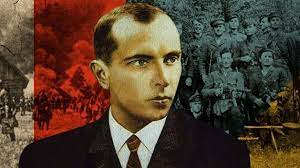
This marked the birth of Ukrainian fascism. Militant resistance fighters began to organize among the Ukrainians. These partisans received support relatively early on from the German Abwehr, the foreign intelligence service of the Weimar Republic. The Abwehr saw them as natural allies in the fight against the Poles. And in 1929, the Organization of Ukrainian Nationalists (OUN) was formed. This was the legal wing, joined by the Ukrainian Insurgent Army (UPA) as its armed wing. The fanatical anti-communist Stepan Bandera and the somewhat more moderate Andriy Melnyk soon emerged as the leading figures of these groups. The Ukrainian nationalists were by no means squeamish. The precursor to the UN, the League of Nations, therefore classified Stepan Bandera’s OUN as a terrorist organization. This was because OUN leaders Mykola Lebed and the aforementioned Stepan Bandera assassinated Polish Interior Minister Bronisław Pieracki in 1934. Bandera was initially sentenced to death for this crime but was later pardoned and given a life sentence.
In September 1939, Hitler’s blitzkrieg against Poland began. Amid the turmoil of the war, Bandera was released from prison and once again took over the leadership of the OUN. Evidently, his polarizing demeanor led to a split in the OUN as early as 1940, resulting in one faction led by Bandera and another led by Melnyk.
The OUN’s heyday began when the German Wehrmacht invaded the Soviet Union in the summer of 1941. In the wake of the Wehrmacht and the Waffen-SS, OUN fighters entered the occupied Soviet territories. They hoped that, in return for their collaboration, the Germans would grant them an autonomous Ukrainian state of their own. OUN political officer Volodymyr Stakhiv wrote to Adolf Hitler in this vein, stating that they wanted to build a fascist state that would “consolidate the ethnic reorganization of Eastern Europe and enforce the destruction of the rebellious Jewish-Bolshevik influence.”
And so, in the wake of the Nazis, the Ukrainian partisans of the OUN were already bringing about the long-awaited “ethnic reordering.” In Odessa, 19,000 Jews were murdered by the Wehrmacht and Romanian military units in a single night. In the weeks that followed, another 40,000 defenseless Jewish civilians were killed. In Krasnodar, 7,000 Jews and communists were gassed. During the Babi Yar massacre on the outskirts of the Ukrainian capital Kyiv, 33,000 Jews were murdered in a single blow from September 29 to 30, 1941, in a joint operation by the Wehrmacht, the Waffen-SS, and the OUN. As early as June 30, 1941, Ukrainian extremists were assisting the Wehrmacht in sadistic mass murders. The cruelty and bloodthirstiness of the Ukrainians shocked even hardened SS executioners. General Heggendorff reported: “In dealing with unreliable individuals, they were so brutal that we often had to intervene.” The German executioners often assigned tasks to the eager Ukrainian collaborators that they themselves considered “beneath their dignity.” So while the German murderers targeted adult victims, the Ukrainians were tasked with murdering children and the elderly. The German occupiers benefited from their Ukrainian collaborators’ local knowledge, language skills, and familiarity with the networks in the region. It was the Ukrainians’ job to “comb through” the population for Jews and communist “commissars.”
According to Hitler’s “Commissar Order,” Jews and Communist officials were to be shot on the spot. Fascism scholar Raul Hilberg quotes a statement by an SS general: “We were horrified by the bloodthirstiness of these people.” The Ukrainians also made short work of the Poles: between 1943 and 1944, over 100,000 Polish civilians were massacred.
However, all this zealous effort was of no use whatsoever to the Ukrainian collaborators. It is true that leading Nazi officials would have liked to establish new, partially autonomous republics on Soviet soil by Hitler’s grace. After all, this principle of indirect rule had proven highly successful in ancient Rome and also in the British Empire. Yet this concept failed due to the stubbornness of the Führer, Adolf Hitler. Instead, he wanted to exterminate the “Slavic subhumans” just as the Americans had once exterminated the Native Americans, in order to make room on the depopulated land for pure-blooded Aryan settlers. Thus, the leaders of the Ukrainian separatists were also eliminated by the Nazis. Bandera lived in a luxury apartment in a concentration camp until the end of the war, as did other leading Ukrainians. Nevertheless, the rank-and-file of the OUN remained as unofficial collaborators in the wake of the SS and the Wehrmacht. However, when the defeat of the German forces became apparent, and the armed forces were only retreating westward, Ukrainian volunteers were even accepted into the Waffen-SS. The Nazis established the Nachtigall Battalion and the Roland Battalion for the Ukrainians. As German forces were already withdrawing from Eastern Europe, 40,000 OUN fighters entrenched themselves in the Carpathians and held back the Red Army to cover the German forces’ retreat.
After Germany’s surrender, fighters from the OUN and the UPA went underground. Between 1945 and 1951, Ukrainian snipers killed an estimated 35,000 Soviet police officers and party cadres. Some of the Ukrainian terrorists, however, chose to flee to safety abroad. Especially since the Ukrainian population was growing increasingly war-weary and was slowly becoming fed up with the constant attacks. Ukrainians formed their own exile communities, for example in Bradford, England. Other Ukrainians, however, did not want to give up their warlike activities even in exile.
They benefited from the fact that President Roosevelt had died in the United States. After his death, a new political course was set. Cooperation with the Soviet Union was now replaced by a policy of increasing confrontation. And while a registry of relevant war criminals had initially been created to bring them to justice, this registry—known as CROWCASS—was increasingly used to recruit future collaborators for the planned war against the Soviet Union. Anyone who could provide information about the Soviet Union was warmly welcomed. In this way, Nazi General Reinhard Gehlen made a seamless transition from the Nazi foreign intelligence service “Fremde Heere Ost” (Foreign Armies East), acting as a subcontractor for the CIA, to the top position at the new Federal Intelligence Service (BND). In 1948, the U.S. National Security Council decided in Decree No. 20 to recycle Nazi criminals for the planned Third World War. It became legally possible to bring Nazi criminals to the U.S. Operation Bloodstone determined which qualifications were required for Nazi recycling. Funding for the Nazis was to be provided through the propaganda radio stations Radio Free Europe and Radio Liberty.
However, there were constant problems with the Eastern European Nazi collaborators who had been recruited. This was because they actively acted out their mutual hostilities. Their loyalty to their American employer was also not always entirely clear. As Christopher Simpson observes: “Double, triple, and quadruple agents were the rule, not the exception. Political assassinations and kidnappings were commonplace.” Yet these individuals were still needed for a special mission. The U.S. had tested two different atomic bombs in Hiroshima and Nagasaki. They believed they were the sole possessors of nuclear weapons. Thus, at the end of 1948, a plan emerged to drop seventy atomic bombs on the Soviet Union over the course of thirty days. The aim was to cripple forty percent of the Soviet Union’s industrial capacity. Next, 5,000 Eastern European war criminals were to be sent to the post-nuclear contaminated area. They were to annex the now-contaminated territory for the U.S. In fact, 5,000 Ukrainian and Russian volunteers came forward who were willing to serve as law enforcement officers for the U.S. in their now-nuclear-contaminated homeland.
Fortunately, in 1949 the Soviet Union was able to detonate its own atomic bomb, thereby establishing the famous balance of terror that has kept the nuclear inferno at bay to this day. The Nazi collaborators thus remained unharmed. Instead, they were trained to carry out targeted acts of sabotage in the Soviet Union. They landed in enemy territory by parachute. Unfortunately, the Soviet police intercepted the saboteurs there. For, as we have already mentioned, many Ukrainian U.S. agents had already been blackmailed by the Soviet secret service and “turned” into double agents. Then there was Kim Philby. He held a senior position in the British intelligence service and, as a double agent, revealed to the Soviets all the names and all the operations of the Western intelligence services. Thus, this sabotage attempt also failed.
Some of the Ukrainian Nazi collaborators, however, were able to emigrate to the United States. Within the exile communities there, they exerted a strong influence and increasingly steered people toward their own staunchly anti-communist agenda. The Assembly of Captive European Nations, established by the U.S. government, was the lobbying organization that in turn committed the political parties to this radical line. Thus, the anti-communist shift of the Republican Party under Ronald Reagan was a result of this lobbying. And when the Soviet empire imploded, the heirs of Stepan Bandera’s OUN returned from the U.S. to their homeland, Ukraine.
Today, Ukraine is deeply divided. In the east of the country, people identify as Russian. In the west, on the other hand, there is great enthusiasm for a kind of “Ukrainization.” It is important to note that, traditionally, there have been few differences between Ukrainian and Russian culture. Yet a Ukrainian language is being artificially cultivated. The attempt to impose this artificial construct on Ukrainians living in the east is being vigorously rejected by the people there. This situation holds the potential for bloody conflict. Furthermore, in 2010, the Nazi collaborator Stepan Bandera was declared a “Hero of Ukraine” by law. Streets are named after Bandera, and statues have been erected in his honor. Anyone who speaks critically of Bandera faces imprisonment.
The political culture in western Ukraine is dominated by far-right, anti-Semitic militias and parties. The Svoboda party, which means “Freedom” in English, openly promotes Nazi ideology. Its leader, Oleh Tyahnybok, proudly referred to the OUN’s atrocities when he said in 2004:
“You are Ukrainian nationalists, Ukrainian patriots! You must become the heroes who defend the land beneath our feet today! They slung their rifles around their necks and went into the forests. They fought against the Russians, against the Germans, against Jewish swine and other scum who wanted to take the Ukrainian state away from us! We must finally give Ukraine back to the Ukrainians!”[1]
In this context, all non-Ukrainians are being terrorized and intimidated. Or even massacred, in the good old OUN tradition. On May 2, 2014, in Odessa, 42 people were once again locked inside the Trade Union House by Ukrainian extremists and then burned alive[2]. Things had already turned extremely bloody on Maidan Square in Kyiv. Here, the even more violent terrorist group “Right Sector” was particularly active. More than eighty far-right militias have now been placed under the authority of the Ukrainian Ministry of the Interior. Thus, Ukrainian taxpayers are unwittingly financing Nazi terror, which is used by criminal elements to oppress the general population. Unimaginable conditions.
It’s roughly as if in Germany, a rather ragged Waffen-SS and a tattered Gestapo were still maintaining “law and order.” It’s also shocking that all Western politicians are paying homage to these dangerous fascists and criminals and trying to sell us on the idea that they’re supporting “freedom fighters” and champions of democracy here. In fact, we taxpayers are also footing the bill for these notorious felons in the fight against the “evil empire”—that is, Russia. Crazy world. Corrupt world.
*
Click the share button below to email/forward this article. Follow us on Instagram and X and subscribe to our Telegram Channel. Feel free to repost Global Research articles with proper attribution.
Hermann Ploppa is a political scientist and journalist. Ploppa recently published the book “Der Neue Feudalismus – Privatisierung, Blackrock, Plattformkapitalismus” (The New Feudalism – Privatization, Blackrock, Platform Capitalism). As Amazon does not yet stock the book, it is best to order it from the author at: liepsenverlag@gmail.com. Visit the author’s blog here.
He is a regular contributor to Global Research.
Sources
Christopher Simpson: Blowback: America’s Recruitment of Nazis and Its Destructive Impact on Our Domestic and Foreign Policy. London 1988
Hermann Ploppa: Der Griff nach Eurasien – Die Hintergründe des ewigen Krieges gegen Russland. Marburg 2019
Notes
[2] „Remember Odessa“ – eine Dokumentarfilm von Wilhelm Domke-Schulz
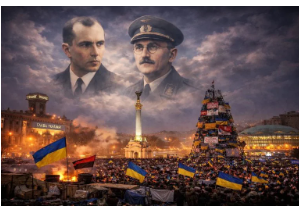
Featured image is AI-generated / from the author
Global Research is a reader-funded media. We do not accept any funding from corporations or governments. Help us stay afloat. Click the image below to make a one-time or recurring donation.