It’s tempting to believe that the US war machine is finished. Militarily, Iran have indeed dealt the US their worst humiliation in modern history — one I covered in clinical detail.
To read this article in the following languages, click the Translate Website button below the author’s name.
Русский, Hebrew, Farsi, Español, Portugues, عربي, 中文, Français, Deutsch, Italiano, 日本語, 한국어, Türkçe, Српски. And 40 more languages.
But in the background, Washington have been quietly carrying out an armed robbery of the world’s oil and gas supply. All of it.
In just 90 days, the US have executed an energy blitzkrieg decades in the making:
- Hundreds of strikes on Russian tankers and refineries
- Disrupting a third of China’s oil and LNG supply
- Capturing the largest oil reserves on the planet
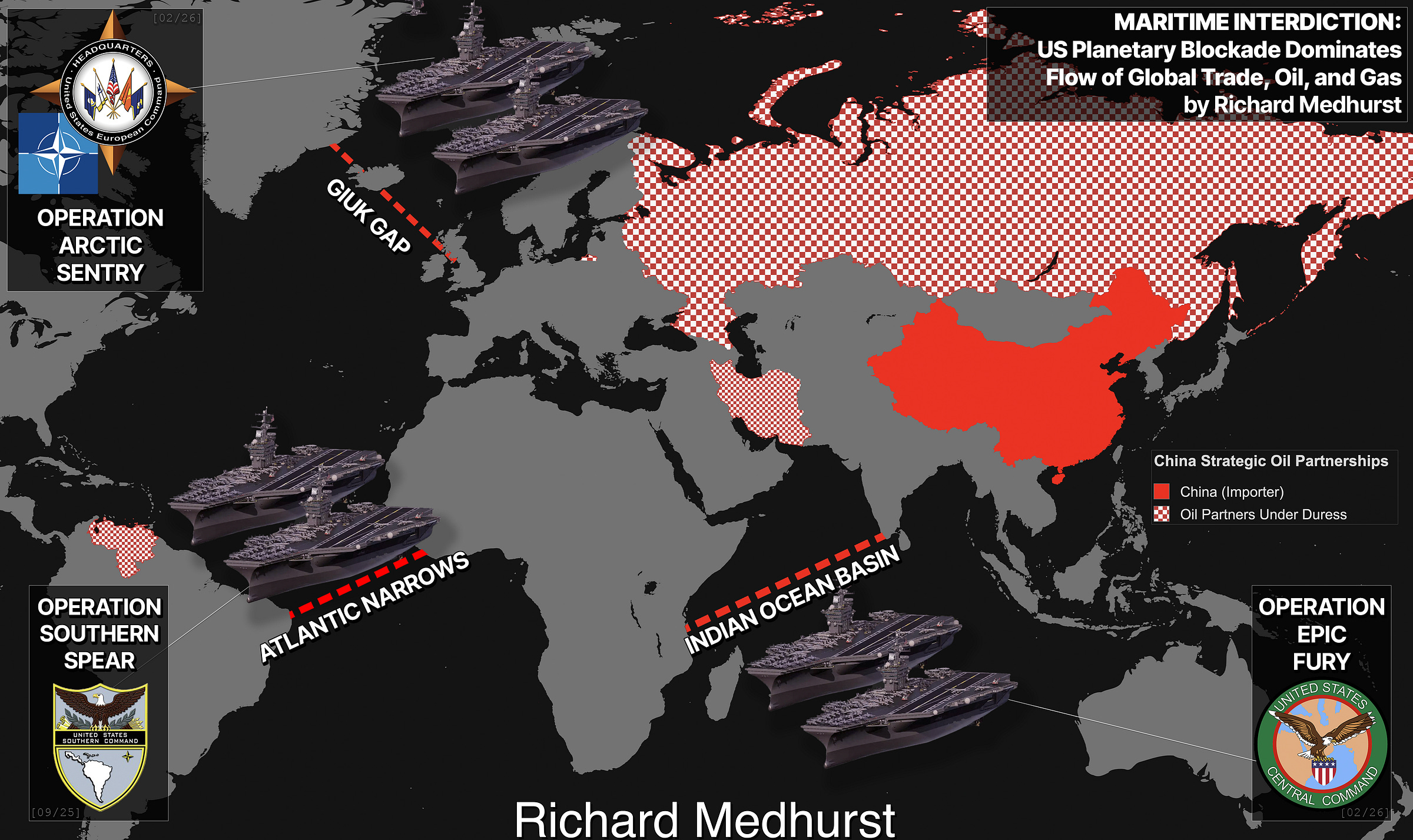
- Establishing a global naval blockade from the Arctic to the Indian Ocean
And in the process, kidnapped and assassinated two heads of state. We are witnessing the transition of the United States from an empire into a lawless Pirate State, and the birth of what I call the Petrogas-dollar or LNG-Dollar.
The timeline of this campaign speaks for itself:
Chaos Is the Objective
In the past, the United States were very sensitive to oil shocks. Closing the Strait of Hormuz would have been a catastrophe, as the US couldn’t produce enough oil to meet demand.
But today, they are the world’s largest producers of oil, gas, and refined products, and the planet’s top exporter of liquefied natural gas (LNG).
Many still buy into the old mantra that high oil prices are bad for the US, but the opposite is true. For the first time during a global shortage, the dollar isn’t crashing while gold surges — it’s the other way around. High energy prices aren’t a threat to Wall Street anymore — they are in fact the objective.
It’s no coincidence the US became the world’s #1 exporter of LNG after the Ukraine war. The gains were multifold: the US went from supplying just 9% of Europe’s energy to being Europe’s number one source of coal, oil, and LNG.
.

EU imports of Petroleum, Coal, LNG from US (2021-2025) Source: EU/Eurostat
.
When Condoleezza Rice or Joe Biden said Europe should want to “depend” on US energy, and promised to “put an end” to Nord Stream — they meant it literally. By sanctioning Moscow and blowing up the Nord Stream pipelines, the US didn’t just hurt Russia — they turned Europe into a permanent US client, securing long term profits, and cementing the Petrogas-dollar.
The US is separated by two oceans, which makes delivering gas expensive. No one was ever going to buy American LNG with cheap Russian gas just next door. So the US killed off the competition.
Not just at Russia’s expense, but eating half of Qatar’s LNG share in the process:
.

.
Finishing the Job in Europe
The US, however, are now at full export capacity. They have the gas, but can’t ship it fast enough to satisfy the market that they cleared. Washington realized that they didn’t need to build more infrastructure to win. They just needed to delete the competition — again.
After the US, Qatar and Australia are the world’s largest suppliers of LNG and America’s biggest competitors.
Just as Washington used the cover of the Ukraine war, sanctions, and Nordstream bombings to force Russia out of Europe — similarly, they used the cover of the Iran war to finish off Qatar’s position as a global LNG player.
By forcing Doha to declare force majeure on March 4 within the first week of the war, then triggering the retaliatory strikes on Ras Laffan on March 18, Washington took the world’s largest gas field out of the picture — crippling Iran, and sidelining Qatar in one fell swoop.
The claim that Israel carried out this specific strike without informing Washington, is both politically and logistically impossible — made only more suspicious by Netanyahu and Trump’s attempts to profusely distance the White House from it.
Regardless, there can be little doubt that the US and Israel provoked this. At that point, they had spent three weeks working their way up the escalation ladder; bombing Iran around the clock, and gauging their responses. Moreover, Tehran had made it abundantly clear (as early as March 12), that any strikes on Iranian energy infrastructure would be met with “an eye for an eye”.
By crippling Qatar’s LNG capacity — even just partially — Washington hit three birds with one stone:
- Qatar were forced to cancel their cheap long-term contracts to China and Europe, driving them toward purchase of US gas
- LNG prices soared, but only in Europe and Asia (they don’t go up in America, as shown later on in the investigation)
- The US positioned themselves as a reliable supplier of energy in an unstable world
Then a week later, by some astronomical stroke of luck — Australia, the planet’s second largest LNG supplier, were hit by a cyclone. This forced half of their LNG hubs offline. Nothing as catastrophic as Qatar, but horrible timing — or great timing if you’re selling US LNG.
Even if one chooses to look at these events as pure coincidence, the result is identical: in the span of just nine days, the United States’ had its two largest competitors taken off the board, sending LNG prices soaring, and strengthening the LNG-Dollar.
And in yet another move of incredible timing, the day that Qatar’s LNG was taken out (March 18) was the same day the European Union banned Russian spot gas. As the name implies, this is gas one buys on the spot, i.e. in small quantities or without a contract — which can be useful in moments like these, when your Qatari and Australian suppliers are incapacitated. This, once again, would push buyers into the arms of the US.
The date of this ban was publicly known months in advance.
The Levantine Basin
The Levantine Basin is one of the largest gas fields in the world, located off the coast of Syria, Palestine, and Lebanon. The US-Israeli takeover of this area coincided perfectly with the Iran war, and Washington’s broader capture of the planet’s energy. It is with this that the US and Israel plan to connect Europe to a Mediterranean artery — a symmetrical replacement for the Nord Stream pipeline they killed off.
Sitting on Europe’s doorstep, the Levantine Basin could replace piped Russian gas entirely — a goal explicitly stated by Von der Leyen. This allows Washington to continue selling overpriced LNG by sea, while simultaneously securing a massive, second revenue stream.
In that vein, US company Chevron signed a $35bn gas deal with Israel in December — for which they began laying the groundwork almost 2 years before the Gaza genocide.
Everything unfolded like clockwork: first the Gaza ceasefire in October, then the Board of Peace, and finally, the Chevron gas deal.
Chevron would formalize the contracts and handle extraction, while the “Board of Peace” would serve as the humanitarian front.
This corporate body was railroaded through the United Nations Security Council, in order to provide the legal cover for Washington’s colonial plan — a plan which China and Russia inexplicably allowed to pass.
A closer examination of Resolution 2803 reveals only a brief mention of “water, electricity, and sewage”. The word “energy” or “gas” doesn’t appear once.
However, at the first Board of Peace Summit, oil and gas rigs suddenly appeared on the corporate advertisements of “New Gaza”.
.

Bait and switch: Reconstruction of Gaza via UNSC 2803 (left) turns out to be corporate theft of gas and oil through the Board of Peace (right)
.
This blatant messaging, coupled with the timing of Israel’s gas deal — and the fact that only Chevron operate in the area — lead us to the only logical conclusion: that they plan on robbing the gas fields of the Gaza Marine.
In October 2023, I warned that this war was never about hostages or Hamas — it was about plundering Gaza’s resources.
Not a second was wasted. The moment Washington and Chevron were ready to move, the war was sidelined and a “ceasefire” was suddenly on the table.
.

.
Syria were the next domino to fall. Chevron had barely even signed the Israel deal in December, when they already began moving on Syria’s oil and gas — with US Special Envoy Tom Barrack meeting the new Al-Qaeda-linked rulers that Washington helped install in Damascus.
By February 2026, it was a done deal, and the US could finally start picking clean the country’s offshore wealth.
Before the war, Syria were entirely self-sufficient in oil and gas. Today, that sovereignty is gone. Syrians are rationed to just a few hours of electricity a day and forced to buy their entire supply from Turkey — the very state that helped dismantle their own — while Chevron pipe Syria’s offshore wealth straight to Europe.
But the Chevron corporate blitzkrieg didn’t stop there.
As the Syria deal was being finalized, Chevron secured yet another gas deal with Greece that very same month, then another with Cyprus in April. Everything was linked.
Washington had now constructed an American artery, running from the Levant, to Cyprus, to Greece. The gas, the plumbing and the leases all set — not to mention, an additional LNG exit via Egypt.
The northern gas corridor from Russia was now dead, and a new one — almost perfectly symmetrical — built in its place by a US corporation. The final nail in Nord Stream’s coffin.
.

The Mediterranean Artery: How the EastMed-Poseidon pipeline and the capture of the Levantine Basin symmetrically replaced Nord Stream as Europe’s primary energy corridor.
.
In total, the entire basin is worth over half a trillion dollars — surpassing the combined profits of BP, Shell, Chevron, ExxonMobil, and TotalEnergies from the entire Ukraine war. These untapped reserves have been kept on ice by the Israeli military, effectively acting as private mercenaries for Corporate America.
It’s no coincidence that all the ports along this coast have been destroyed except Israel’s. By blockading Gaza and crippling the ports in Beirut and Syria, they have ensured Levantines cannot touch their own inheritance — while holding the door open for Chevron to collect.
With Qatar and Iran sidelined and the Mediterranean secured, on the other side of the planet the US Navy were already clearing the way for Chevron to seize the world’s largest oil fields
.
Targeting China’s Oil and Gas
Controlling Europe and weakening Russia was, however, only the beginning. The real target is China.
.
.
China are too big and competitive for the US to destroy. Washington’s goal is to control them instead.
By cutting off Beijing’s most vital fuel sources, the US want to force a total dependency on American energy. This creates the leverage needed to guarantee the Dollar’s survival while undermining BRICS, the Belt and Road Initiative (BRI), and multipolarity.
China receive around 1/3 of their oil from Venezuela, Russia, and Iran combined —partnerships they consider strategic. The United States proceeded to target all three in the last 90 days with increasing escalation.
.

China’s Strategic Oil: Total Volume (2025) (Source: GAC China / Kpler & Vortexa)
.
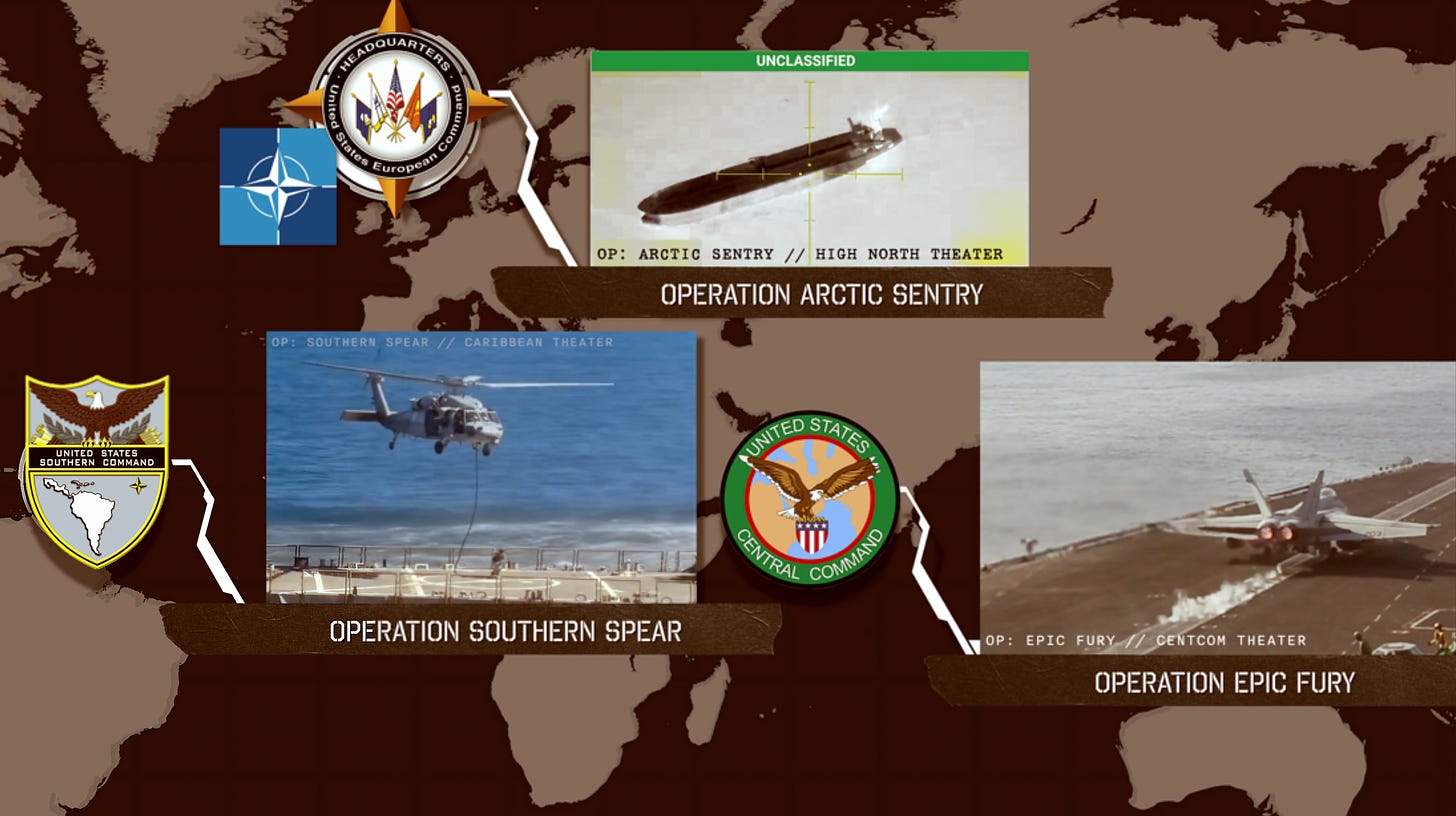
Venezuela (Operation Southern Spear)
The blockade began in September 2025, when a US fleet were deployed to the Caribbean under the pretext of “fighting narcotics.” Acting under Southern Command (USSOUTHCOM), Washington positioned these ships right on Venezuela’s borders, effectively encircling the country.
By December, the fleet had revealed their true purpose by openly pirating Venezuelan oil. This campaign culminated in the kidnapping of President Nicolás Maduro in January and the capture of the world’s largest oil reserves.
The US navy parked their ships on Venezuela’s doorstep, where they remain to this day. They decide which oil tankers are allowed in and out, and of course, it’s mainly Chevron.
Meanwhile, the US government — having strong-armed the local administration into submission — proceed to formalize this theft by issuing Treasury waivers and General Licenses to their own corporations, as if they own the rights to the oil themselves.
Trump bragged a few days later (at the “Board of Peace” summit, of all places) that the US now control 62% of the world’s oil. This takeover achieved two critical goals for the Pirate State: first, it immediately cut China off from a vital energy partner, and second, it secured a second strategic petroleum reserve to offset the chaos Washington were about to unleash on Russia and Iran.
Russia (Operation Arctic Sentry)
In the last months, US and NATO forces have been literally hunting down Russian oil and gas ships across the entire planet, from the Mediterranean Sea, to the Black Sea, Baltic Sea, Caribbean, Arctic, North Atlantic, and Indian Ocean.
Russia provide 17% of China’s total oil imports. While some is piped, the vast majority leaves by sea. This includes the critical medium Urals blend that China’s independent “teapot” refineries rely on. Because these exports leave from Russia’s western ports in the Baltic Sea, they are particularly vulnerable due to their proximity to NATO.
The US knew that China would immediately look to Russia to replace the oil lost in Venezuela — so to cut them off, Washington redeployed key strike groups from the Caribbean to the Arctic and Atlantic. This is precisely why NATO quietly established “Operation Arctic Sentry” in February, making no effort to conceal its true purpose:
“China’s interest in the Arctic is also growing, as Beijing seeks to gain access to energy, critical minerals and sea lines of communication. Furthermore, increased Russia-China cooperation has strategic and operational implications for NATO’s deterrence and defence posture in the region.” —NATO Arctic Security Brief
Simply put: it’s an oil and gas embargo. NATO are openly admitting that their goal is to sever Beijing’s “access to energy, critical minerals”, and disrupt their growing trade with Russia. None of these things are security issues. They are geostrategic and economic.
This explains why Donald Trump is so interested in Greenland and Canada, and why the Royal Navy deployed a carrier strike group last month to the Greenland-Iceland-UK (GIUK) corridor — and again this week. The goal is to corner Russian tankers in the Baltic and the Arctic before they are even able to leave.
.

Greenland-Iceland-United Kingdom (GIUK) Corridor: gateway to the Arctic Circle.
.
This passage has been a critical chokepoint since the Cold War; it was once the only way Russian submarines could reach the Atlantic. NATO are now returning there with a different goal in mind: harassing trade along the Northern Sea Route (NSR), Russia’s primary shortcut to Asia — and in anticipation of the future Transpolar Sea Route (TSR).
The media described the launch of Arctic Sentry as a diplomatic “off-ramp” to “defuse tensions” between the US and Greenland. Clearly this mission wasn’t designed to “defuse” anything, but instead a Trojan Horse to move NATO troops into position to implement a blockade — with the participation of many Western navies, including France, Sweden, Spain, and Britain, all actively helping Washington pirate Russian oil.
When I first laid out my “Pirate State” thesis in March, only Russian tankers were being hit at the time. But throughout the course of this investigation, these attacks escalated from hitting ships, to hitting refineries and export hubs.
This supports my core argument that we are witnessing a physical energy war. In March alone, around 40% of Russia’s seaborne oil export capacity was disabled — the most severe logistical disruption in modern Russian history. As I publish this, the results from April are irrefutable: this was the most violent month so far, forcing Russia to slash oil output by 300,000 to 400,000 barrels per day — the sharpest production cut in 6 years. The latest OPEC report confirms Russia sit 400,000 BPD below their official quota, which shows that these strikes are having a definitive effect on the ground.
And that’s not even counting what was lost/pirated at sea.
In the four years of the Ukraine war, Russia’s energy infrastructure has never been struck this deep nor on this scale. While the campaign began in Autumn 2025, the Blitz on Russian energy only truly ramped up once Washington had secured Venezuela and launched the war on Iran.
The calculated timing, and global scale of this pincer move show that the Pirate State were waiting until they had secured their own strategic reserve before moving in for the kill — achieving two goals at once: interdiction of China’s supply, and consolidation of the global market.
Iran (Operation Epic Fury)
Iran export around 60% of the oil they produce, and like Russia and Venezuela, ship the majority to China at a discount. Iran account for 11% of China’s seaborne crude imports. With shipments from Venezuela and Russia being sabotaged by the US, a steady supply from Iran became even more critical — and Beijing increased their imports accordingly.
As the Strait of Hormuz is under Iran’s control, these shipments should in fact be prioritized as China is a strategic partner. However, the very nature of a war ensures chaos, and Tehran’s experimental toll booth system — like all infrastructure — is being systematically targeted by the US-Israeli aggression, creating a backlog.
By sinking the IRIS Dena more than 3,200 km from the Persian Gulf, the Pirate State have signaled their intentions to all vessels in the Global South — armed or unarmed, inside or outside the theatre of war. Unfortunately, pricing cargo in Yuan isn’t going to suffice with a Pirate State at the gates, robbing and sinking vessels at random.
The US have no intention of deescalating. Even during the “ceasefire”, War Secretary Pete Hegseth explicitly declared that Washington will not be leaving these waters — ceasefire or not, confirming what I forewarned: that the US are going to apply their Arctic and Venezuelan model on Iran.
The US-Israeli assault, coupled with the disruption to Qatari LNG, have caused China’s LNG imports to plummet to an 8-year low.
Chinese government figures (GACC) show that total natural gas imports plummeted 16.3% from February to March — or if compared to last year, a 10.7% year-on-year drop. Since pipelines are running at 100% capacity, this drop is all but certain due to the US global blockade and the clearest indicator yet that Washington’s wars and blockades are constricting China’s supply.
.

.
Russia and Iran hold the world’s largest proven reserves of natural gas, yet their ability to mitigate China’s deficit is physically constrained.
Iran consume 94% of the gas they produce, and their remaining export potential was already damaged by the recent strikes. Moreover, Russia are already running their primary gas and oil pipelines to China (Power of Siberia and ESPO, respectively) at full capacity. Power of Siberia 2 is still years away from completion, and Russia lack the tanker fleet — Arctic-class or otherwise — to help China make up for these losses by sea.
Even if these ships were available, the intensity of the US-backed strikes has caused insurance premiums on Russian tankers to skyrocket, almost defeating the entire purpose of buying their oil at a discount.
Multi-layered Sabotage and Multi-layered Gains
For the time being, this means that all three strategic suppliers of Chinese oil are being actively disrupted or attacked by the United States.
.
.
These attacks are even more costly when taking into account the following:
Teapots designed for heavy crude
China’s “teapot” refineries are specifically designed to process the sour crude sent from Venezuela, breaking down the heavy, thick sludge and turning it into the diesel that powers China’s high-tech industries.
While Russian and Iranian oil are chemically different — and easier to refine — China received them at such a discount that it was worth their while to refine them using the teapots.
Discounted oil
It’s not just the physical and technical ability of the teapots that made them a perfect match for these kinds of oil — it’s the price. These varieties were supplied to China at a discount, or in the case of Venezuela, as a form of debt repayment. Obtaining identical blends, and at the same competitive price is practically impossible.
First, Washington are leaving the teapot refineries without the heavy “sludge” they were specifically designed to cook. Second, by removing the cheap Russian and Iranian alternatives, they are making it financially impossible to fire the refineries up at all. This creates a cascade effect of sabotage on China’s economy, of which the United States are undoubtedly acutely aware.
While China can recover in the long term and their energy consumption is diverse, solar and coal alone can’t power their industrial base to its absolute potential. Even with massive reserves, these cannot compare in the long run with the impact of having a Pirate State attack their 3 most vital energy partners in the span of 90 days.
Most governments would consider Washington’s behavior an act of war, or at best treat the issue as a national security threat — and they would be right.
Rerouted to the Gulf of Mexico
To add insult to injury, the US have rerouted the seized Venezuelan crude to their own Gulf of Mexico refineries. This ensures a cascade of gains for Washington:
- These refineries are designed to process heavy crude — just like China’s teapots. By feeding them Venezuelan oil, they operate at maximum efficiency, increasing Washington’s share of the global diesel market as well as their profit margins.
- By using the stolen heavy crude domestically, the US can export their own light shale oil — at record wartime prices — to Europe and Asia.
Cuba
In addition to cutting off China from Venezuela, the US are using their control of the world’s largest oil fields to close in on Cuba and threaten them with regime change.
Half of Cuba’s energy grid was dependent on this oil. Immediately after kidnapping Maduro, Washington cut Havana off, plunging the country into darkness, and worsening the 60-year siege they have laid on the Caribbean nation. This is further proof that capturing Venezuela’s oil wasn’t merely about corporate greed, but for strategic, geopolitical purposes.
While the US “allowed” a single Russian tanker to reach Havana, and also issued a 30-day reprieve for Iranian and Russian oil, these acts shouldn’t be mistaken for signs of de-escalation. They are merely pressure valves designed to stabilize global markets while Washington complete the hostile takeover.
Click here to read the full article.
*
Click the share button below to email/forward this article. Follow us on Instagram and X and subscribe to our Telegram Channel. Feel free to repost Global Research articles with proper attribution.
Global Research is a reader-funded media. We do not accept any funding from corporations or governments. Help us stay afloat. Click the image below to make a one-time or recurring donation.