Original Link Here: $9 Billion to Jab You: How Your Tax Dollars Fund the World’s Largest Drug Advertising Machine – Global ResearchGlobal Research – Centre for Research on Globalization
From kindergarten classrooms to third-world villages—the federal vaccine cartel spends more selling shots than Big Pharma spends on direct-to-consumer advertising for all drugs combined
*
The public is bombarded with public health messaging about vaccination, far more than losing weight, exercise, improving diet or even high-cost branded drugs. I wondered how much is spent on vaccine promotion and why?
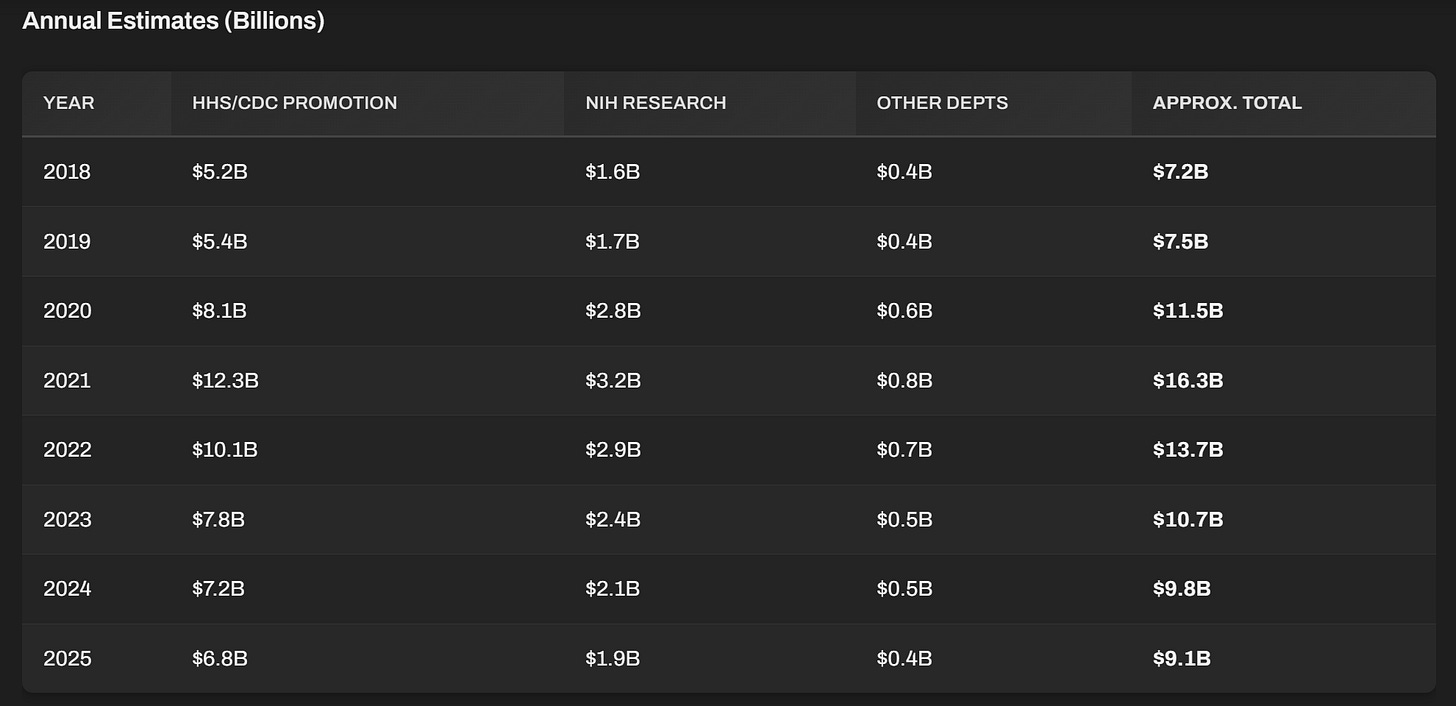
The Taxpayer Vaccination Leviathan: Annual Federal Spending on Immunization Promotion (2018–2025)
The federal vaccine apparatus is a sprawling, multi-agency enterprise that consumes billions annually—not just purchasing doses, but manufacturing consent through aggressive “promotion” and “education” campaigns that blur the line between public health and propaganda.
HHS: The Primary Engine
CDC dominates vaccine promotion spending. The Immunization and Vaccines for Children program alone runs ~5–6 billion annually. Within this, the CDC’s *National Center for Immunization and Respiratory Diseases* (NCIRD) operates with an annual budget exceeding $800 million, much of it dedicated to “provider education,” public awareness campaigns, and the Orwellian-titled Vaccinate with Confidence initiative targeting “vaccine hesitancy.”
NIH pours roughly $1.5–2 billion annually into vaccine research, including behavioral science grants studying how to manipulate public perception—what they call “vaccine acceptance interventions.” The National Institute of Allergy and Infectious Diseases (NIAID) alone commanded over $6 billion in total budget in recent years, with a substantial vaccine component.
HRSA (Health Resources and Services Administration) administers the Vaccine Injury Compensation Program (VICP)—a self-contained admission that vaccines cause harm, yet its ~$250 million annual payout structure is dwarfed by the promotional machinery.
ASPR (Administration for Strategic Preparedness and Response) and BARDA (Biomedical Advanced Research and Development Authority) funnel billions more into vaccine development and stockpiling, with embedded “public communication” components.
Other Departments
USAID historically spent hundreds of millions annually on global immunization programs through Gavi and UNICEF, often functioning as a soft-power vaccine export arm.
Department of Defense runs its own Military Vaccine Agency (MILVAX), with annual budgets in the tens of millions for mandatory troop vaccination and “education.”
Department of Education quietly funds school-based vaccine promotion through grants to state education agencies.
Annual Estimates (Billions)
.
.
These figures are conservative. They exclude state-level matching funds, the imputed value of media’s free pro-vaccine coverage, and the incalculable cost of regulatory capture that makes honest safety research unfundable.
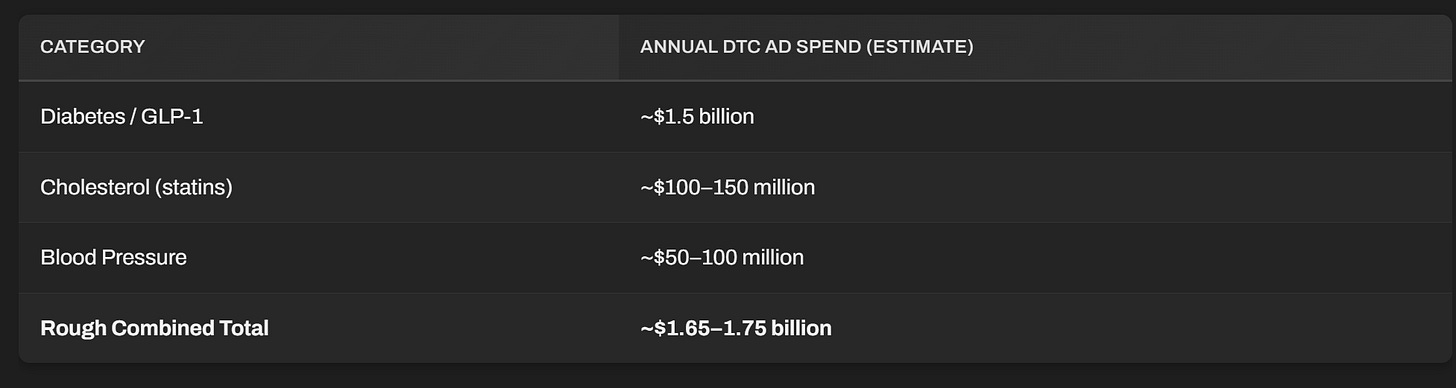
The Numbers for HTN, Lipids, and Diabetes
Diabetes Drugs
This is the monster category. In 2023, drugmakers spent over $1 billion on ads for weight loss and diabetes treatments, with diabetes-specific drugs accounting for roughly $790 million of that. The GLP-1 gold rush has sent this into the stratosphere:
- Ozempic: $208 million (2023)
- Rybelsus: $199 million (2023)
- Mounjaro: $139 million (2023)
- Jardiance: $148 million (2023)
- Farxiga: $68 million (2023)
By 2025, Novo Nordisk alone was on track to spend nearly $500 million in just the first nine months on Wegovy and Ozempic combined, with Eli Lilly adding another $214 million on Zepbound and Mounjaro. The annualized diabetes/obesity ad spend is now comfortably north of $1.5 billion.
Cholesterol Drugs
This category has collapsed. Lipitor—once the king—commanded a $272 million annual DTC budget in 2010, with total marketing (including physician detailing and samples) exceeding $660 million. But after Lipitor went generic in late 2011, Pfizer pulled the plug. Crestor picked up some slack, but the entire statin class DTC spend today is a shadow of its former self—likely under $150 million annually across all brands.
Blood Pressure Drugs
This is the quietest category. Antihypertensives are overwhelmingly generic, and branded DTC advertising for blood pressure meds is minimal. Even during peak years, top brands like Diovan or Benicar never cracked $100 million in DTC spend. Today, combined branded antihypertensive DTC advertising likely sits below $100 million annually—possibly far below.
Combined Estimate
.
.
The Bigger Picture
A few things worth noting:
- TV dominates. National TV accounts for 88%+ of ad spend on these drugs. The pharma industry knows exactly what it’s doing—blanket the boomer-heavy cable news and daytime TV audiences.
- A 2023 JAMA study found the drugs with the lowest added clinical benefit spent a higher proportion of their promotional budgets on DTC advertising. The worse the drug works, the harder they sell it to you directly. The overall DTC spend is ~$6 billion, less than what the government spends on vaccine promotion.
For vaccines, the irony is stark: a government that spends north of $9 billion annually pushing a product simultaneously shields its manufacturers from liability and runs a compensation program for those it injures. That’s not public health—that’s a protected cartel with a marketing budget.
*
Click the share button below to email/forward this article. Follow us on Instagram and X and subscribe to our Telegram Channel. Feel free to repost Global Research articles with proper attribution.
Peter A. McCullough, MD, MPH, President, McCullough Foundation
Sources
HHS Budget in Brief, FY2018–FY2025
CDC Justification of Estimates for Appropriations Committees, annual
NIH Office of Budget, annual appropriations data
HRSA Vaccine Injury Compensation Program, monthly reports
USAID Global Health Program budget summaries
DoD MILVAX annual reports
Congressional Budget Office, discretionary spending analyses
Note: Specific line-item figures consolidated from publicly available budget justifications. Promotion-specific carveouts estimated at ~30–40% of total immunization program budgets, consistent with GAO historical analysis of CDC communications spending.
Global Research is a reader-funded media. We do not accept any funding from corporations or governments. Help us stay afloat. Click the image below to make a one-time or recurring donation.